
British fashion has shaped what the world wears more than the fashion of almost any other country. The suit, the trench coat, the waxed jacket, the brogue, the miniskirt, punk and the mod look all came from Britain, and UK fashion today still moves between those two poles: tradition and rebellion. On one London street you can pass a banker in a tailored navy suit, a student in a vintage football shirt, a countrywoman in tweed and wellies, and a teenager in a tracksuit, and all four are dressed in recognisably British style. This guide explains how people dress in the UK today, London outfits and street style, what to wear each month, traditional clothing in England, Scotland, Wales and Northern Ireland, British fashion through history, British brands and designers, and the practical details of sizes, shopping and dress codes.
British fashion at a glance
- Tradition and rebellion. Savile Row tailoring and punk both began in London, a few miles apart.
- Dressed for rain. The weather changes hourly, so coats, layers and waterproof shoes matter.
- Understated by default. Navy, grey, black, olive and brown, with pattern from checks, stripes and tweed.
- Town and country. City dress is sharp and dark. Country dress is tweed, wax and wool in earth colours.
- Individual. Eccentricity is admired. Vintage, charity-shop finds and personal quirks are part of the look.
- Strong subcultures. Mods, punks, casuals and ravers still influence what people wear.
- Dress codes still exist. Weddings, the races, private clubs and formal dinners have real rules.
- Four nations. England, Scotland, Wales and Northern Ireland each have their own traditions.
How people dress in the UK
Everyday clothes
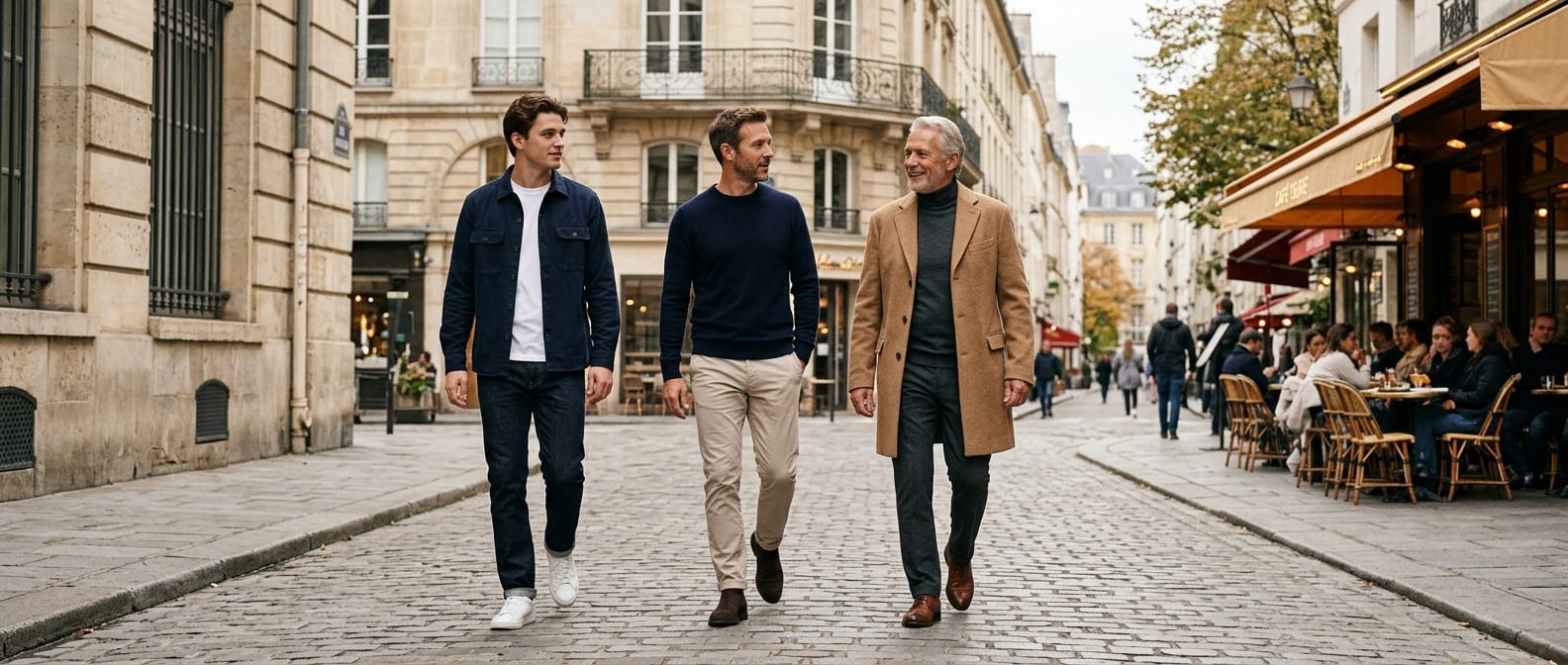
What do people wear in the UK on a normal day? Jeans or chinos, a T-shirt, shirt or jumper, trainers or boots and, most days, a jacket or coat. Dress is casual and practical, and there’s a wide range of what counts as acceptable. People rarely comment on what others wear.
Layers and rain
British weather is mild, damp and unpredictable. Sunshine, wind and showers can all arrive within an hour, so people dress in layers and carry a waterproof or a small umbrella. Heavy rain is less common than visitors expect. Light drizzle is the norm.
Smart when it matters
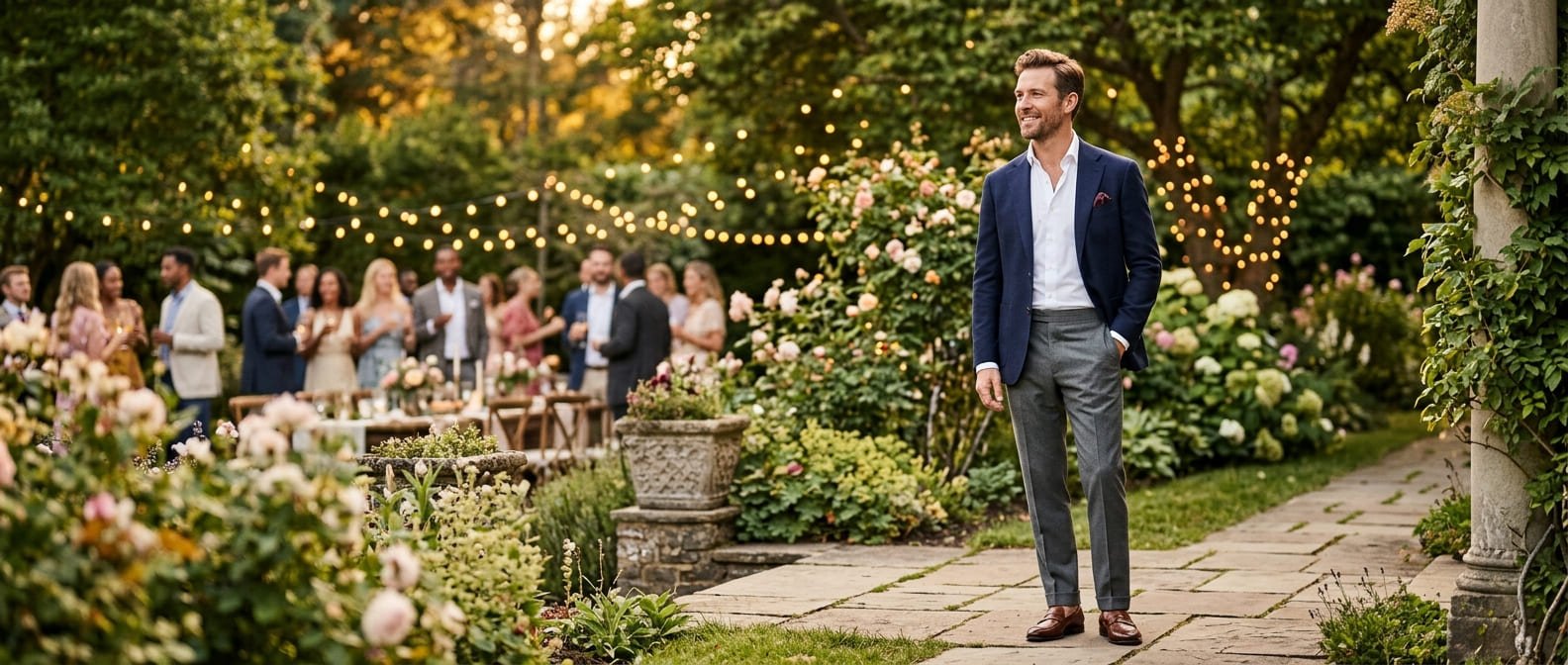
The British dress up for occasions. Weddings, the races, graduation ceremonies, Christmas parties and nights out all call for an effort, and in many towns a Friday or Saturday night out is far more dressed-up than a visitor would guess.
Class, place and tribe
Clothing in Britain still signals belonging. A waxed jacket and a flat cap suggest the countryside. A particular polo shirt or pair of trainers marks a football fan. A tailored overcoat and polished shoes belong to the City of London. Many British style choices are quiet references that other Britons read at once.
What stands out
Very bright, matching holiday outfits, shorts in cool weather and bulky sports sandals are noticed. Overdressing is rarely a problem.
Men’s fashion in the UK
British men’s fashion rests on a few lasting ideas.
- Tailoring. The British suit has structured shoulders, a defined waist and side vents.
- Knitwear. Lambswool, Shetland and merino jumpers, cardigans and Fair Isle patterns.
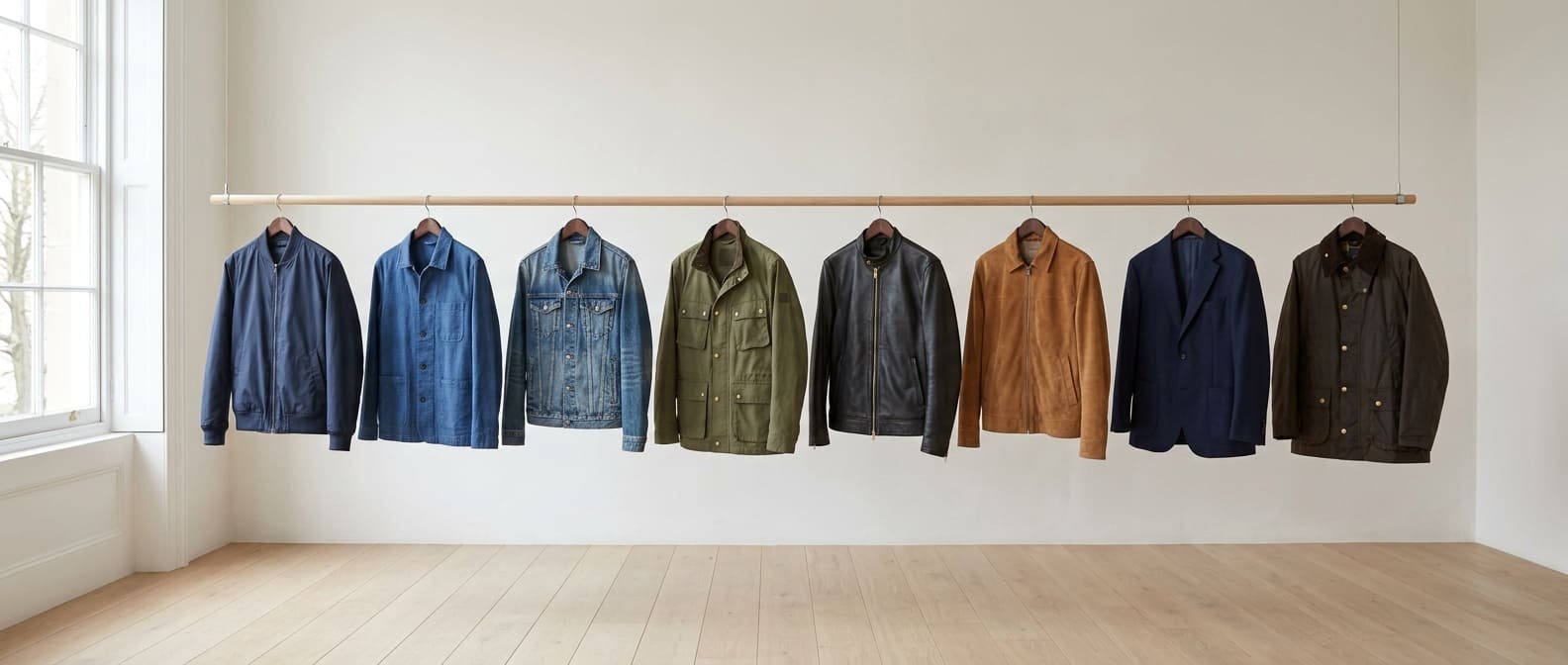
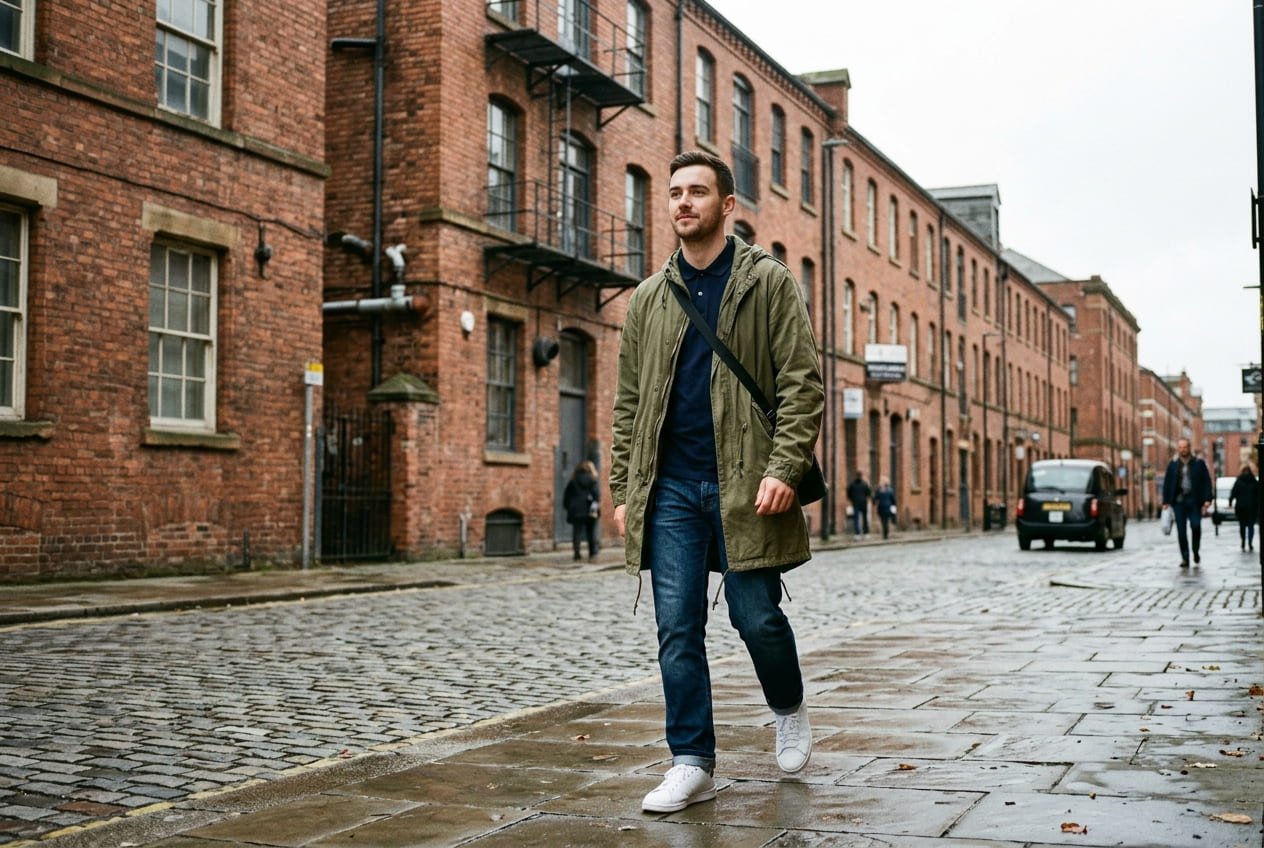
- Outerwear. Trench coats, macs, waxed jackets, duffle coats, peacoats, parkas and Harrington jackets are all British designs or British favourites.
- Shirts. Oxford cloth, bold stripes and checks.
- Shoes. Brogues, Oxfords, Chelsea boots, desert boots and trainers.
- Sportswear. Football shirts, polo shirts and tracksuits are everyday clothes for many.
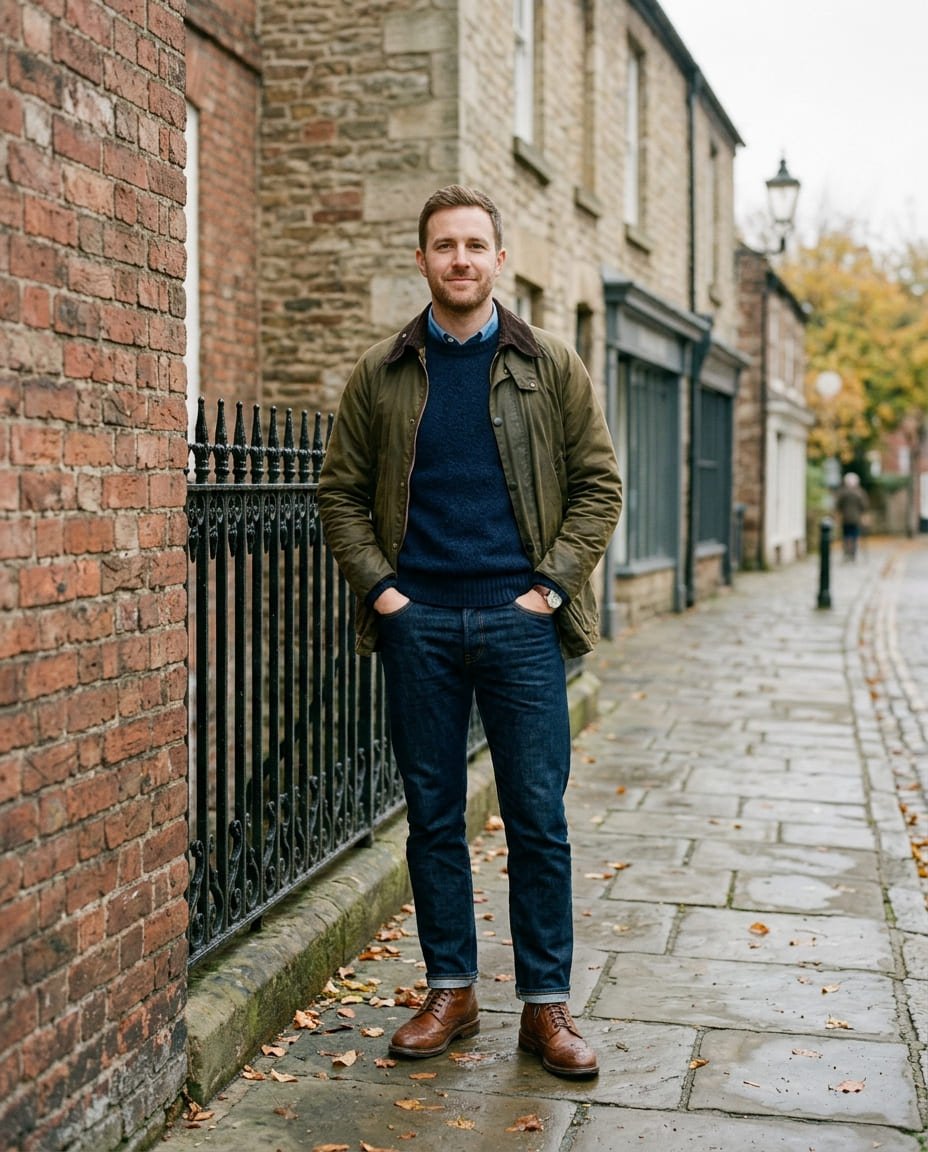
- Olive waxed jacket Jacket
- Navy lambswool jumper Knit
- Blue Oxford shirt Shirt
- Dark indigo jeans Trousers
- Brown leather brogue boots Shoes
To compare British style with France, Italy, Spain and Germany, read our guide to European men’s fashion. Our guides to winter coats for men and the types of jackets for men explain the coats and jackets named above.
London style and street fashion
London is one of the world’s four fashion capitals, and London street style is the most varied in Europe. There isn’t one London look. There are many, and they change by neighbourhood.
| Area | Style |
|---|---|
| Mayfair and St James’s | Savile Row suits, shirts from Jermyn Street, polished Oxford shoes |
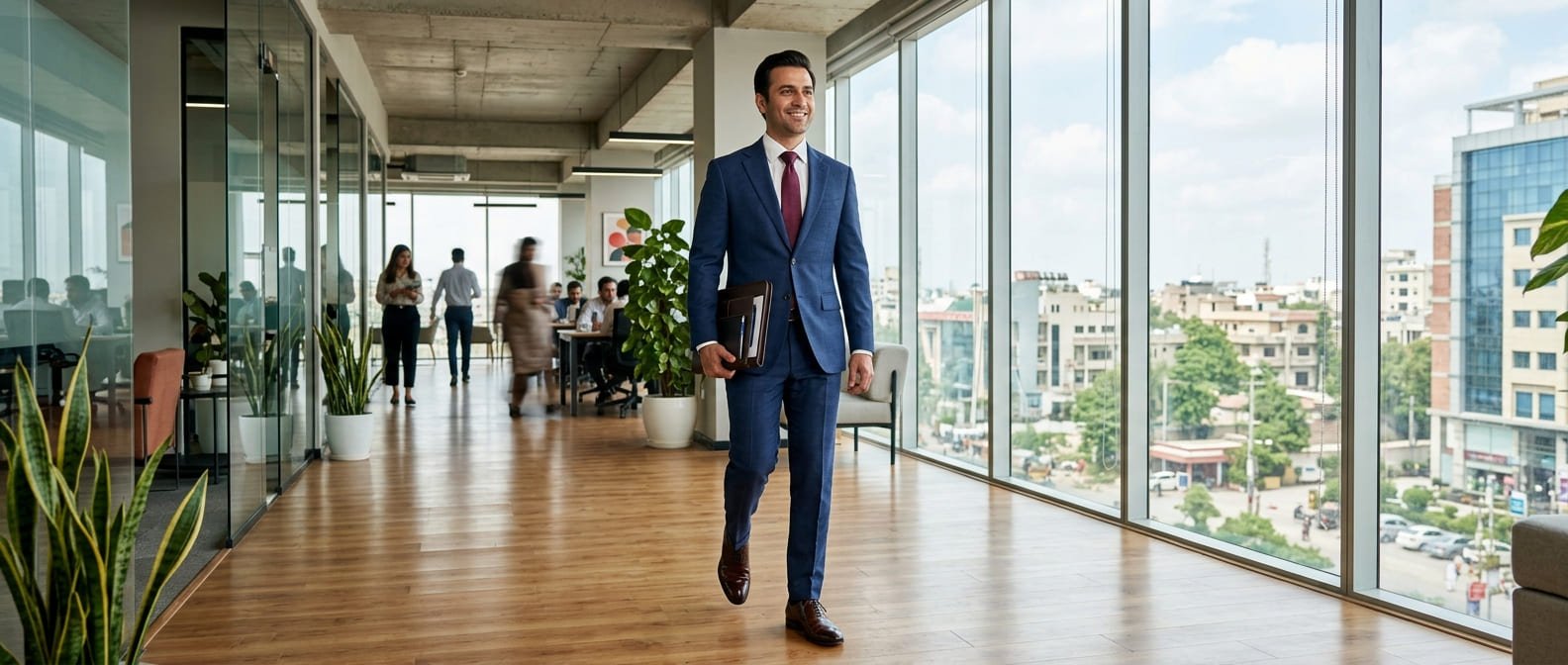
| The City and Canary Wharf | Business dress: dark suits, increasingly worn without a tie |
| Chelsea, Kensington and Notting Hill | Preppy and polished: blazers, loafers, quilted jackets and good knitwear |
| Shoreditch and Hackney | Creative and vintage: workwear, wide trousers, second-hand finds |
| Soho and Covent Garden | Fashion-led, mixed and international |
| Camden | Punk, goth and alternative style |
| Brixton and Peckham | Streetwear, sportswear and bold colour |
London style for men
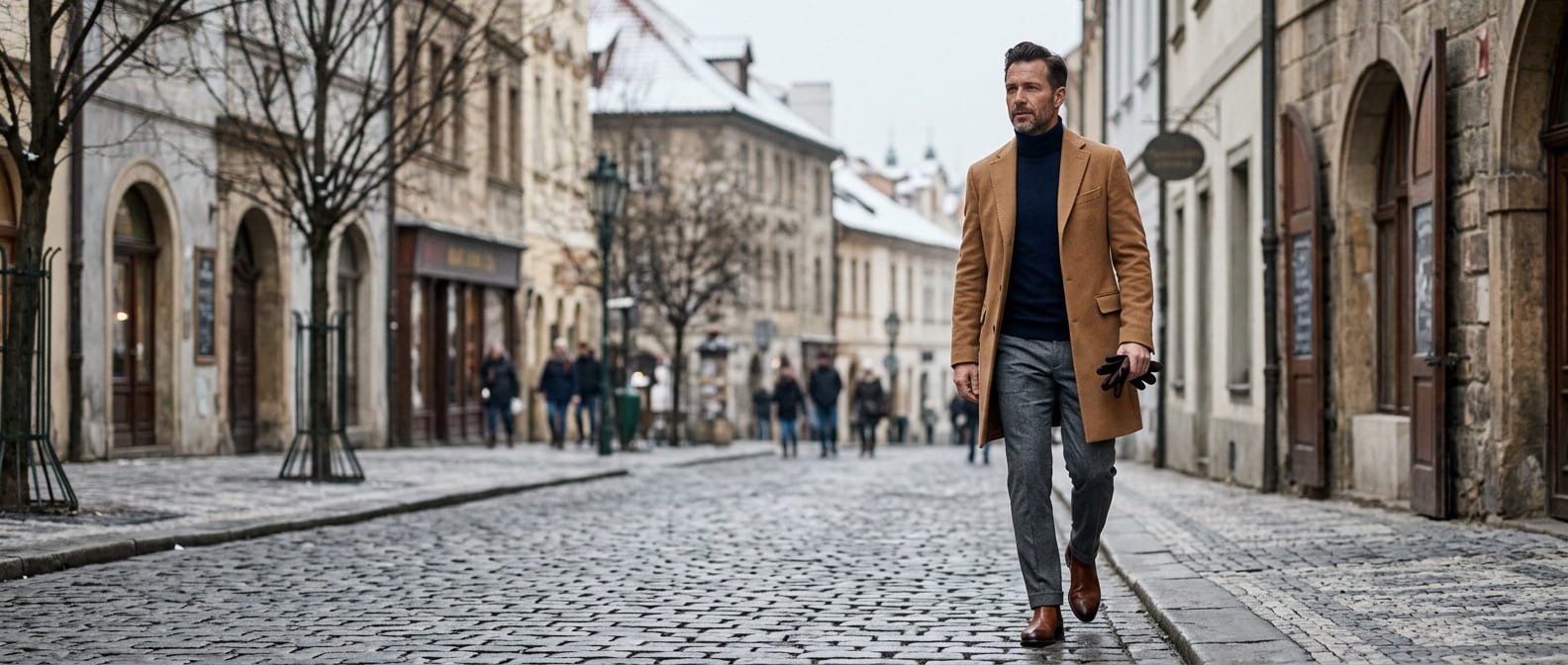
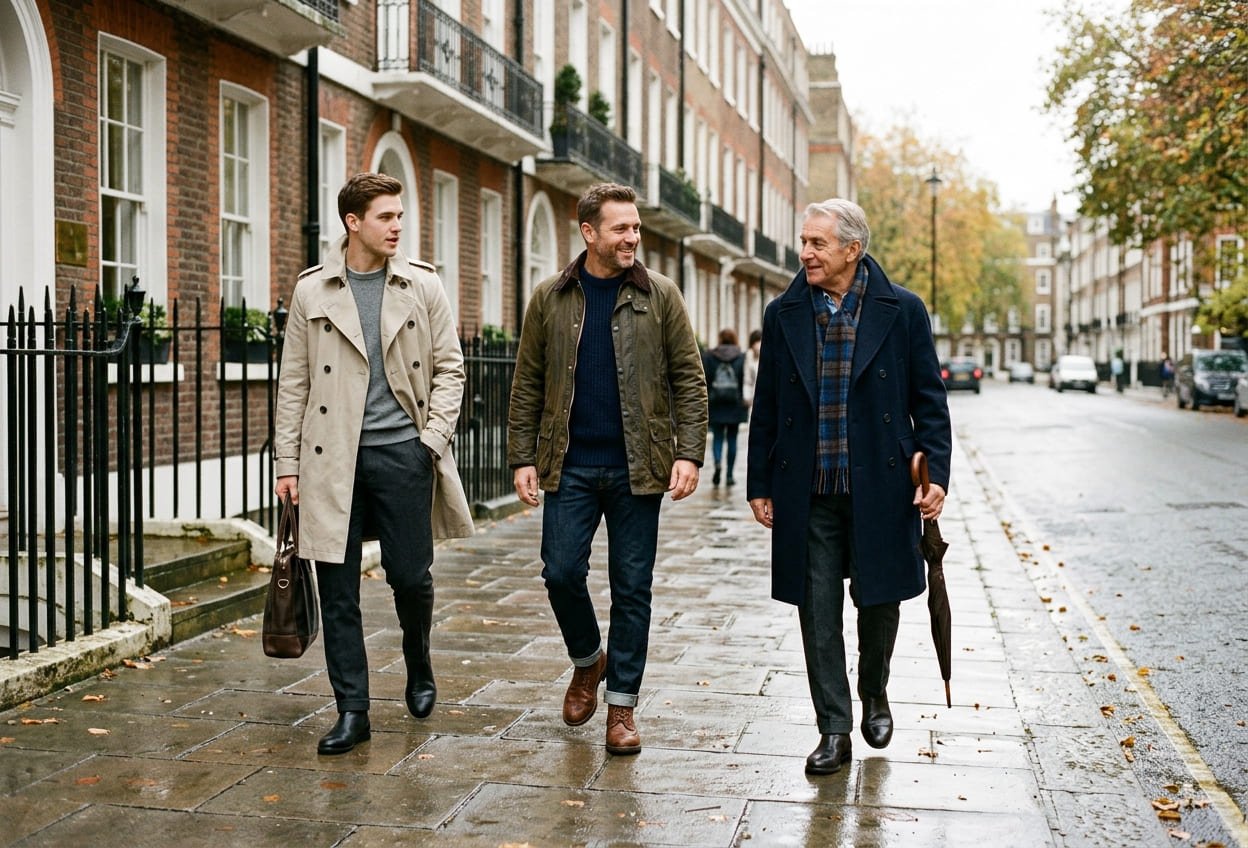
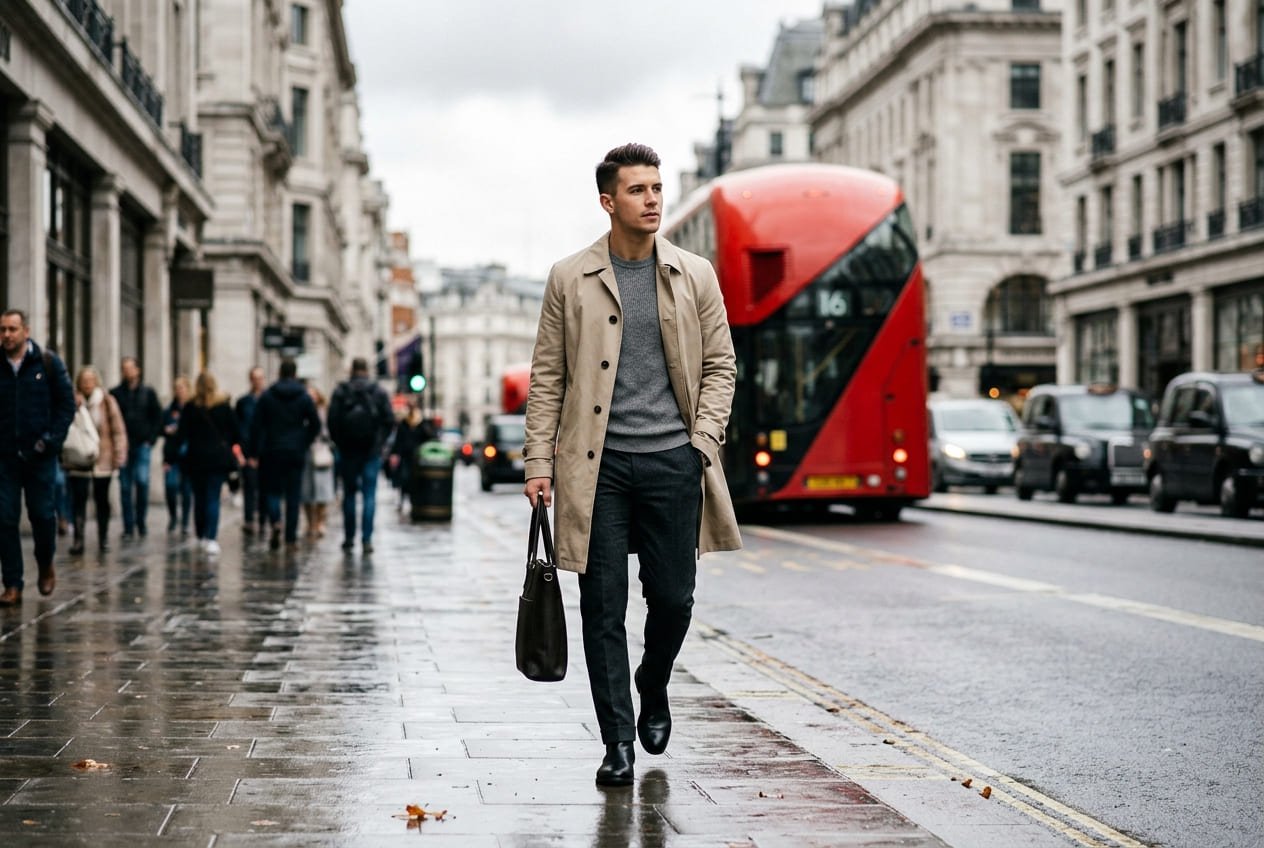
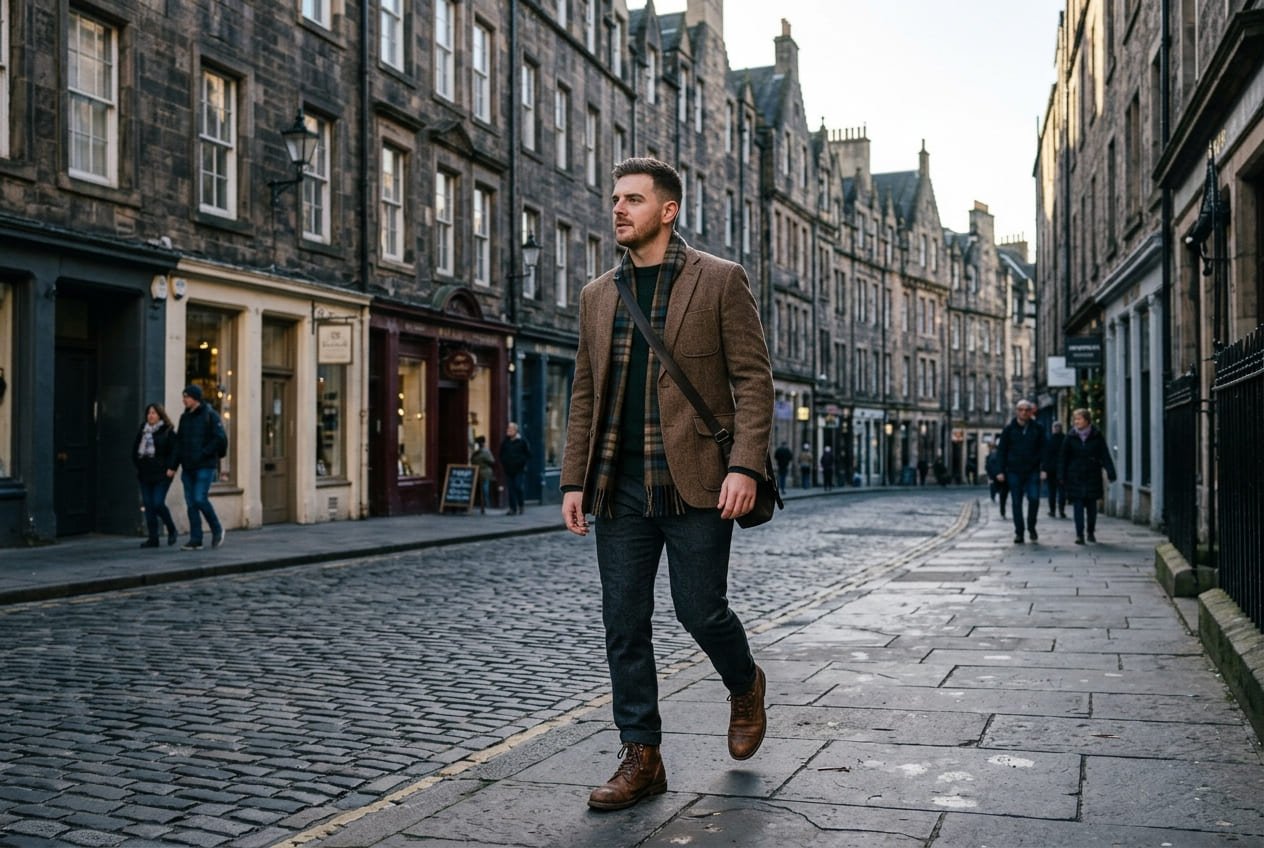
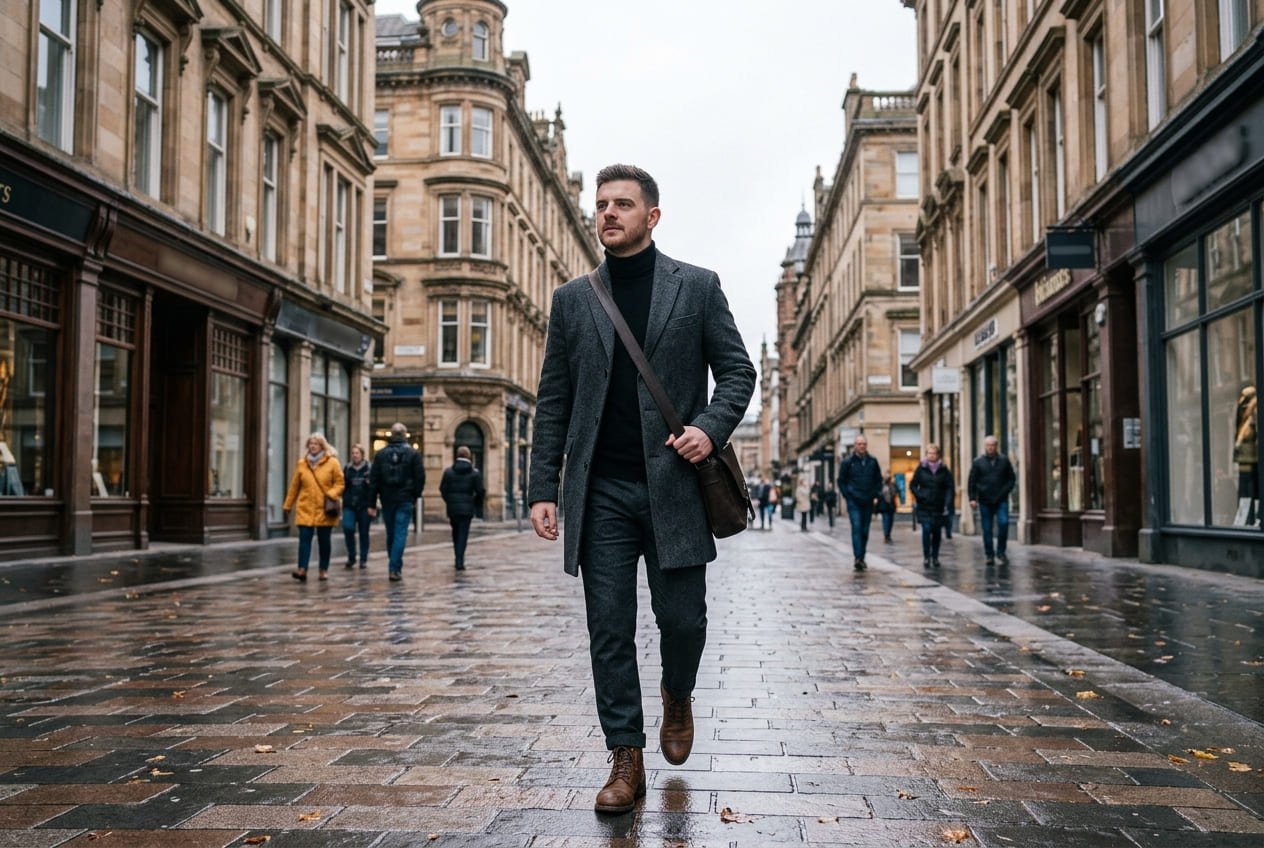
- The classic Londoner: a navy overcoat, a roll neck or shirt, tailored trousers and leather boots.
- The creative: a chore jacket, a vintage sweatshirt, wide trousers and trainers.
- The streetwear look: a puffer jacket, a tracksuit or cargo trousers and the right trainers.
- The preppy look: a blazer or quilted jacket, an Oxford shirt, chinos and loafers.
- Stone trench coat Coat
- Grey merino jumper Knit
- Dark tailored trousers Trousers
- Black Chelsea boots Shoes
- Compact umbrella Accessory
London outfits: what to wear in London, month by month
London is milder than most visitors expect, rarely very hot and rarely very cold, but it is changeable. The table uses typical daytime highs for London and Edinburgh. Scotland and northern England are cooler and wetter all year.
| Month | London | Edinburgh | What to wear |
|---|---|---|---|
| January | about 8 °C | about 7 °C | Wool coat, jumper, scarf, gloves and waterproof boots |
| February | about 9 °C | about 7 °C | As January. Damp cold feels colder than the number |
| March | about 12 °C | about 9 °C | Coat or padded jacket, jumper and a scarf |
| April | about 15 °C | about 12 °C | Trench coat or light jacket, layers and an umbrella |
| May | about 18 °C | about 15 °C | Light jacket, shirt or T-shirt and a jumper for the evening |
| June | about 21 °C | about 17 °C | T-shirts, light trousers and a light jacket or cardigan |
| July | about 24 °C | about 19 °C | Summer clothes, with a layer for evenings. Heatwaves can pass 30 °C |
| August | about 23 °C | about 19 °C | As July. Carry a light waterproof |
| September | about 20 °C | about 17 °C | Layers: shirt, light knit and a jacket |
| October | about 16 °C | about 13 °C | Trench coat or jacket, jumper and boots |
| November | about 12 °C | about 10 °C | Warm coat, scarf and waterproof shoes |
| December | about 9 °C | about 7 °C | Winter coat, knitwear, scarf and gloves |
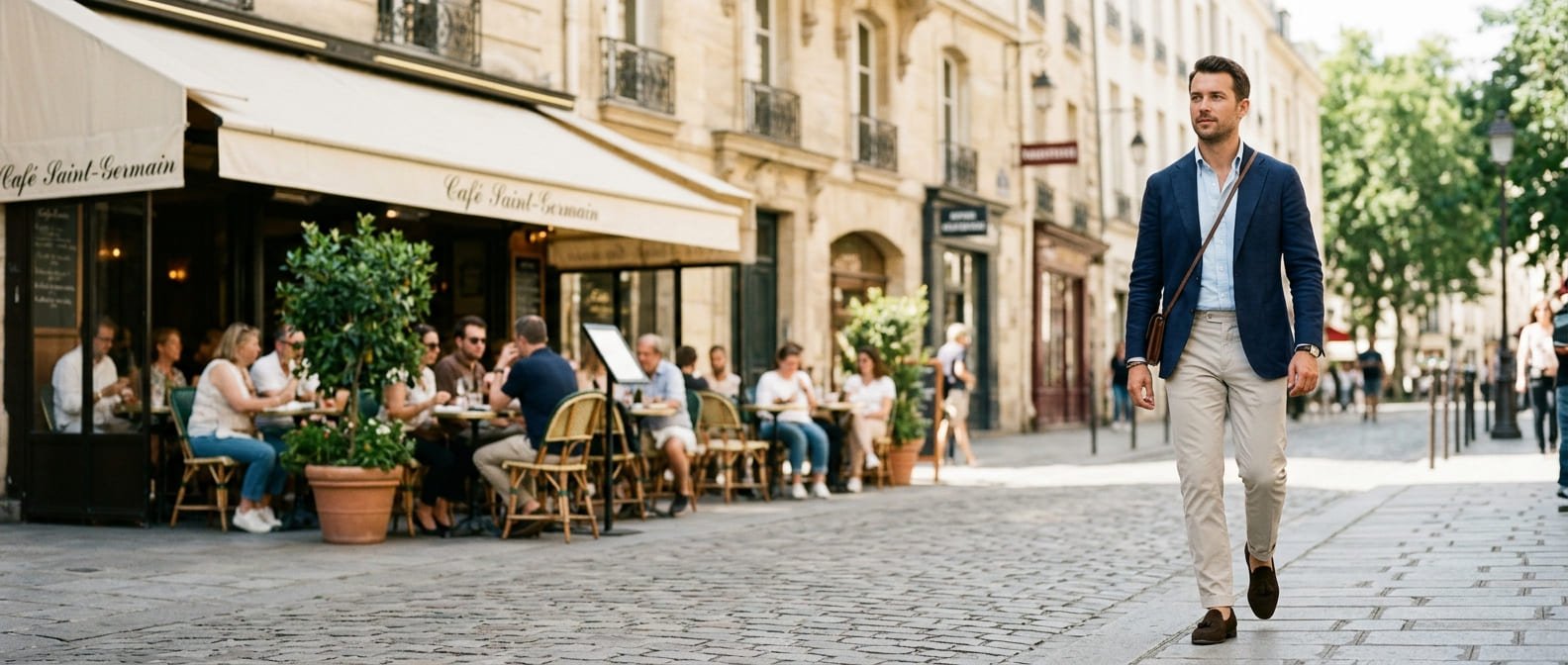
- What to wear in London in summer (June, July and August): T-shirts, shirts, light chinos or jeans and trainers, with a light jacket or jumper for the evening. Much of the Underground has no air conditioning, so choose breathable fabrics.
- What to wear in London in September and October: layers. A trench coat or light jacket over a jumper covers most days.
- What to wear in London in November and December: a proper coat, a scarf and waterproof boots. It gets dark by four in the afternoon.
- What to wear in London in winter (January and February): a wool coat or padded jacket, a jumper, gloves and a hat. Snow is rare, and cold rain is common.
- What to wear in London in spring: a trench coat or mac, a light knit and comfortable shoes. April showers are real.
- Do people wear shorts in London? Yes, on warm summer days, in parks and at weekends. They’re less common in offices, restaurants and the evening.
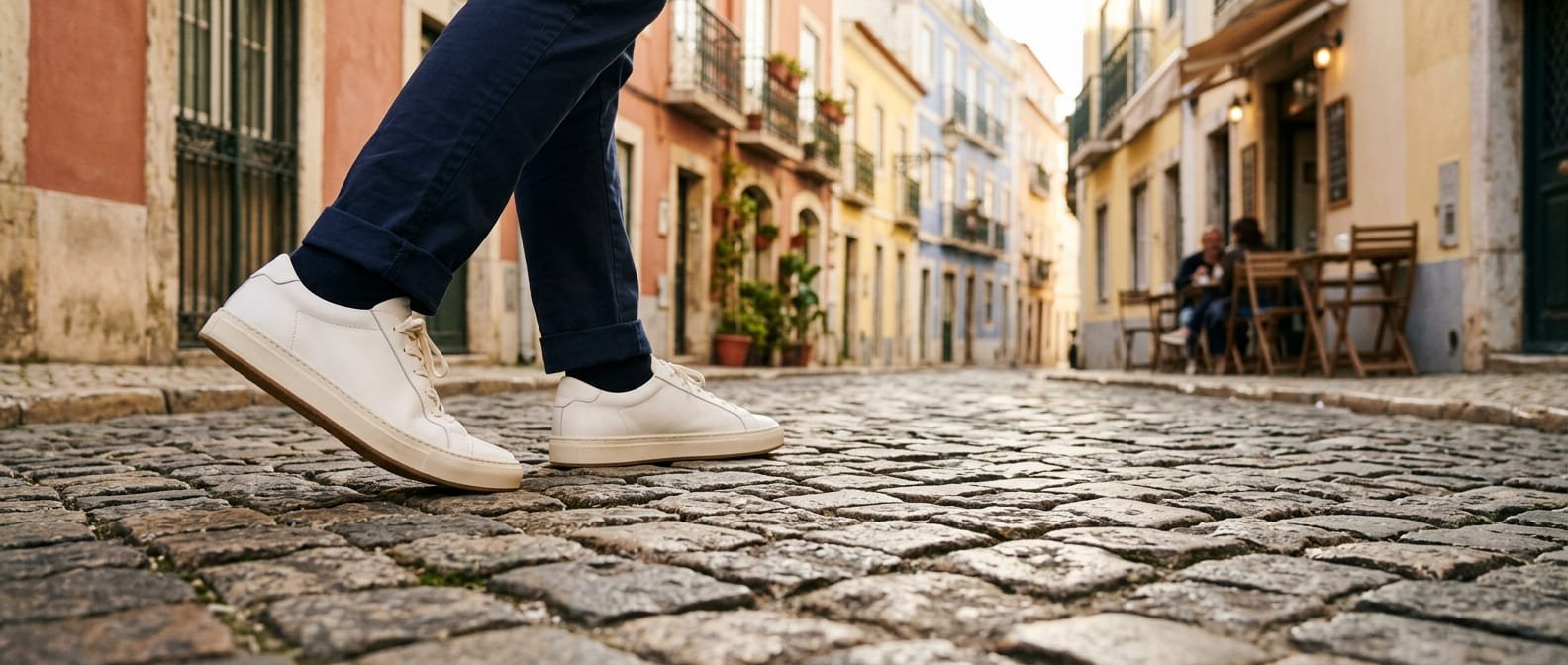
For every month, the same rule applies: wear layers, carry something waterproof and choose shoes you can walk in. Londoners walk a great deal.
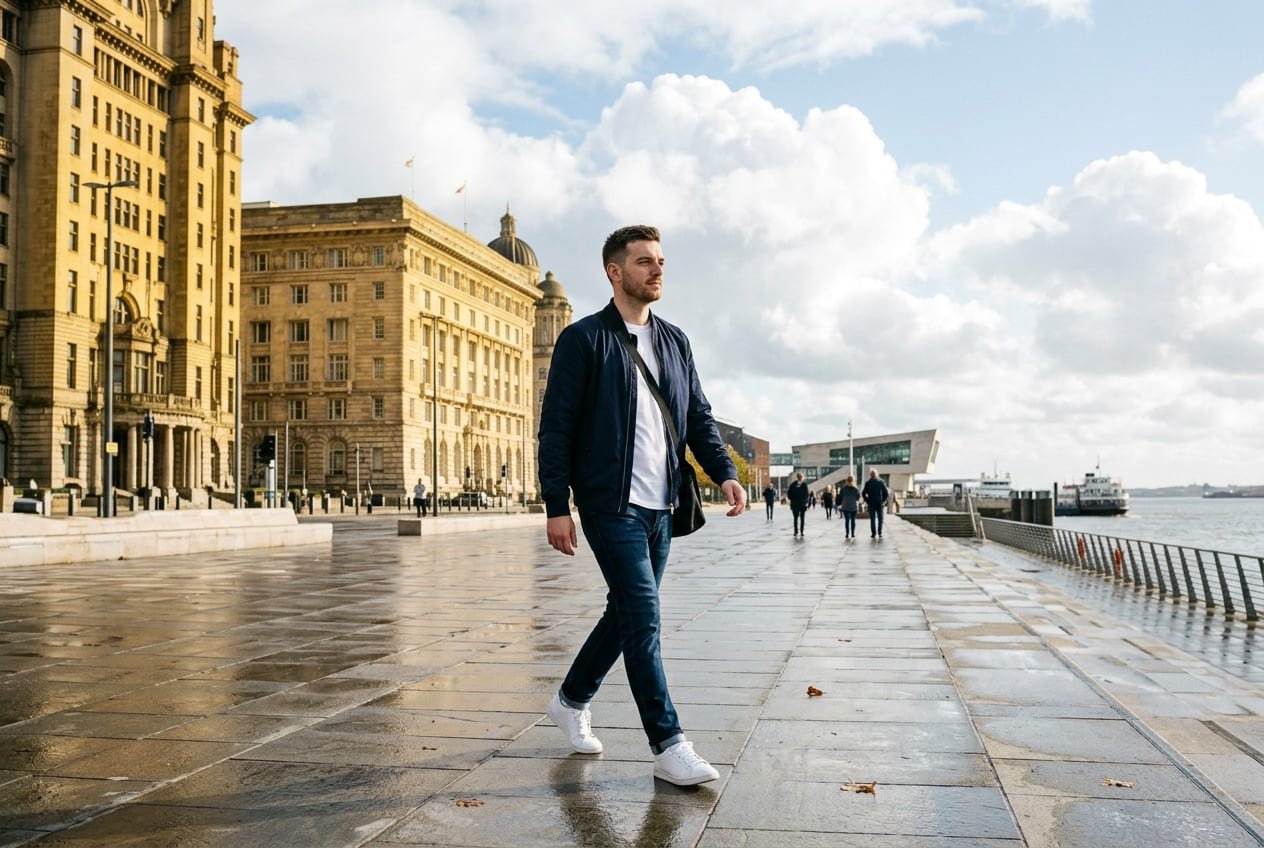
- White Oxford shirt, sleeves rolled Shirt
- Stone chinos Trousers
- White leather trainers Shoes
- Navy cotton jumper Layer
For packing, read what to pack for a Europe trip, walking shoes for Europe and our airport outfit ideas. Seasonal ideas are in spring outfits for men, fall outfits for men and winter outfits for men.
Traditional British clothing
The United Kingdom has no single national dress. England in particular has no official national costume, which surprises many visitors. Scotland, Wales and Northern Ireland each have their own traditions, and England has many regional and ceremonial costumes.
Traditional English clothing
| Costume | What it is | Where you’ll see it |
|---|---|---|
| Morris dancer | White shirt and trousers, bells at the knees, ribbons, sashes and a flowered hat | Village festivals, May Day |
| Yeoman Warder (Beefeater) | Dark blue and red Tudor-style uniform, with a scarlet and gold state dress | Tower of London |
| Pearly Kings and Queens | Dark suits covered in mother-of-pearl buttons | London charity events |
| City gentleman | Bowler hat, pinstripe suit and rolled umbrella | Historic City of London dress, now rare |
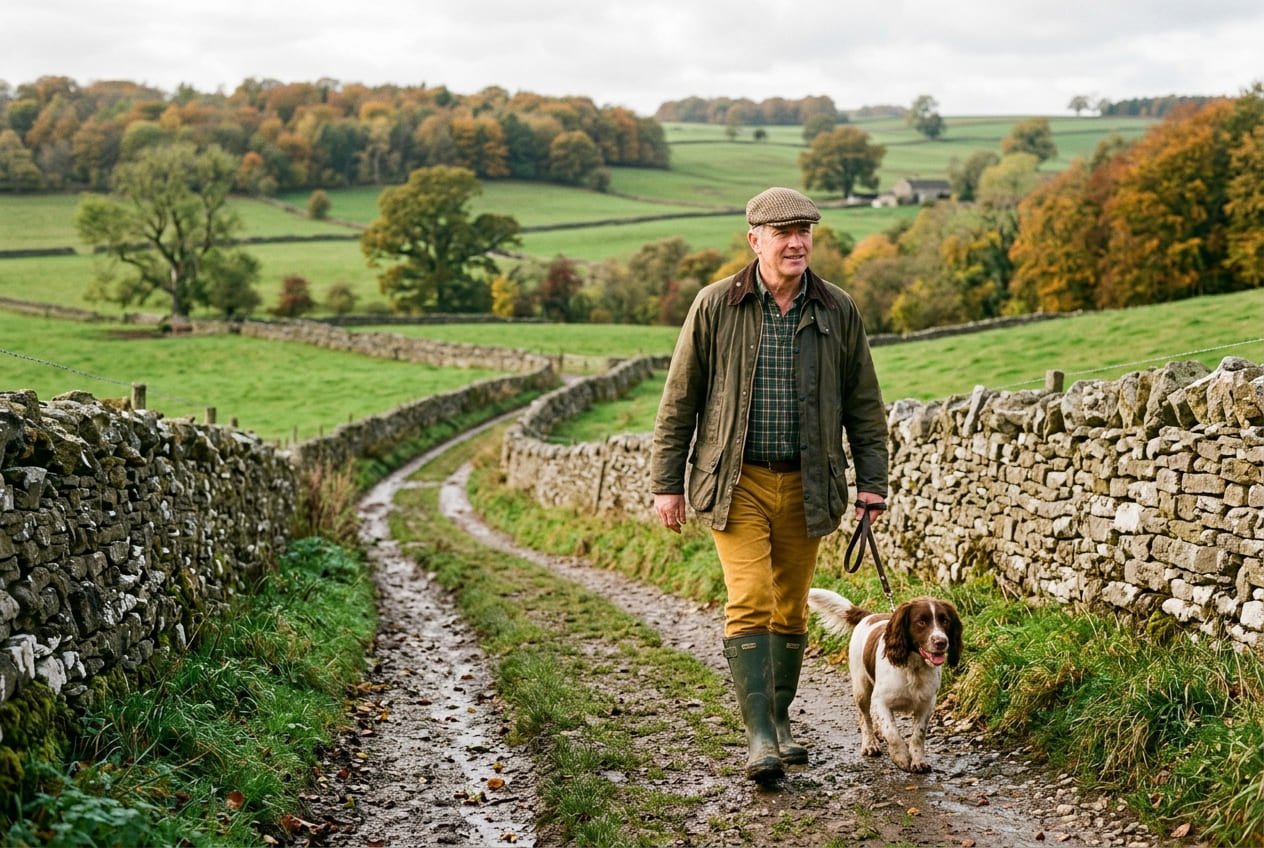
| Country dress | Tweed jacket, flat cap, waxed jacket, moleskin or corduroy trousers and wellington boots | The countryside, shoots, country shows |
| Morning dress | Tailcoat, waistcoat, striped trousers and top hat | Royal Ascot, formal weddings |
| Smock frock | A loose embroidered linen overgarment once worn by farm workers | Museums and folk events |
Traditional Scottish clothing
Highland dress is the best-known traditional clothing in the UK.
- Kilt: a pleated wool garment in tartan, wrapped around the waist and worn to the knee.
- Tartan: a pattern of crossing coloured stripes. Many are linked to Scottish clans, regions or regiments.
- Sporran: a leather or fur pouch worn at the front, because a kilt has no pockets.
- Jacket: a short tweed jacket by day, or the formal Prince Charlie jacket with a waistcoat in the evening.
- Hose and flashes: knee-length wool socks with coloured garter tabs.
- Sgian-dubh: a small ornamental knife tucked into the top of the sock.
- Ghillie brogues: shoes with no tongue and long laces tied around the ankle.
Kilts are worn at weddings, graduations, ceilidhs, Highland games and on Burns Night.
Traditional Welsh clothing
Welsh national dress, as worn today, is mainly a women’s costume: a tall black hat over a white lace cap, a red wool shawl, a striped or checked flannel skirt and an apron. Children wear it at school on St David’s Day, 1 March. Men and boys typically wear a flat cap, a waistcoat and breeches, or a rugby shirt.
Northern Ireland
Northern Ireland shares traditions with both Ireland and Scotland: Irish linen, Aran-style knitwear, tweed and, in some communities, kilts and pipe-band uniforms.
British fabrics and patterns
- Tweed: a rough wool cloth in earthy checks and herringbones. Harris Tweed is handwoven in the Outer Hebrides and protected by law.
- Tartan: see above.
- Fair Isle: bands of coloured geometric pattern, from the Shetland island of the same name.
- Gansey: a dense, patterned fisherman’s jumper from the coasts of England, Scotland and the Channel Islands.
- Pinstripe and chalk stripe: the cloths of City suits.
- Prince of Wales check: a large grey check popularised by royalty.
- Paisley: a curved teardrop motif named after the Scottish town that wove it.
- Waxed cotton and gabardine: British answers to rain.
British fashion through history
Searches for Elizabethan, Regency and twentieth-century British fashion are common, so here is a short timeline.
| Period | Key features |
|---|---|
| Elizabethan (1558 to 1603) | Ruffs, padded doublets, trunk hose and cloaks for men. Stiff bodices, wide farthingale skirts and jewels for women |
| Jacobean and 17th century | Softer lace collars, then the contrast of Cavalier silk and Puritan black. In 1666, Charles II introduced the vest, an ancestor of the three-piece suit |
| Georgian and Regency (to 1820) | Beau Brummell replaced silk and lace with dark tailored coats, pale trousers and a white cravat, the basis of modern menswear. Women wore high-waisted muslin gowns |
| Victorian (1837 to 1901) | Frock coats and top hats, crinolines and bustles. The lounge suit and Savile Row tailoring emerged |
| 1920s | Shorter dresses, Oxford bags, plus fours and Fair Isle jumpers |
| 1930s | Elegant draped suits and bias-cut dresses |
| 1940s | Clothes rationing, Utility clothing and “make do and mend” |
| 1950s | Teddy Boys in long drape jackets and narrow trousers, Britain’s first youth style |
| 1960s | Swinging London: mods in slim suits and parkas, the miniskirt, Carnaby Street and the King’s Road |
| 1970s | Glam rock and punk: ripped clothes, safety pins, tartan and leather |
| 1980s | New Romantics, power dressing, football casuals and the first rave styles |
| 1990s to now | Britpop, streetwear, grime tracksuits and the revival of heritage brands |
Elizabethan fashion and clothing in Shakespeare’s time
Clothing in the Elizabethan era showed rank at a glance. Shakespeare lived from 1564 to 1616, so the clothing of his time was Elizabethan and then Jacobean.
- Elizabethan men’s clothing: a linen shirt, a fitted and padded doublet, a sleeveless jerkin, short padded trunk hose with stockings, a ruff at the neck, a short cloak and a hat.
- Elizabethan women’s clothing: a linen smock, a stiffened bodice, a farthingale to hold the skirt wide, a gown, separate sleeves and a ruff.
- Upper class clothing: silk, velvet, satin, fur, lace and embroidery in gold and silver thread.
- Lower class clothing: wool, linen and leather in undyed, brown, russet and blue shades. A law of 1571 required most men and boys to wear a wool cap on Sundays and holidays, to support the wool trade.
- Elizabethan colours: purple, gold cloth and certain furs were reserved for royalty and the highest nobility by sumptuary laws. Black was costly to dye and marked wealth.
- Queen Elizabeth I: her gowns were covered in pearls, jewels and embroidered symbols, with huge ruffs and sleeves. Her wardrobe was a statement of power.
Mods, punks and the British Invasion
British youth style became a global export in the 1960s. British Invasion bands wore slim collarless suits, narrow ties and Chelsea boots. British mod fashion added tailored three-button suits, button-down shirts, fishtail parkas, desert boots and scooters. A decade later, punk tore it all up on the King’s Road. These looks still shape British menswear.
British brands and designers
This section lists well-known British clothing brands and designers for reference. StyleGauge is independent: the names are not ranked, recommended or linked, and we earn nothing from any of them.
British heritage and luxury fashion brands
| Brand | From | Known for |
|---|---|---|
| Burberry | Founded in Basingstoke in 1856 | The trench coat, gabardine and its camel, black and red check |
| Barbour | South Shields, founded in 1894 | Waxed cotton jackets |
| Mulberry | Somerset | Leather bags and goods |
| Paul Smith | Nottingham | Classic tailoring with colourful stripes and linings |
| Vivienne Westwood | London | Punk, tartan and theatrical tailoring |
| Alexander McQueen | London | Dramatic, sharply cut luxury fashion. Now French-owned |
| Stella McCartney | London | Luxury fashion made without leather or fur |
| Dunhill | London | Luxury menswear and leather goods |
| Belstaff | Founded in Staffordshire in 1924 | Waxed motorcycle jackets |
| Mackintosh | Scotland | The rubberised raincoat, or mac |
| Johnstons of Elgin and Pringle of Scotland | Scotland | Cashmere and fine knitwear |
| John Smedley and Sunspel | Derbyshire | Fine knitwear, T-shirts and underwear |
Savile Row and British tailoring
Savile Row in Mayfair is the home of bespoke tailoring, where suits are cut by hand for each customer. Well-known houses include Henry Poole, Gieves & Hawkes, Huntsman, Anderson & Sheppard and Ozwald Boateng. Nearby Jermyn Street is known for shirtmakers such as Turnbull & Asser.
British clothing brands and the high street
| Brand | Known for |
|---|---|
| Marks & Spencer | Founded in Leeds in 1884. Everyday clothing and underwear for all ages |
| Next | Mainstream fashion for men, women and children |
| Reiss | Smart, modern tailoring |
| AllSaints | Leather jackets and a dark, rock-inspired look |
| Ted Baker | Colourful, detailed smart casual clothing |
| Hackett | Classic British menswear |
| Charles Tyrwhitt | Business shirts and suits |
| Moss | Suits and formal hire |
| Boden and Joules | Colourful casual and country-inspired clothing |
| Superdry | Casual wear with a Japanese-inspired graphic style |
| River Island and New Look | Trend-led high-street fashion |
| ASOS and Boohoo | Online fashion retailers |
| Hobbs, Temperley London and Beulah London | Womenswear, from workwear to occasion dresses |
British shoe brands
- Northamptonshire shoemakers: Church’s, Crockett & Jones, Tricker’s, Loake, Grenson and Barker make traditional welted shoes.
- Clarks: founded in Somerset in 1825, and the maker of the desert boot.
- Dr. Martens: air-cushioned boots made in Northamptonshire since 1960, adopted by punks and skinheads.
- Hunter: wellington boots.
British sportswear and streetwear
- Fred Perry: polo shirts with a laurel wreath, central to mod and football style.
- Ben Sherman and Baracuta: the button-down shirt and the Harrington jacket.
- Lyle & Scott and Kangol: knitwear with a golden eagle, and caps and bucket hats.
- Umbro, Gola and Gymshark: football, retro trainers and gym wear.
- Berghaus and Rab: outdoor and mountain clothing from northern England.
- Palace, Corteiz and Trapstar: London streetwear labels.
- JD Sports: the sports-fashion retailer, founded in Bury.
Famous British fashion designers
| Designer | Known for |
|---|---|
| Charles Frederick Worth (1825 to 1895) | Lincolnshire-born founder of Parisian haute couture |
| Mary Quant (1930 to 2023) | The miniskirt and the look of Swinging London |
| Vivienne Westwood (1941 to 2022) | The mother of punk fashion |
| Alexander McQueen (1969 to 2010) | Savile Row-trained master of dramatic tailoring |
| Paul Smith | Tailoring with wit and colour |
| Stella McCartney | Sustainable luxury fashion |
| Ozwald Boateng | Colourful, modern Savile Row tailoring |
| Kim Jones and Jonathan Anderson | Designers who have led major European menswear houses |
| Grace Wales Bonner, Martine Rose and Craig Green | Leading contemporary London menswear designers |
| Victoria Beckham | Pop star turned womenswear designer |
British department stores
Harrods, Selfridges, Liberty, Harvey Nichols, Fortnum & Mason and John Lewis are the best known. Liberty is famous for its floral prints.
British children’s brands
- Marks & Spencer, Next and John Lewis: school uniform and everyday clothes.
- Boden, Joules and Frugi: colourful children’s clothing.
- JoJo Maman Bébé: baby and toddler clothing.
- Clarks and Start-Rite: children’s shoes, fitted and measured in the shop.
Shopping for clothes in the UK
Where to shop
- London: Oxford Street and Regent Street for the high street, Bond Street for luxury, Savile Row and Jermyn Street for tailoring, Carnaby Street and Covent Garden for younger fashion, the King’s Road for Chelsea style, and Shoreditch, Brick Lane, Portobello Road and Camden for vintage and markets.
- Manchester: the Northern Quarter for independent and vintage shops.
- Edinburgh: Princes Street and George Street, with tartan, tweed and cashmere on the Royal Mile.
- Glasgow: Buchanan Street and the “Style Mile”.
- Liverpool, Leeds and Bath: all strong shopping cities.
- Charity shops: found on every high street and a normal place to buy second-hand clothes.
Opening hours
Most shops open from about 9 or 10 am to 6 pm, and later in big cities. On Sundays, large shops in England and Wales may open for only six hours, usually from 11 am or noon. Scotland has no such limit.
Tax-free shopping
Tax-free shopping for overseas visitors ended in Great Britain in 2021, so VAT can’t normally be reclaimed at the airport. Check the current rules before you travel.
UK clothing sizes
| Item | UK | US | Europe |
|---|---|---|---|
| Jackets and suits (chest) | 38 | 38 | 48 |
| Jackets and suits (chest) | 40 | 40 | 50 |
| Jackets and suits (chest) | 42 | 42 | 52 |
| Shirts (collar) | 15.5 in | 15.5 in | 39 cm |
| Shirts (collar) | 16 in | 16 in | 41 cm |
| Shoes | 8 | 9 | 42 |
| Shoes | 9 | 10 | 43 |
| Shoes | 10 | 11 | 44.5 |
Men’s jacket, suit and shirt sizes are the same in the UK and the US. UK shoe sizes are about one size smaller than US men’s sizes. Conversions are approximate.
British clothing words
British and American English use different words for many clothes, and a few cause real confusion.
| British English | American English |
|---|---|
| Trousers | Pants |
| Pants | Underwear |
| Jumper | Sweater |
| Trainers | Sneakers |
| Waistcoat | Vest |
| Vest | Undershirt or tank top |
| Braces | Suspenders |
| Dressing gown | Robe |
| Polo neck or roll neck | Turtleneck |
| Dungarees | Overalls |
| Wellies (wellington boots) | Rain boots |
| Mac | Raincoat |
| Anorak or cagoule | Light hooded rain jacket |
| Swimming trunks or costume | Swimsuit |
| Nappy | Diaper |
| Fancy dress | Costume |
| Brolly | Umbrella |
| Plimsolls | Canvas gym shoes |
Dress codes in the UK
- Smart casual: the most common code for restaurants, parties and offices. See smart casual for men.
- Lounge suit: a suit and tie. Standard for weddings, christenings and formal dinners.
- Black tie: a dinner jacket (rarely called a tuxedo in Britain), a black bow tie and black shoes.
- Morning dress: a tailcoat, waistcoat and striped trousers, with a top hat at Royal Ascot. Worn at formal weddings and in the Royal Enclosure.
- Weddings: a suit and tie for men. Women often wear hats or fascinators.
- Offices: business dress has relaxed. Many City workers now wear a suit without a tie, and creative industries are casual. See business attire for men and business casual for men.
- Private members’ clubs and grand hotels: some require a jacket, and many refuse trainers and sportswear.
- Afternoon tea: smart casual at the grand London hotels.
- Pubs: come as you are.
- Theatre: there’s no dress code in the West End, though many people dress smartly.
- Wimbledon, Henley and the races: smart dress for spectators, with strict rules in the most exclusive enclosures.
- Nightclubs: some refuse sportswear and trainers.
For invitations, our guide to dressy casual for men covers the smarter end of casual.
British country style
British country fashion is a look of its own, and one of the country’s most copied exports.
- Waxed or quilted jacket in olive or navy.
- Tweed jacket or gilet in green, brown or heather checks.
- Tattersall check shirt and a lambswool jumper.
- Corduroy or moleskin trousers in mustard, rust, olive or navy.
- Flat cap.
- Wellington boots or brogue boots.
- Olive waxed jacket Jacket
- Checked shirt Shirt
- Mustard corduroy trousers Trousers
- Brown leather boots Shoes
- Tweed flat cap Accessory
British fashion for boys and kids
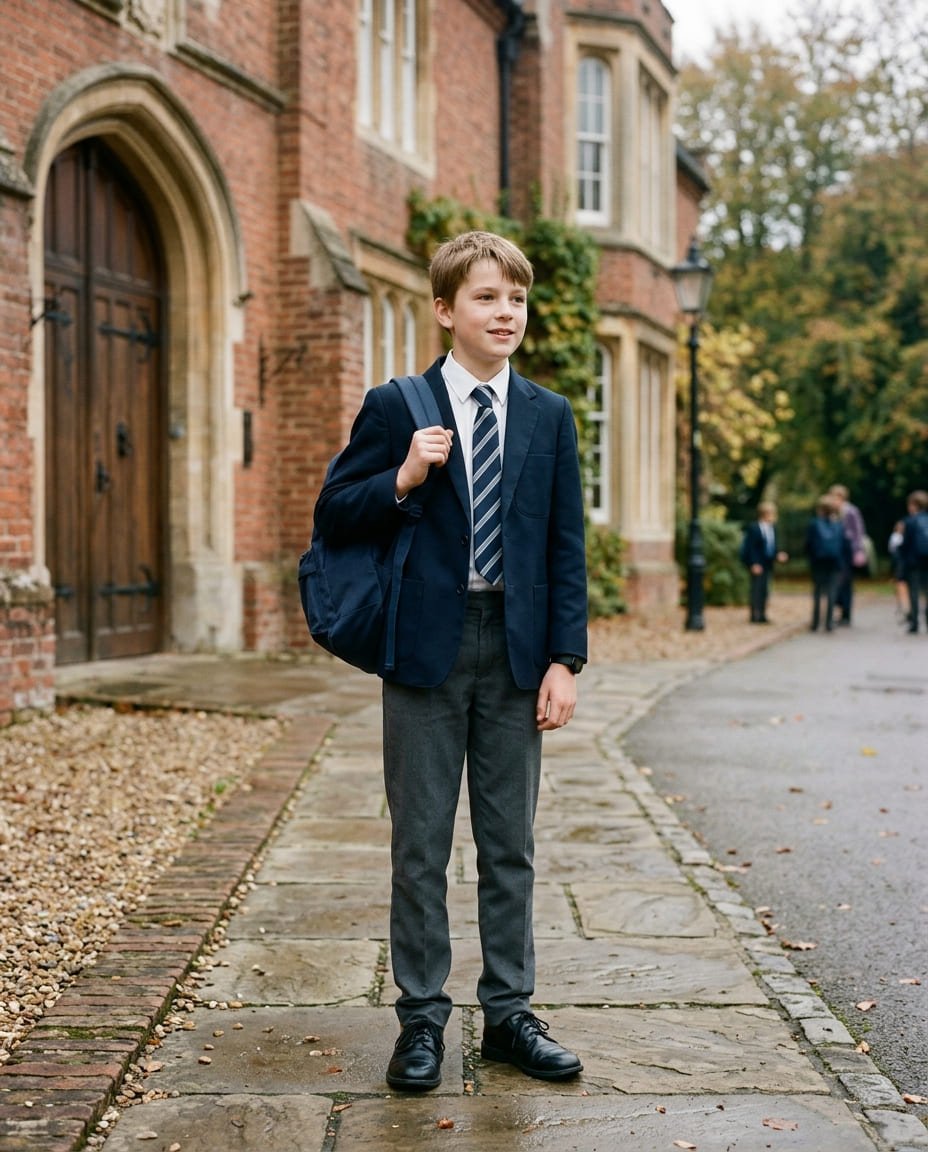
- School uniform. Almost all British schoolchildren wear a uniform: a shirt or polo shirt, a jumper or blazer in school colours, grey or black trousers and black shoes. Many schools add a tie.
- After school. Tracksuits, football shirts, hoodies, jeans and trainers.
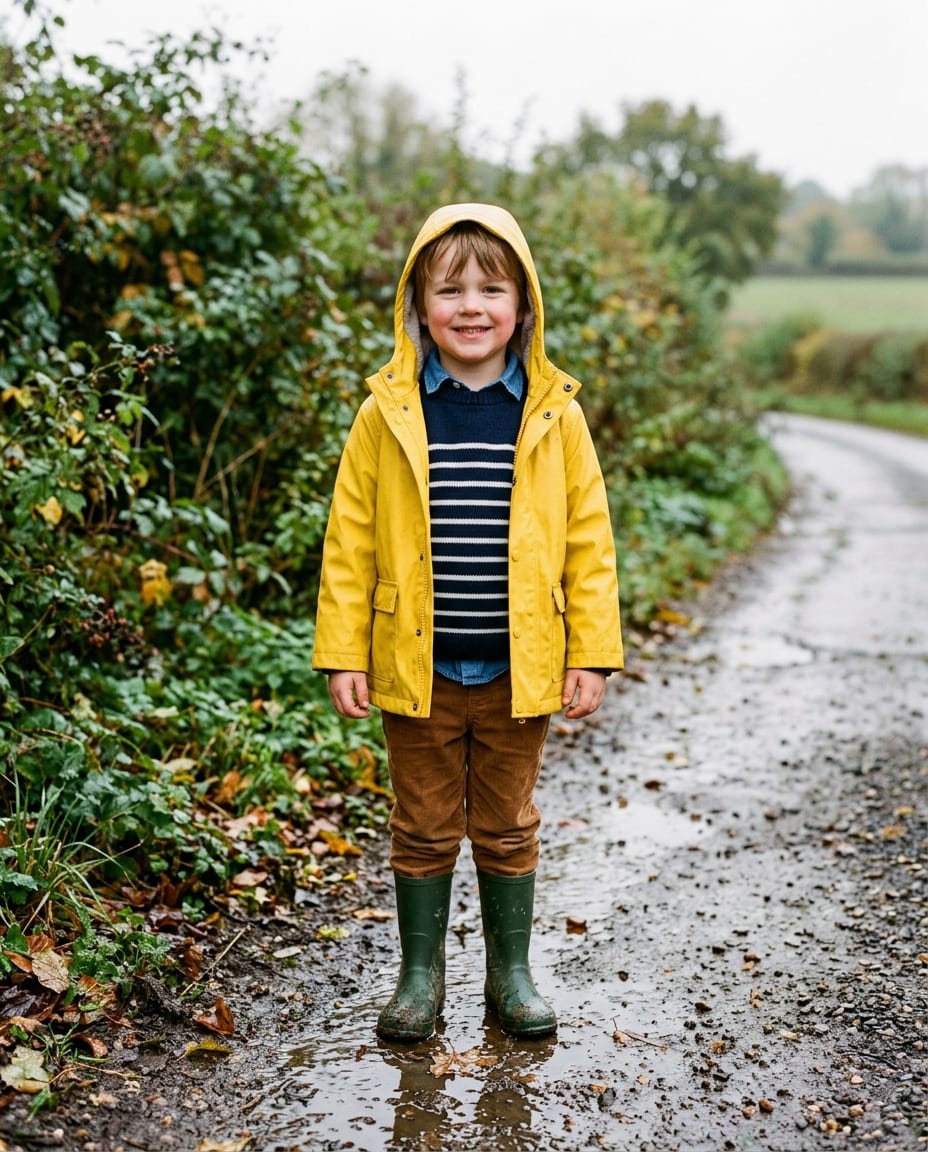
- Weatherproofing. A waterproof coat with a hood and wellington boots for younger children.
- Fitted shoes. Parents traditionally have children’s feet measured in the shop.
- Dressing up. Children wear costumes for World Book Day in March, and Christmas jumpers in December.
- Smart occasions. A shirt, chinos and a jumper or blazer for boys, and, in Scotland, a kilt.
- Navy school blazer Jacket
- White shirt and striped tie Shirt
- Grey trousers Trousers
- Black leather shoes Shoes
See our guide to clothes for teenage boys and the Boys’ Fashion and Kids’ Fashion hubs.
UK fashion trends
What are people wearing in the UK now? Trends shift each season, but several have lasted.
- Heritage revival: waxed jackets, tweed, Fair Isle knits and loafers worn by a younger generation.
- Vintage and second-hand: charity shops, resale apps and vintage football shirts.
- Wide trousers and relaxed tailoring.
- Gorpcore: hiking jackets, fleeces and trail shoes in the city.
- Tracksuits and trainers as everyday wear.
- Quiet, logo-free clothing in navy, grey and brown.
- Made in Britain: renewed interest in British-made shoes, knitwear and tailoring.
How to dress like a local: a British capsule
- Trench coat or mac
- Wool overcoat for winter
- Waxed or quilted jacket
- Navy blazer
- Two Oxford shirts
- Lambswool crew-neck jumper
- Fine roll neck
- Dark jeans
- Grey flannel or wool trousers
- Chinos or corduroys
- Leather brogues or Chelsea boots
- White leather trainers
- A scarf and a compact umbrella
Check your wardrobe against the list with our Wardrobe Planner.
Mistakes visitors make
| Mistake | Why it stands out | Do this instead |
|---|---|---|
| No waterproof layer | Showers arrive without warning | A trench coat, mac or packable rain jacket |
| Packing for a hot summer | Evenings are cool even in July | Bring a jumper or light jacket |
| New shoes for sightseeing | London involves long walks | Worn-in trainers or boots |
| Shorts and sandals in spring | Locals are still in coats | Light trousers and closed shoes |
| Calling trousers “pants” | Pants means underwear | Say trousers |
| Trainers at a smart venue | Some clubs and hotels refuse them | Leather shoes |
| Heavy luggage on the Underground | Many stations have stairs only | Pack light |
Frequently asked questions
People in the UK wear casual, practical clothes: jeans or chinos, T-shirts, shirts and jumpers, trainers or boots and a coat or jacket for the changeable weather. They dress up for weddings, the races and nights out.
Wear layers, comfortable walking shoes and a waterproof coat or jacket. A trench coat, a jumper, dark jeans or chinos and trainers or boots work for most of the year.
London street style is varied and individual. It mixes tailoring, vintage clothing, sportswear and streetwear, and it changes by neighbourhood, from polished Chelsea to creative Shoreditch.
England has no official national dress. Traditional English clothing includes the Morris dancer's costume, the Beefeater's uniform, the bowler hat and pinstripe suit, country tweeds and morning dress.
The UK has no single national dress. Scotland has the kilt and Highland dress, Wales has a costume with a tall black hat and red shawl, and England has several regional and ceremonial costumes.
Burberry, Barbour, Paul Smith, Vivienne Westwood, Alexander McQueen, Mulberry, Marks & Spencer, Fred Perry, Dr. Martens and Clarks are among the best known.
Vivienne Westwood, Alexander McQueen, Mary Quant, Paul Smith and Stella McCartney are the most famous. Charles Frederick Worth, born in England, founded haute couture in Paris.
Elizabethan men wore a linen shirt, a padded doublet, a jerkin, short padded trunk hose with stockings, a ruff, a cloak and a hat. Fabric and colour showed their rank.
T-shirts, shirts, light trousers and trainers, with a light jacket or jumper for the evening and a small umbrella. Choose breathable fabrics for the Underground.
A wool coat or padded jacket, a jumper, a scarf, gloves and waterproof boots. Temperatures are usually above freezing, but it is damp and windy.
There is no general dress code. Smart casual suits most restaurants and theatres. Some private clubs, grand hotels and nightclubs require a jacket or refuse trainers and sportswear.
British country style is built on waxed and quilted jackets, tweed, checked shirts, corduroy trousers, flat caps and wellington boots in green, brown and mustard.
Men's jacket, suit and shirt sizes are the same. UK men's shoe sizes are about one size smaller than US sizes, so a UK 9 is roughly a US 10.
In British English, pants means underwear. The American word pants is trousers in Britain, and a sweater is usually called a jumper.