
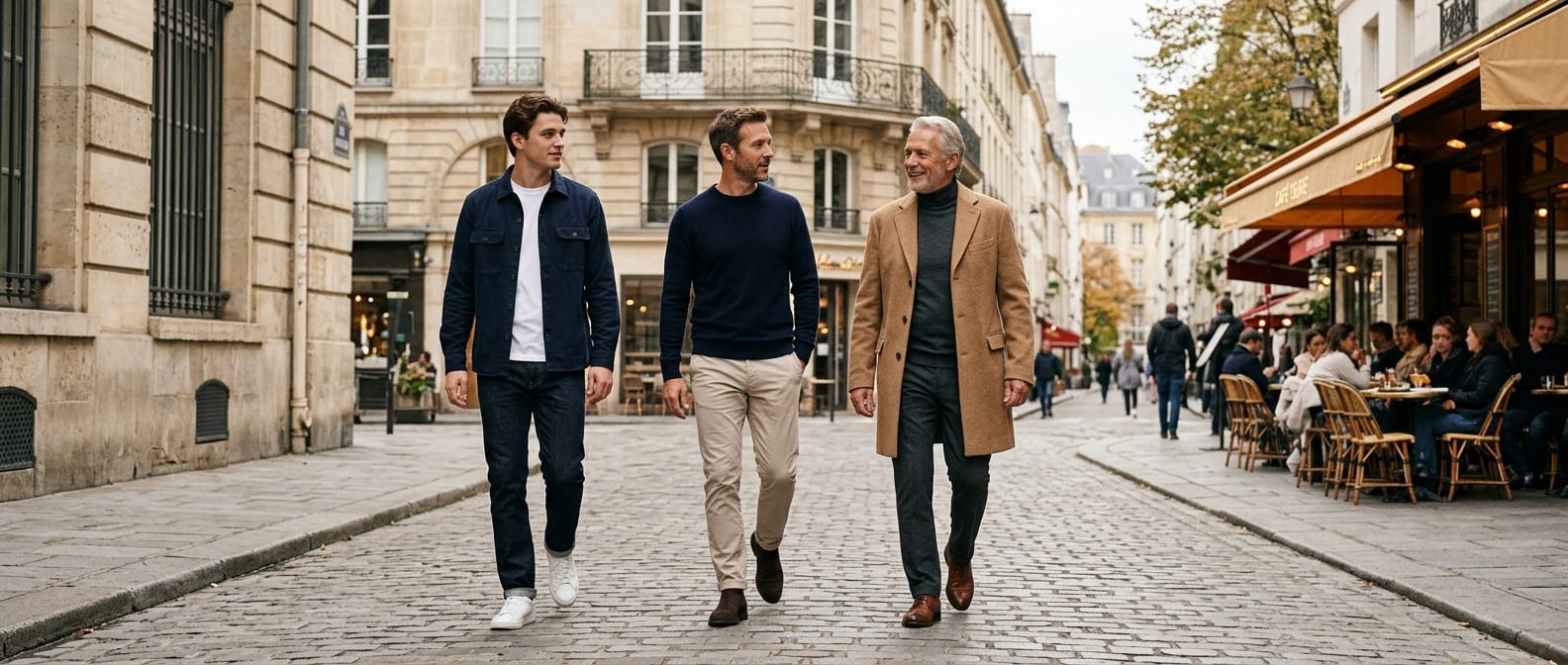
European men’s fashion has a reputation for looking effortless. Walk through Milan, Paris, Copenhagen or Lisbon and you’ll see men of every age in clothes that fit well, suit the setting and never look as if they tried too hard. The secret isn’t money or a hidden rulebook. European men’s fashion rests on a handful of habits: good fit, a calm colour palette, natural fabrics, proper shoes and a small wardrobe where everything works together. This guide explains those habits, shows how style changes from country to country and gives you a practical plan to dress the same way, wherever you live.
European men’s fashion in one minute
- Fit first. Clothes follow the body without being tight. Sleeves, hems and shoulders are the right length.
- Fewer, better pieces. A small wardrobe of quality basics replaces a large one full of trends.
- Neutral colours. Navy, grey, white, cream, brown, olive and black, with one accent at a time.
- Natural fabrics. Wool, cotton, linen and leather, chosen for the season.
- Leather shoes and clean trainers. Shoes are cared for, and running shoes stay at the gym.
- Little or no branding. Logos are small or absent.
- Dressing for the occasion. A little smarter for dinner, a little sharper for the city.
Why European men dress differently
Several things shape how men dress in Europe.
Cities are walked, not driven. In most European cities, people walk, cycle and take public transport. Clothes are seen at close range all day, and shoes have to be comfortable and presentable.
Homes and wardrobes are smaller. With less storage, people own fewer clothes and choose them more carefully. That naturally leads to a capsule wardrobe.
Tailoring traditions run deep. Italy, Britain and France all have long histories of tailoring and shoemaking, and their influence reaches everyday clothes.
Social settings expect some effort. Meeting friends for dinner, going to the theatre or visiting family often means dressing up a little. It’s seen as a sign of respect rather than vanity.
Weather demands good outerwear. Much of Europe is cool and wet for half the year, so coats, knitwear and boots matter as much as what’s underneath.
The seven principles of European men’s fashion
1. Fit is everything
European men wear clothes in their actual size. Jackets sit cleanly on the shoulder, shirt cuffs end at the wrist and trousers touch the shoe without pooling. Fits have relaxed in recent years, with wider trousers and softer jackets, but the proportions are still deliberate.
2. A restrained palette
Most outfits use two or three colours, usually neutrals. That makes everything in the wardrobe compatible and lets one accent, such as a burgundy scarf or an olive jacket, stand out.
3. Quality over quantity
A good wool coat, a well-made pair of leather shoes or a merino jumper is worn for years. Many European men would rather own three good knits than ten cheap ones.
4. Smart casual as the default
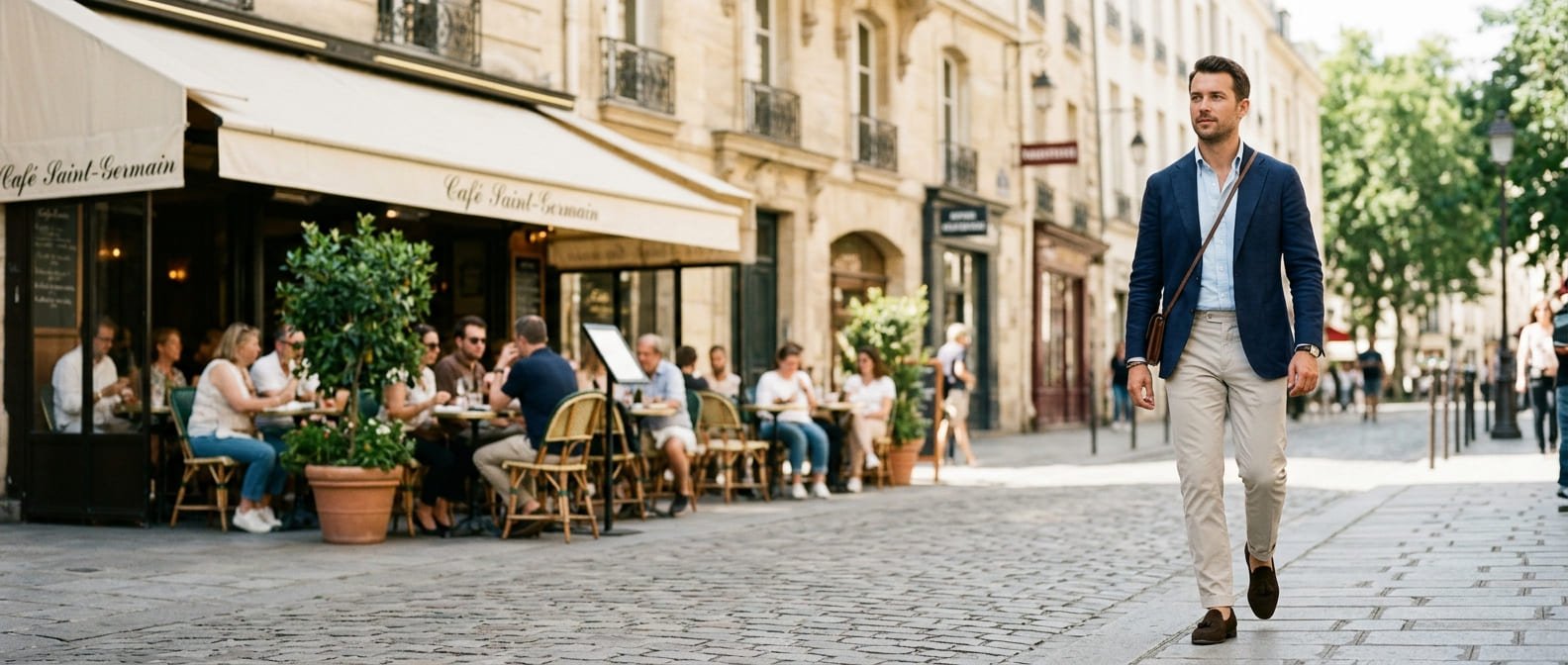
The everyday uniform across much of Europe sits between casual and formal: chinos or dark jeans, a shirt, polo or knit, a jacket or coat and leather shoes or clean trainers.
5. Layers
Changeable weather makes layering essential. A T-shirt, a knit, an overshirt and a coat can be combined or removed through the day.
6. Shoes matter
Shoes are often the first thing Europeans notice. Leather shoes are polished, suede is brushed and trainers are clean.
7. Understated details
Accessories are few and simple: a scarf, a good watch, a leather belt. Nothing shouts.
The European men’s wardrobe essentials
| Piece | Why it matters | Best colours |
|---|---|---|
| Dark straight jeans | Work with everything from a T-shirt to a blazer | Indigo or black |
| Chinos | The backbone of smart casual | Navy, stone, olive |
| Wool trousers | Smarter days and evenings | Grey, navy |
| Plain T-shirts | A base layer under shirts, knits and jackets | White, navy, grey |
| Oxford or poplin shirt | Dresses up or down easily | White, light blue |
| Knitted polo | Smart without a shirt | Navy, cream, brown |
| Merino jumper | Light, warm, year-round | Navy, grey, burgundy |
| Unstructured blazer | Makes any outfit smarter | Navy, brown, grey |
| Overshirt or chore jacket | Easy layer for mild weather | Navy, olive, tan |
| Wool overcoat | The centre of the winter wardrobe | Navy, camel, charcoal |
| Leather shoes or boots | Polished and long-lasting | Brown, black |
| Minimal leather trainers | Everyday walking shoes | White, grey |
- Navy merino jumper Knit
- White T-shirt underneath Base
- Stone chinos Trousers
- Brown suede boots Shoes
Colours in European men’s fashion
Northern Europe leans towards navy, grey, black and white. Southern Europe adds warmer tones such as tobacco, cream, olive and terracotta. Wherever you are, the rule is the same: mostly neutrals, with one colour as an accent.
How men dress across Europe
European men’s fashion isn’t one style. Each country has its own character.
Italy
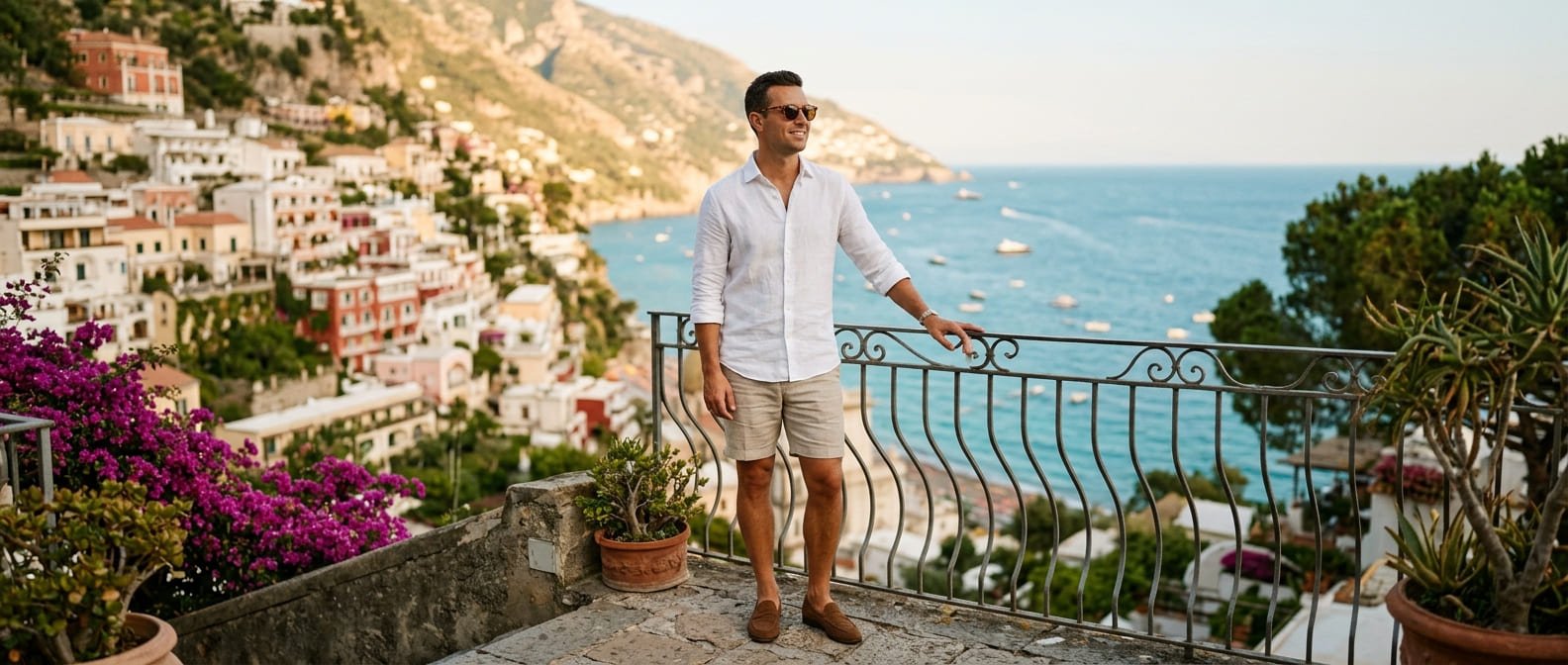
Italian style is the most expressive and polished. Soft, unstructured jackets, fine knitwear, pleated trousers and suede loafers are everyday choices, and colours are warm. The Italian idea of sprezzatura, a studied nonchalance, means clothes are chosen carefully but worn with ease. Read more in our guide to Italian men’s fashion trends.
France
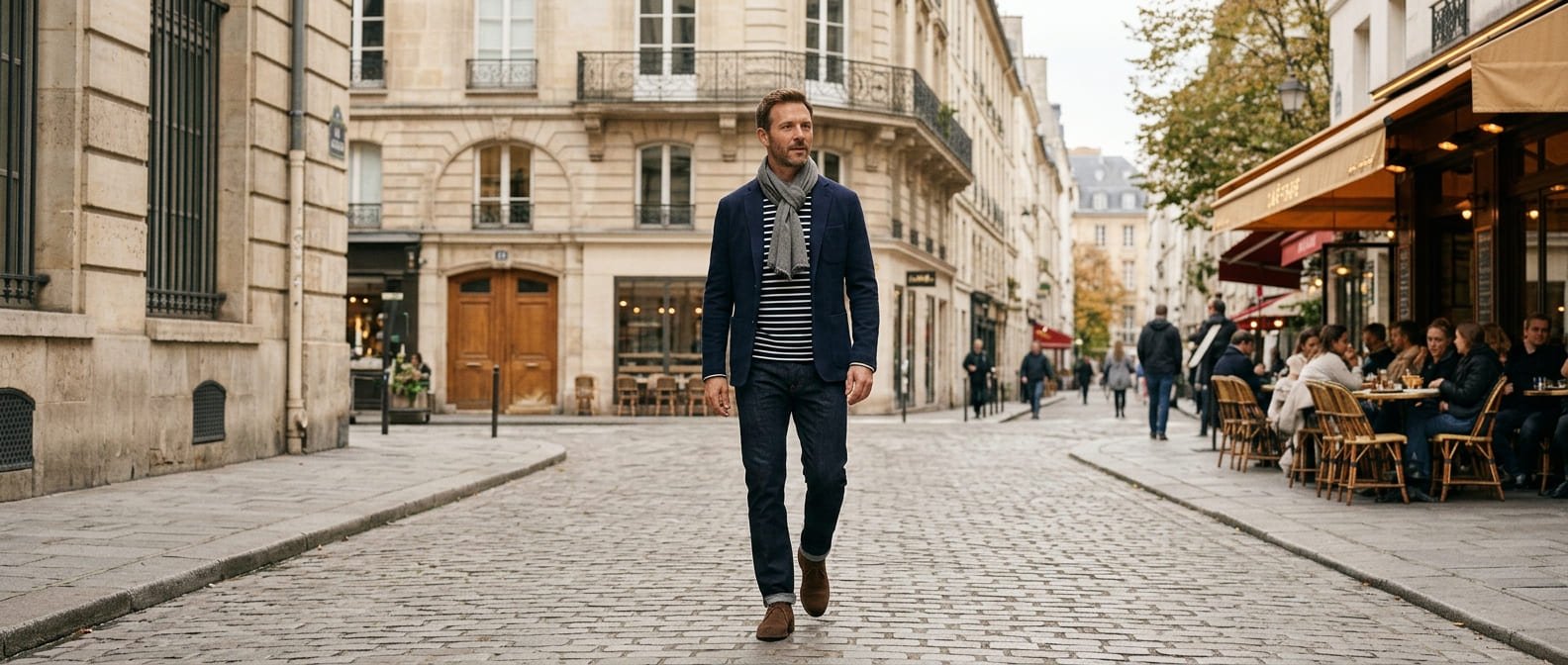
French style is understated. Navy, grey, white and black dominate, fits are neat and nothing looks overdone. A good coat, a knit, straight jeans and leather shoes or clean trainers define the look. See our guide to French style for men.
United Kingdom
British style mixes tradition and street culture. Tailoring, tweed, waxed jackets, knitwear and brogues sit alongside trainers, parkas and sportswear. Practical outerwear is essential in the British weather.
Scandinavia
Denmark, Sweden and Norway favour clean minimalism: muted colours, relaxed fits, quality knitwear and excellent coats. Function matters as much as form, and trainers are worn almost everywhere.
Germany, Austria and Switzerland
Practical, neat and well made. Quality basics, functional jackets and comfortable shoes are common, with sharper tailoring in business. Berlin stands apart with its dark, creative, casual style.
Netherlands and Belgium
Relaxed and practical, shaped by cycling culture. Slim or straight trousers, knitwear, smart trainers and weatherproof jackets are typical. Belgian style adds a quieter, design-led edge.
Spain and Portugal
Relaxed and warm-weather friendly. Linen shirts, chinos, loafers and espadrilles are common, and people dress up for long, late evenings out.
Greece and the eastern Mediterranean
Casual and sun-led: linen, light cotton, sandals and sunglasses in summer, with smart casual for evenings in the cities.
| Region | Overall mood | Signature pieces |
|---|---|---|
| Italy | Polished and warm | Soft blazer, knitted polo, suede loafers |
| France | Understated | Navy knit, trench coat, straight jeans |
| UK and Ireland | Heritage and street | Tweed, waxed jacket, brogues, trainers |
| Scandinavia | Minimal and practical | Wool coat, knitwear, clean trainers |
| Germany and the Alps | Neat and functional | Quality basics, functional jackets |
| Benelux | Relaxed and practical | Knitwear, smart trainers, rain jackets |
| Iberia | Relaxed and sunny | Linen shirt, chinos, espadrilles |
Explore each country in our European fashion guides.
European men’s fashion by season
Spring: light layers. An overshirt or light jacket over a knit or T-shirt, chinos and leather trainers. A trench-style coat for rain.
Summer: linen and cotton shirts, knitted polos, tailored shorts or light trousers and loafers. See our guide to European summer outfits for men.
Autumn: knitwear, corduroy, suede boots and warm colours such as olive, rust and brown. A waxed or wool jacket for wet days.
Winter: a wool overcoat, a scarf, merino or lambswool knits, wool trousers or dark jeans and leather boots.
- Camel wool overcoat Coat
- Grey merino rollneck Knit
- Dark indigo jeans Trousers
- Dark brown leather boots Shoes
How to dress like a European man
You don’t need a new wardrobe. Start with these steps.
- Check your fit. Try on your clothes and remove anything too big, too small or worn out. Take the best pieces to a tailor for small adjustments.
- Choose a palette. Pick three neutrals and one accent colour.
- Upgrade your shoes. Replace running trainers for daily wear with minimal leather trainers, and add one pair of leather or suede shoes.
- Add one good layer. An unstructured blazer, an overshirt or a wool coat changes every outfit.
- Reduce logos. Choose plain or subtly textured pieces.
- Care for your clothes. Iron shirts, polish shoes and store knitwear folded.
- Dress one step up. Wear a collar for dinner, a jacket for the theatre and proper shoes in the city.
European men’s fashion for different ages
- Teens and twenties: clean trainers, straight jeans, plain hoodies and overshirts, with one smart outfit for occasions. Streetwear is popular across Europe, usually in a toned-down form.
- Thirties and forties: smart casual as the daily uniform: chinos, knitwear, an unstructured blazer and leather shoes.
- Fifties and beyond: soft tailoring, fine knitwear, quality coats and comfortable leather shoes. Understated quality is the rule.
European boys and teenagers
Boys in Europe generally dress in a simple, practical way: straight jeans or chinos, plain T-shirts and sweatshirts, a good jacket and trainers. For occasions, a collared shirt, a knit and leather shoes or smart trainers are normal. Helping a teenager choose well-fitting basics in a simple palette teaches the same principles adults follow. See our boys’ fashion guides.
European men’s fashion versus American style
The differences are often small but noticeable.
| Element | Common in Europe | Common in North America |
|---|---|---|
| Fit | Closer, tailored proportions | Roomier, more relaxed |
| Shorts | Tailored, above the knee | Longer, cargo and athletic styles |
| Shoes | Leather shoes and minimal trainers | Running and athletic shoes |
| Logos | Small or absent | Larger and more visible |
| Daily default | Smart casual | Casual and sportswear |
| Outerwear | Wool coats, trench coats | Technical jackets, hoodies |
Neither approach is right or wrong, and both are changing. But if you want to blend in while travelling in Europe, these are the simplest things to adjust. Our guide to what to pack for Europe has a full packing list.
Shoes in European men’s fashion
- Minimal leather trainers: the everyday walking shoe.
- Suede loafers: spring and summer, especially in the south.
- Derbies and brogues: smart casual and business.
- Chelsea and chukka boots: autumn and winter.
- Desert boots: a relaxed option with chinos and jeans.
Look after them: use shoe trees, brush suede, polish leather and resole good shoes rather than replacing them.
Dressing for everyday European occasions
European men’s fashion changes with the setting, and knowing the usual standard helps you get it right.
- A normal working day: smart casual. Chinos or wool trousers, a shirt or knit and leather shoes or clean trainers.
- Dinner with friends: one step up from daytime. A collared shirt or fine knit, a jacket and leather shoes.
- The theatre, opera or a concert hall: a blazer or a suit without a tie is usual; jeans are acceptable in many cities if the rest is smart.
- Sunday lunch with family: neat and relaxed, such as a knit over a shirt with chinos.
- A church or cathedral visit: covered shoulders and knees, and hats off indoors.
- A wedding: a well-fitted suit, usually in navy, grey or blue, with a tie.
European men’s fashion on a budget
Dressing well in the European way is about choices, not spending.
- Buy fewer things. A dozen pieces that all work together beat a full wardrobe of random items.
- Spend most on shoes and outerwear. They’re seen the most and last the longest.
- Use a tailor. Hemming trousers or shortening sleeves costs little and transforms cheap clothes.
- Shop second-hand. Wool coats, tweed jackets, leather shoes and knitwear are widely available in excellent condition.
- Wait for the sales. Many European countries have big seasonal sales in January and July.
- Look after what you own. Brushing, airing and repairing clothes is a normal habit across Europe.
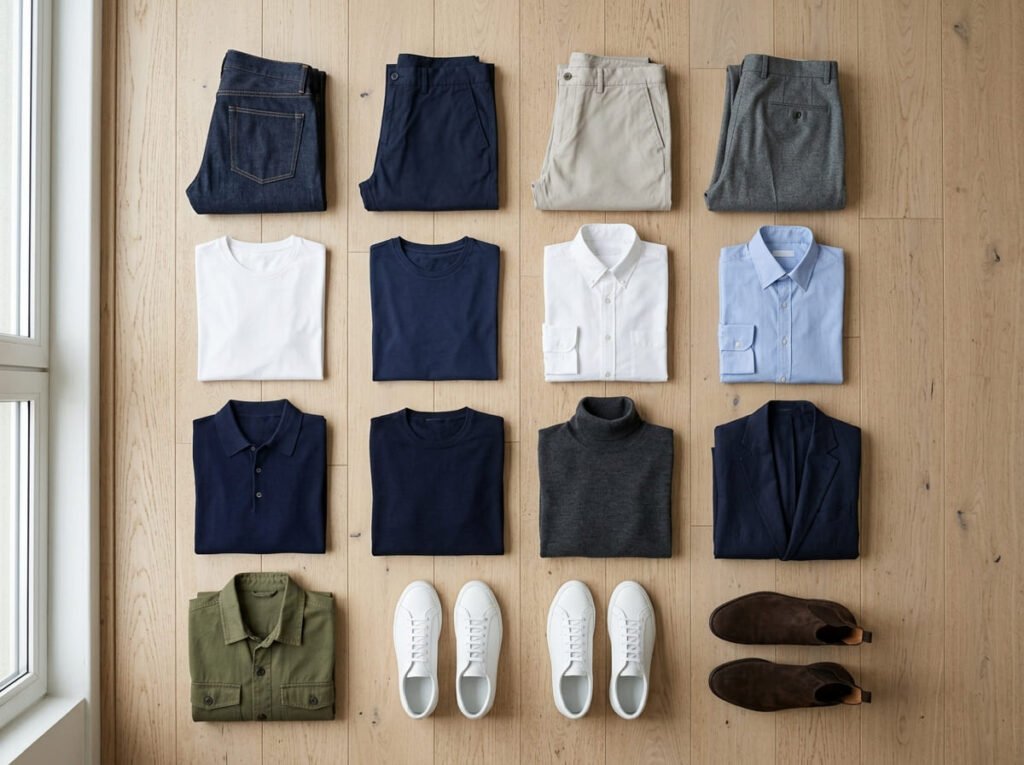
A 15-piece European capsule wardrobe
- Dark straight jeans
- Navy chinos
- Stone chinos
- Grey wool trousers
- Two white T-shirts
- A navy T-shirt
- A white oxford shirt
- A light-blue shirt
- A navy knitted polo
- A navy merino crew-neck
- A grey rollneck or half-zip knit
- A navy unstructured blazer
- An olive or navy overshirt
- A wool overcoat or trench coat, depending on the season
- White leather trainers and brown leather or suede boots
Every item works with every other, which gives you dozens of outfits for work, weekends and travel.
Grooming
European grooming is usually neat but natural. A regular haircut, a tidy beard or clean shave, clean nails and a light fragrance are enough. Heavy cologne is uncommon, especially in offices and restaurants.
Common mistakes
| Mistake | Why it stands out | Do this instead |
|---|---|---|
| Clothes a size too big | Looks careless | Wear your true size; alter what’s close |
| Running shoes with everything | Too sporty for city life | Minimal leather trainers or loafers |
| Too many colours | Looks busy | Two or three neutrals plus one accent |
| Big logos | At odds with understated style | Plain, well-made pieces |
| Ignoring the weather | Uncomfortable and impractical | A proper coat and waterproof shoes |
| Wrinkled clothes | Undermines a good outfit | Iron or steam before you leave |
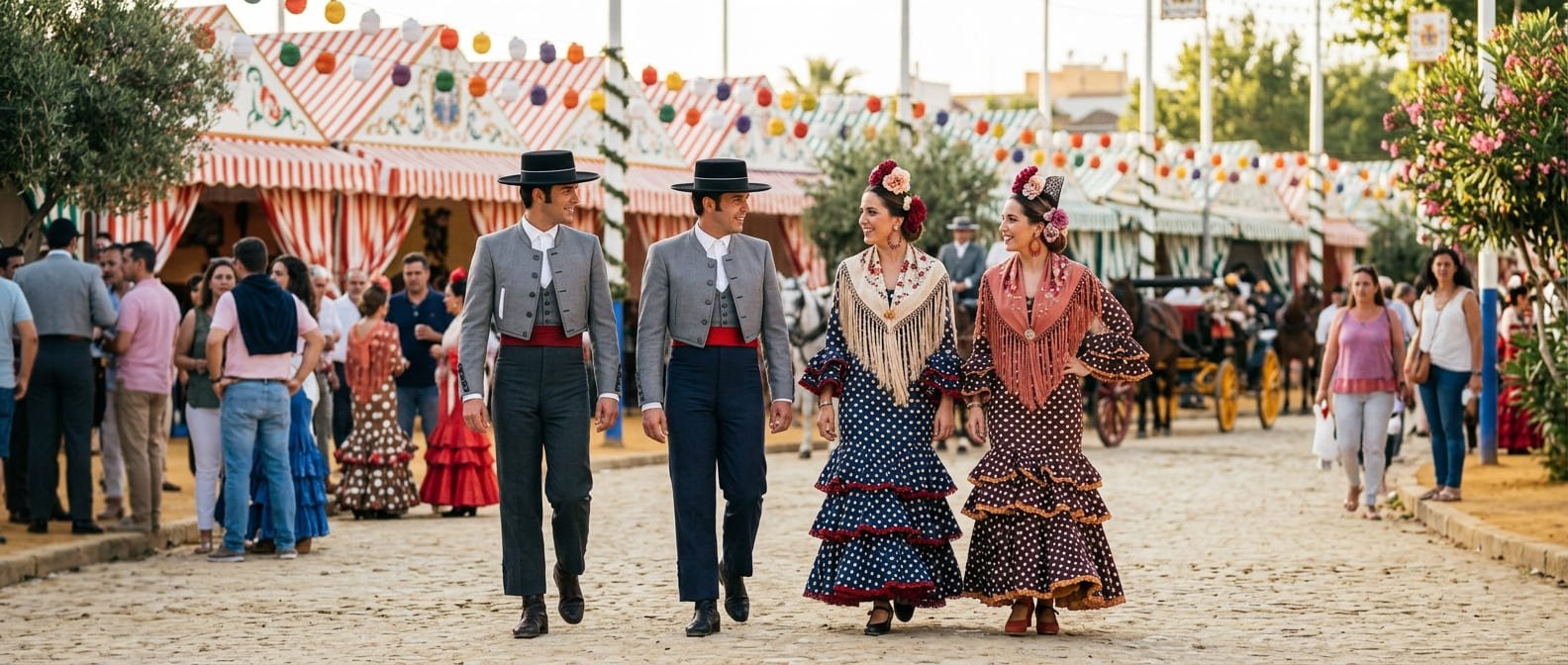
For more detail on southern Europe, see what to wear in Spain, traditional Spanish clothing and Greece outfits.
To plan a small wardrobe where everything works together, try the Wardrobe Planner. For a wider view of different looks, read our guide to the styles of dressing.
Frequently asked questions
European men's fashion is a way of dressing built on good fit, neutral colours, natural fabrics, quality basics and leather shoes or clean trainers. It favours smart casual outfits and understated details over trends and logos.
European men usually wear closer-fitting clothes, tailored shorts, leather shoes or minimal trainers and fewer logos, and they default to smart casual rather than sportswear.
Mostly neutrals: navy, grey, white, cream, brown, olive and black. Southern Europe adds warm tones such as tobacco and terracotta. One accent colour at a time is typical.
Minimal leather trainers for everyday wear, suede loafers in warm weather, derbies and brogues for smart occasions and leather boots in autumn and winter.
Wear clothes that fit, choose a simple palette of neutrals, replace running shoes with leather trainers or loafers, add one good jacket or coat and avoid large logos.
Yes. Dark, straight or slim-straight jeans without rips are everyday wear across Europe, usually paired with a knit, shirt or blazer and leather shoes or clean trainers.
It depends on taste. Italy is known for elegant tailoring, France for understated chic, Britain for heritage and streetwear, and Scandinavia for clean minimalism.
It varies, but many European men build their wardrobes around a small set of versatile pieces, often 15 to 30 core items in a neutral palette, rather than a large collection of trend pieces.