



Germany fashion rarely gets the attention given to Paris or Milan, and Germans themselves are often the first to joke about socks with sandals. That reputation misses what makes German style distinctive. German fashion is built on function, quality and restraint: clothes that fit the weather, last for years and don’t shout. It is also far more varied than the stereotype, from the all-black club uniform of Berlin to the polished elegance of Munich and Hamburg’s understated navy. Behind it sits one of the world’s most powerful clothing industries. This guide explains how people dress in Germany today, how style changes between cities, what to wear each month, the traditional clothing known as Tracht, German brands and designers, and the practical details of sizes, shopping and dress codes.
German fashion at a glance
- Practical first. Germans dress for the weather and the activity. A good rain jacket matters more than a fashionable one.
- Quality over quantity. People buy fewer, better things and wear them for years.
- Understated colours. Black, navy, grey, olive and beige dominate.
- Comfort is respected. Comfortable shoes, backpacks and outdoor jackets are normal in cities.
- Casual, but neat. Everyday dress is relaxed. Clothes are clean, well-kept and appropriate.
- Formal where it counts. Banking, law, the opera and weddings are still dressed up.
- Big regional differences. Berlin, Munich and Hamburg have very different styles.
- Tradition is alive in the south. Lederhosen and dirndls are worn at festivals in Bavaria, not across the whole country.
How people dress in Germany
Everyday clothes
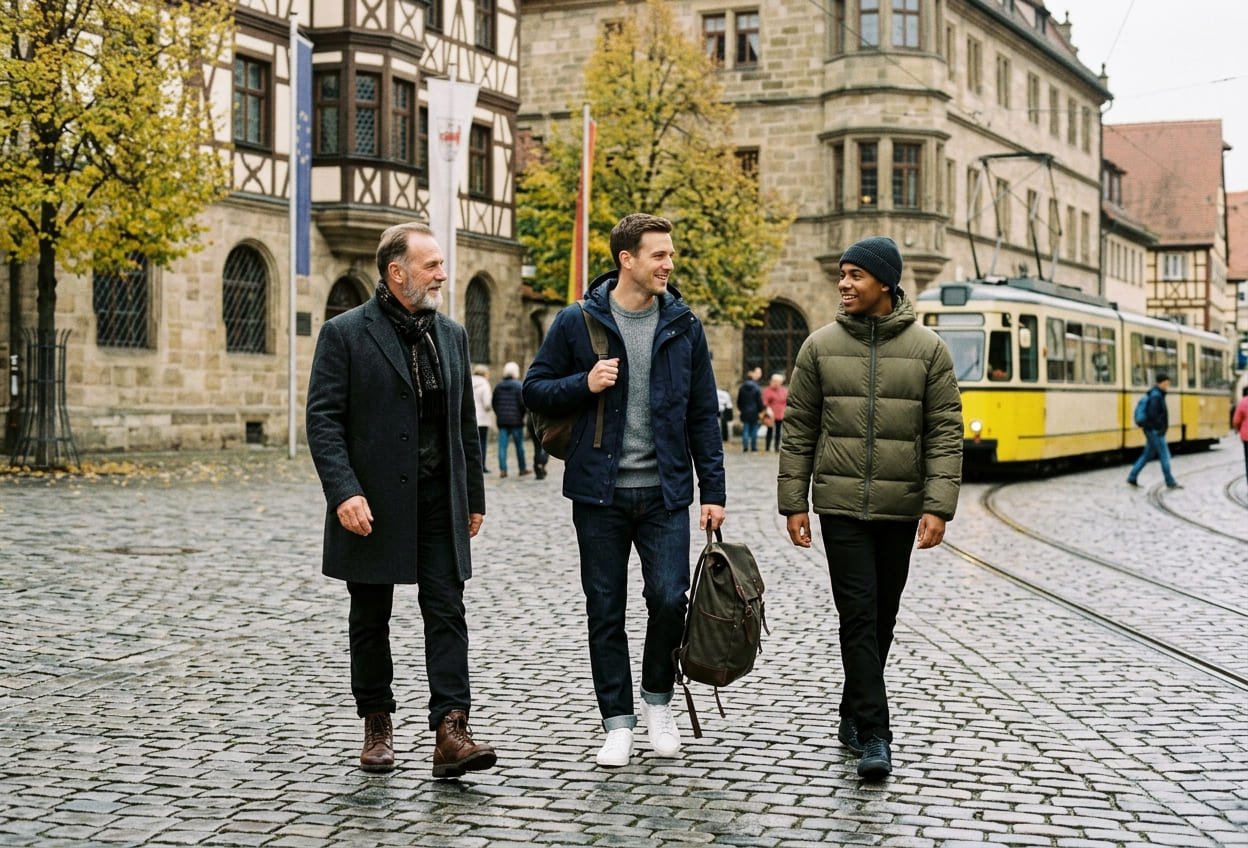
What do people wear in Germany on a normal day? Jeans or plain trousers, a T-shirt, shirt or jumper, a practical jacket and comfortable trainers or leather shoes. Modern German clothing is simple and functional, with few logos and little decoration. People dress to cycle, walk and use public transport in changeable weather, and their clothes reflect that.
Functional clothing
Germans have a word for it: Funktionskleidung, meaning technical or functional clothing. Waterproof jackets, fleece layers, walking shoes and backpacks made for the mountains are worn on city streets, at school gates and on the commute. A popular saying sums it up: there’s no bad weather, only the wrong clothes.
Quality and durability
German shoppers read labels, compare materials and expect things to last. Natural fibres, solid stitching and good soles are valued, and repairing shoes and clothes is common. Sustainability, organic cotton and second-hand shopping are mainstream.
Trousers, jeans and shoes
Jeans are the national trouser, worn by all ages in dark or mid-blue washes. Chinos and outdoor trousers are common too, and tailored trousers appear mainly at work. Shoes are sensible: trainers, leather lace-ups, ankle boots and, in summer, cork-footbed sandals.
What Germans don’t do
Flashy logos, very formal dress for ordinary occasions and impractical shoes are unusual. Overdressing can attract as much notice as underdressing.
Men’s fashion in Germany
German men’s fashion is clean, practical and slightly sporty.
- Tops: plain T-shirts, polo shirts, casual shirts and crew-neck jumpers.
- Jackets: technical shells, quilted jackets, parkas and, in cities, wool coats and bombers.
- Trousers: dark jeans, chinos and functional trousers.
- Shoes: trainers, leather boots and walking shoes.
- Bags: backpacks and messenger bags, even with office clothes.
- At work: suits in finance and law, and smart casual or casual elsewhere.
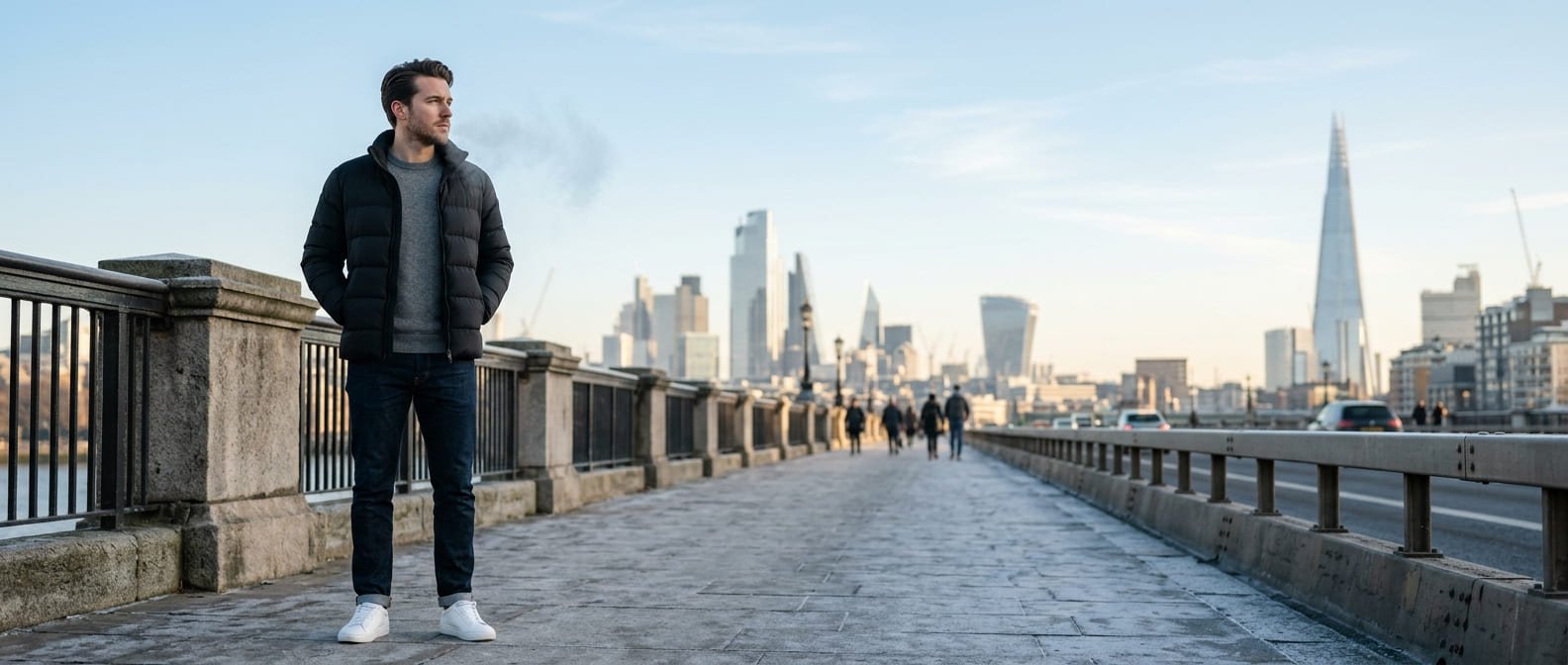
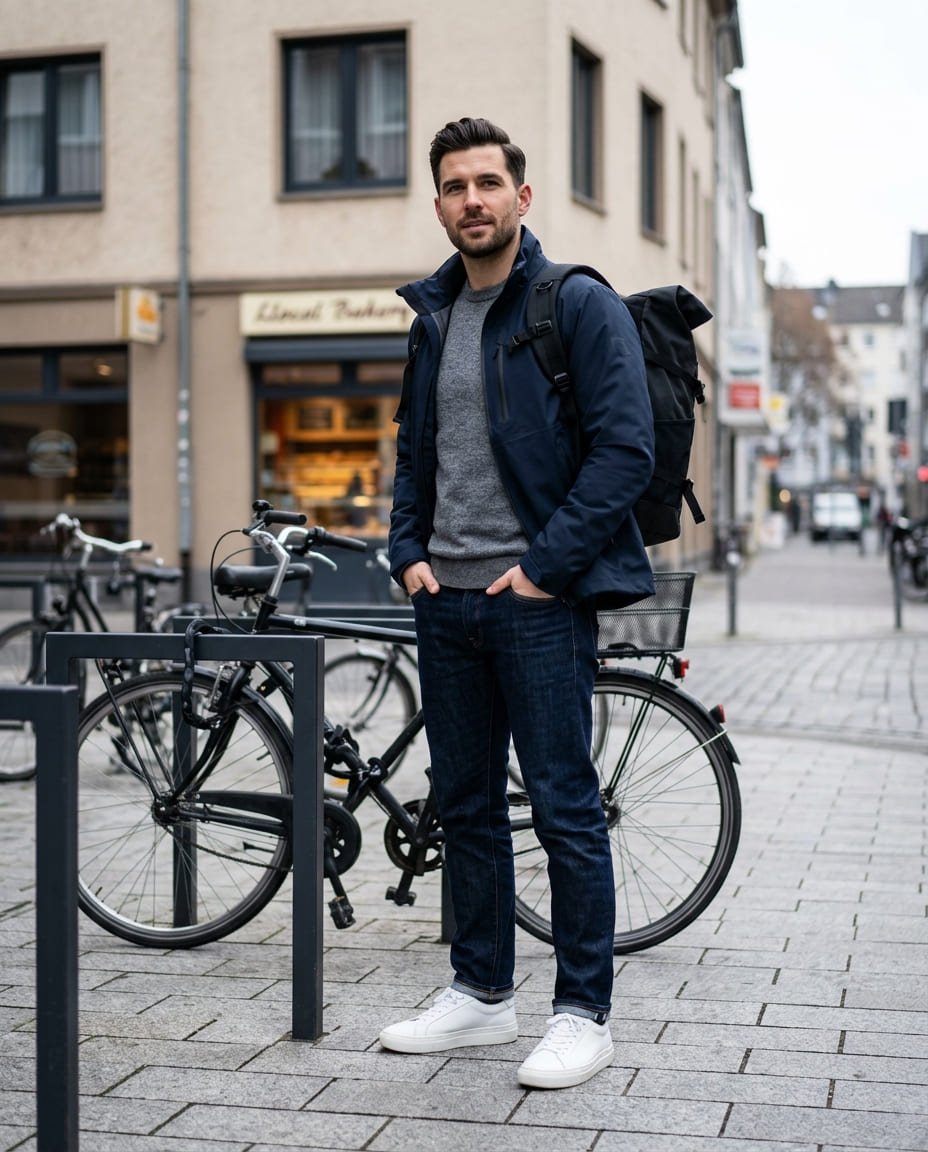
- Navy technical jacket Jacket
- Grey crew-neck jumper Knit
- Dark indigo jeans Trousers
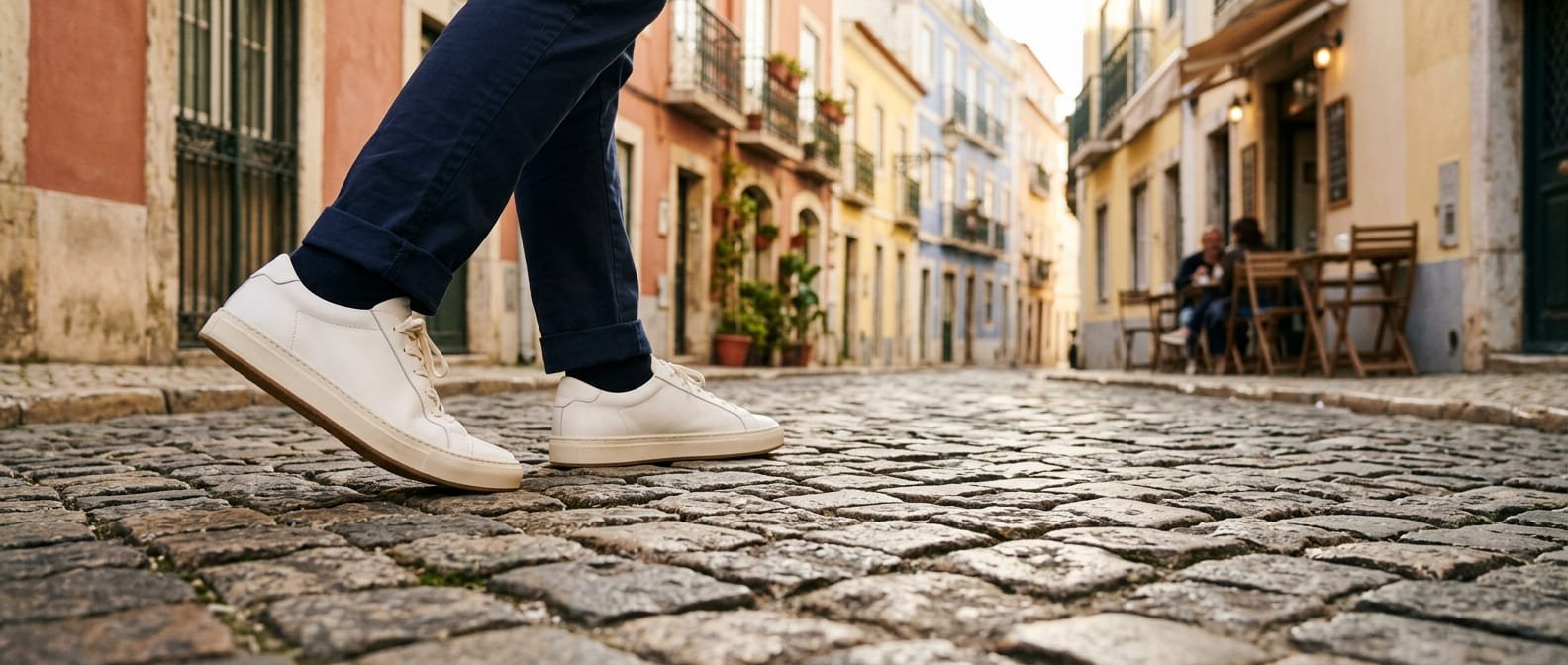
- White leather trainers Shoes
- Black backpack Accessory
For a comparison with France, Italy, Spain and Scandinavia, see our guide to European men’s fashion.
German style by city
Berlin fashion
Berlin is Germany’s fashion capital and its most relaxed city. Berlin outfits are famously dark: black jeans, black boots, oversized coats and vintage finds. The club scene shaped the look, and many venues prefer plain, dark, unshowy clothes at the door. Streetwear, second-hand clothing and independent designers thrive in Mitte, Kreuzberg and Neukölln. Nobody dresses up much, and almost anything goes.
Munich
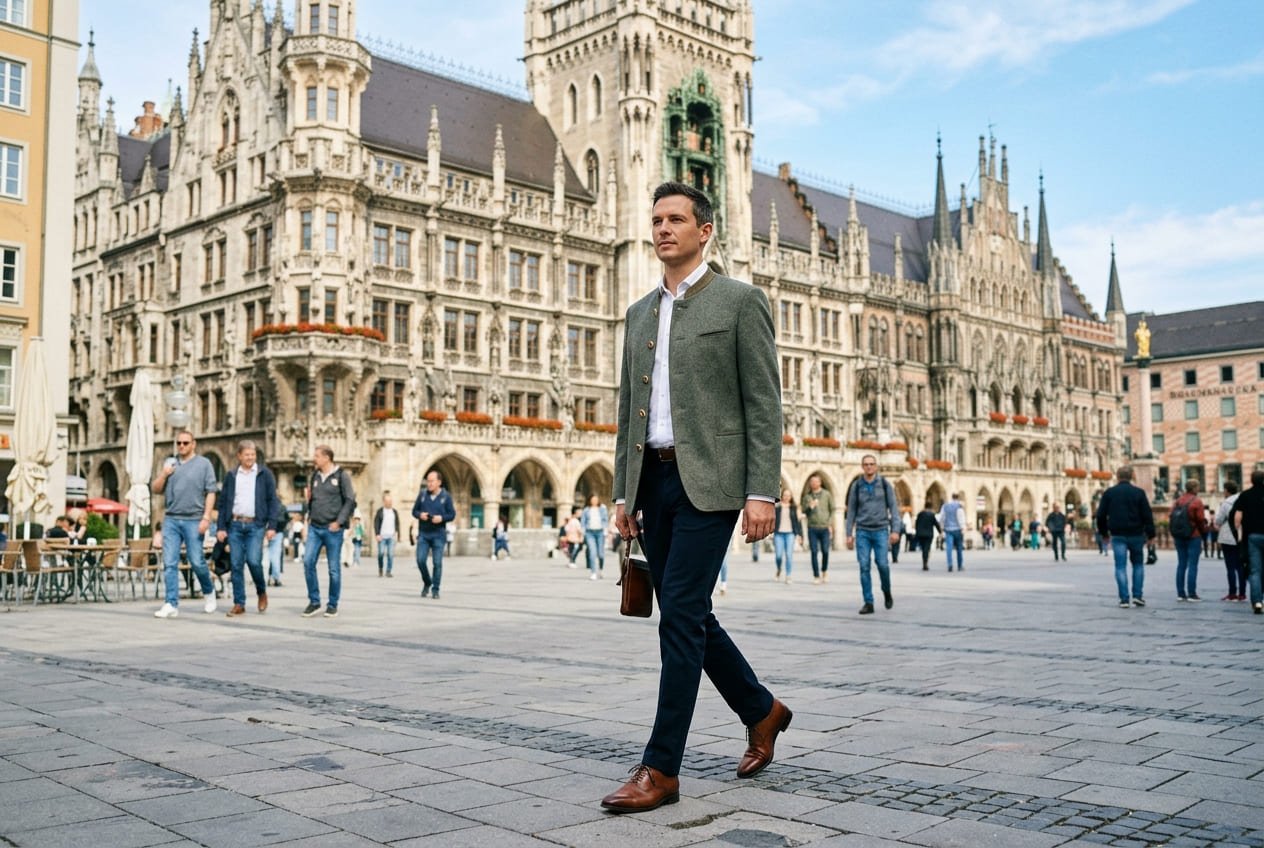
Munich is wealthier, more classic and more polished. Expect quality knitwear, tailored coats, loafers and designer labels on Maximilianstraße. It’s also the home of traditional dress: lederhosen and dirndls appear at beer festivals, weddings and church holidays.
Hamburg
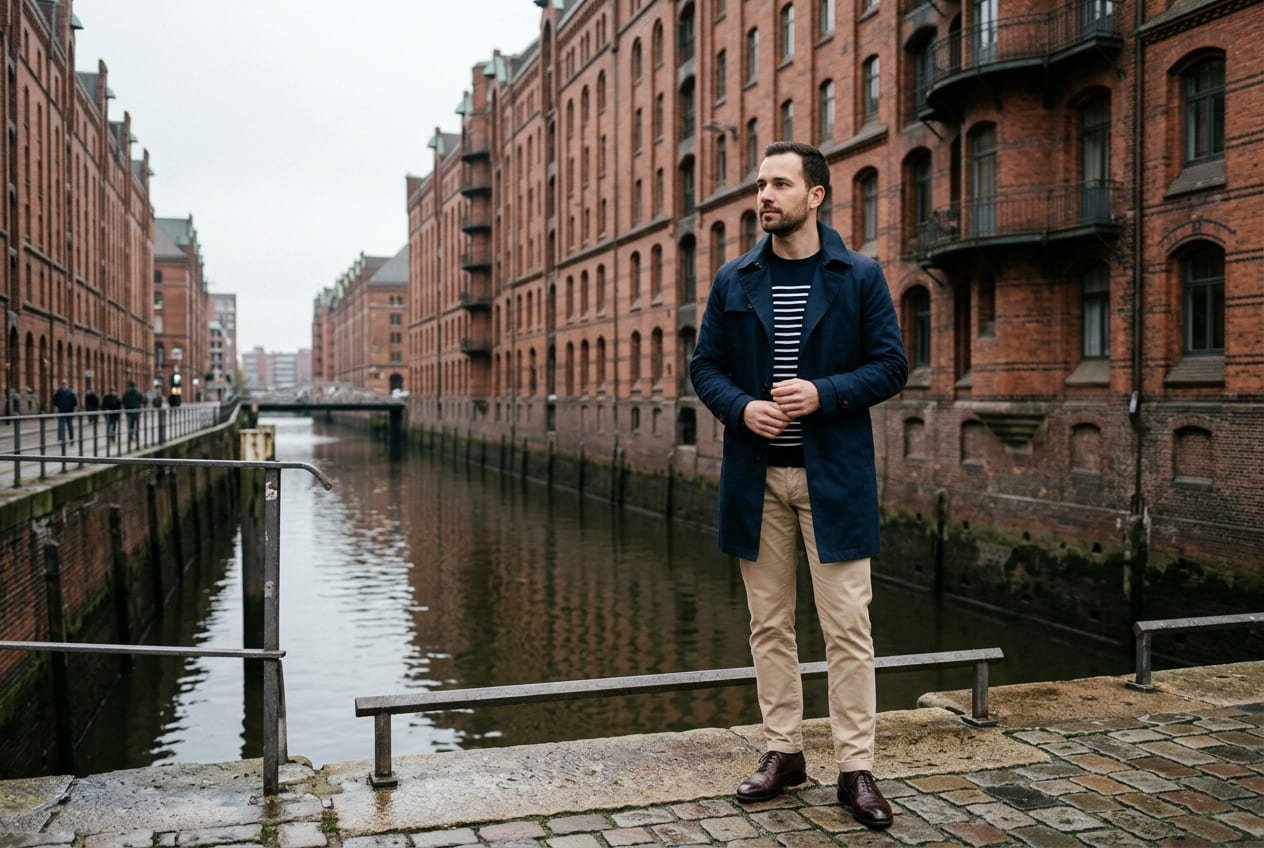
The port city has a Hanseatic style: understated, well-made and maritime. Navy, white and beige dominate, with trench coats, striped tops and, in the rain, the classic yellow raincoat. Hamburg has produced some of Germany’s best-known designers.
Düsseldorf
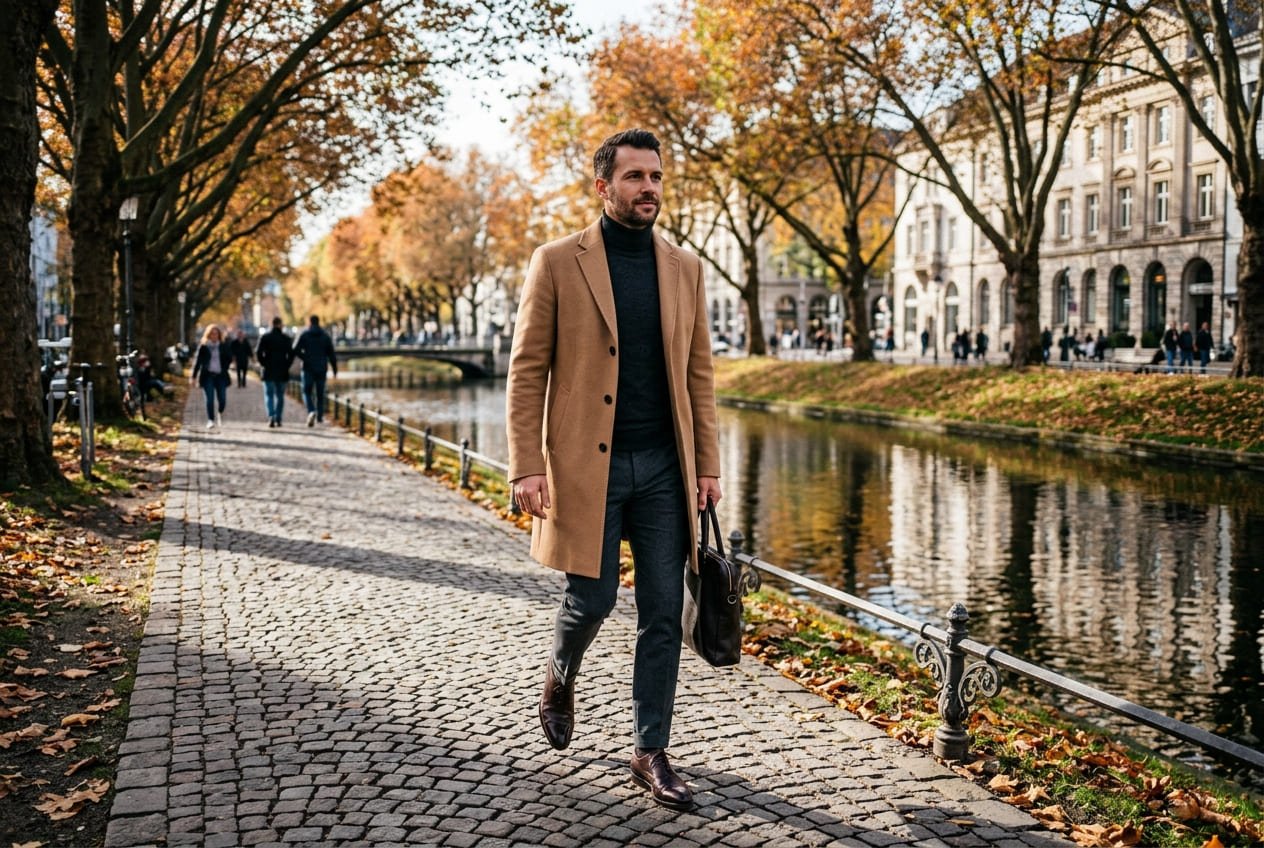
Germany’s fashion trade city, with showrooms, trade fairs and the luxury boulevard known as the Kö. Style is smart and label-conscious.
Cologne
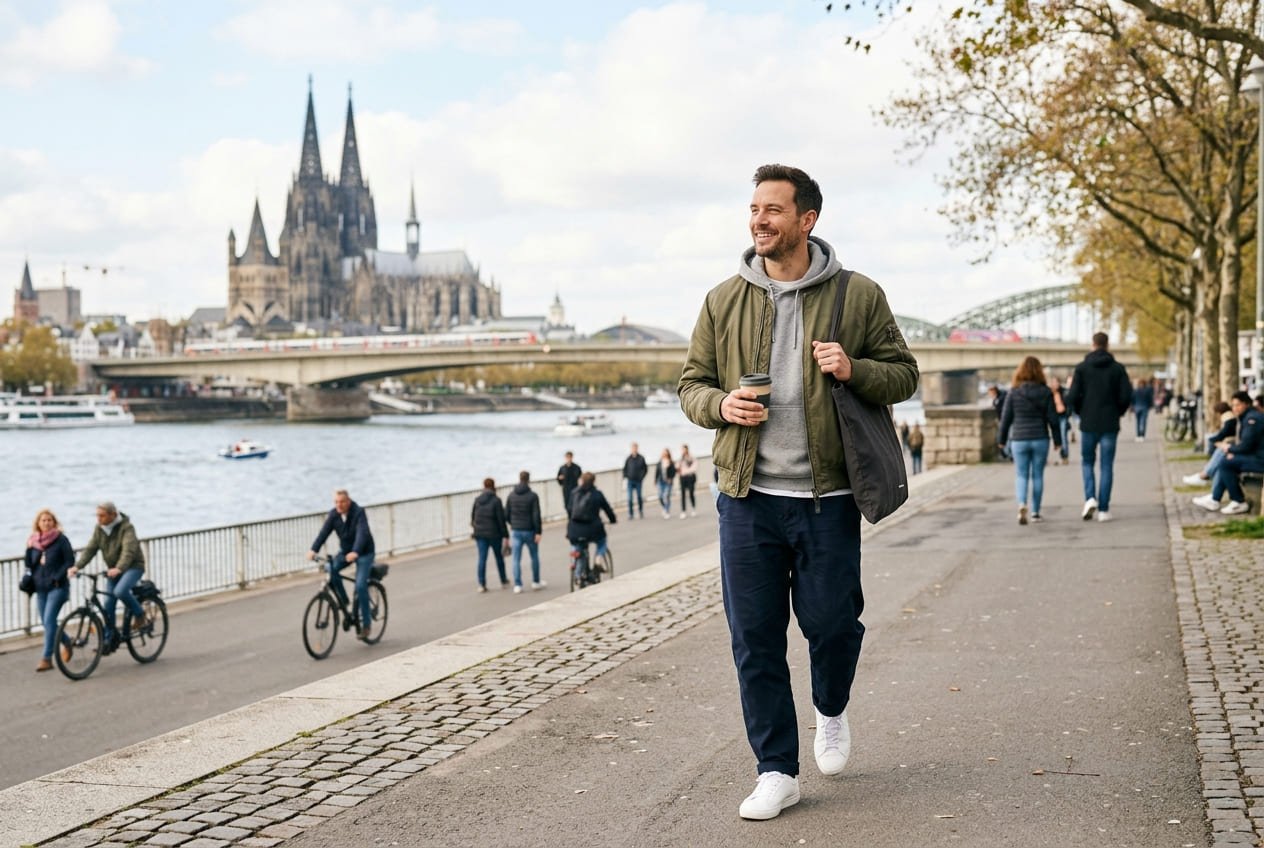
Friendly and relaxed, with a strong streetwear and sneaker scene. Every February, the whole city wears costumes for Carnival.
Frankfurt
The banking capital. Dark suits and polished shoes on weekdays, and smart casual at the weekend.
What to wear in Germany, month by month
Germany has four clear seasons and unpredictable weather in all of them. The table uses typical daytime highs for Berlin and Munich. The north coast is windier, and the Alps are colder and wetter.
| Month | Berlin | Munich | What to wear |
|---|---|---|---|
| January | about 3 °C | about 3 °C | Insulated coat, thermal layer, hat, scarf, gloves and waterproof boots |
| February | about 5 °C | about 5 °C | As January. Snow and ice are possible |
| March | about 9 °C | about 9 °C | Warm coat or padded jacket, jumper and boots |
| April | about 15 °C | about 14 °C | Mid-weight jacket, layers and an umbrella |
| May | about 20 °C | about 19 °C | Light jacket, shirt or T-shirt and a jumper for the evening |
| June | about 23 °C | about 22 °C | T-shirts, light trousers, and a rain jacket for thunderstorms |
| July | about 25 °C | about 24 °C | Summer clothes, with a light layer for cooler days |
| August | about 25 °C | about 24 °C | As July. Heatwaves above 30 °C are increasingly common |
| September | about 20 °C | about 19 °C | Layers: T-shirt, jumper and a jacket. Mornings are cool |
| October | about 14 °C | about 14 °C | Jacket or coat, jumper and closed shoes |
| November | about 8 °C | about 7 °C | Warm coat, scarf and waterproof shoes |
| December | about 4 °C | about 4 °C | Winter coat, hat, gloves and warm boots for Christmas markets |
- What to wear in Germany in summer: T-shirts, light trousers or shorts and trainers, plus a rain jacket. Air conditioning is rare, so choose breathable fabrics.
- What to wear in Germany in September and October: layers. A jumper and a mid-weight jacket handle cool mornings and mild afternoons.
- What to wear in Munich in September: layers and comfortable shoes. If you’re going to the Oktoberfest, traditional dress is welcome but not required.
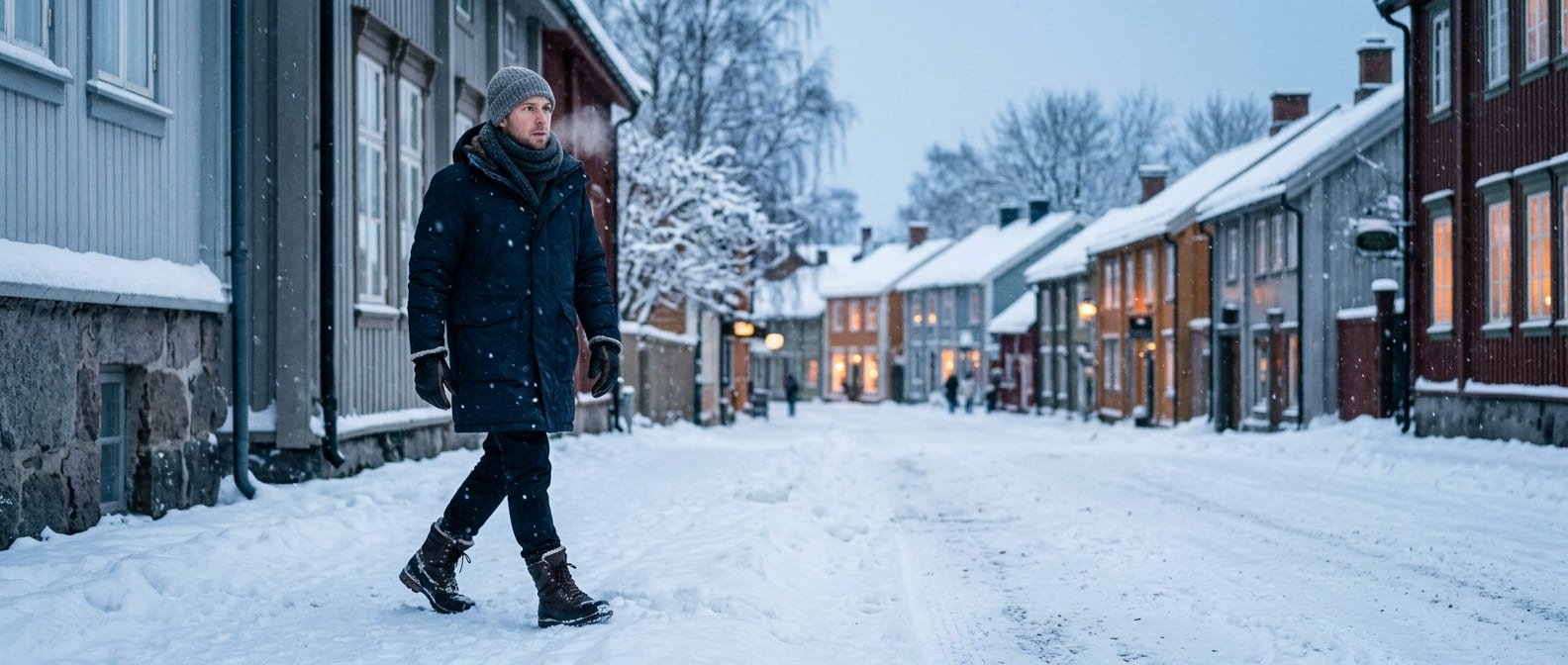
- What to wear in Germany in December: a proper winter coat, a thermal layer, a hat, gloves and boots with thick soles. Christmas markets mean hours of standing outdoors.
- German winter clothes: insulated jackets, wool knitwear, lined boots and thermal base layers. See our guides to cold weather clothing and winter outfits for men.
- Dark padded parka Coat
- Cream wool jumper Knit
- Dark jeans with a thermal layer Trousers
- Lined leather boots Shoes
- Wool hat and scarf Accessories
For packing, read what to pack for a Europe trip and our guide to puffer jackets for men.
Traditional German clothing
Traditional German clothing is called Tracht. Most people picture lederhosen and the dirndl, but those belong to Bavaria and the Alpine south. Germany has no single national dress. Each region developed its own costume, and many are still worn at festivals, weddings and folk events.
What is a German dress called?
The traditional German dress is called a dirndl. It has four parts.
- Bodice (Mieder): fitted, and fastened with buttons, hooks or lacing.
- Blouse: white, usually cropped under the bodice, with short or puffed sleeves.
- Skirt: full and gathered. Traditional lengths fall to the knee or below.
- Apron (Schürze): tied at the waist. By custom, a bow on the wearer’s left means single, a bow on the right means married or in a relationship, and a bow at the back is worn by widows and waitresses.
Traditional German clothing for men
The traditional male German attire of the south is built around lederhosen.
- Lederhosen: leather breeches, traditionally deerskin, cut short or to the knee (Kniebundhosen). A good pair lasts for decades.
- Braces (Hosenträger): often joined by an embroidered chest piece.
- Shirt: white linen or a red, blue or green check.
- Socks: knee-length wool socks, or two-part calf warmers called Loferl.
- Shoes: sturdy side-laced leather shoes called Haferlschuhe.
- Jacket (Janker): a wool or loden jacket with horn buttons.
- Hat: a felt hat, sometimes decorated with a tuft of chamois hair (Gamsbart).
Traditional German clothing by region
| Region | Traditional dress | Notes |
|---|---|---|
| Bavaria and the Alps | Lederhosen and dirndl, loden jackets and felt hats | Worn at the Oktoberfest, church festivals and weddings |
| Black Forest | The Bollenhut, a straw hat with large wool pompoms | Red pompoms for unmarried women, black for married women |
| Northern coast and Hamburg | Blue and white striped fisherman’s shirt and a peaked sailor’s cap | Maritime workwear that became regional dress |
| Spreewald and Lusatia | Sorbian costume with wide embroidered headdresses | Worn by the Sorbian minority at festivals |
| Hesse (Schwalm) | Short layered skirts and a small red cap | Often linked to the story of Little Red Riding Hood |
| Franconia and Swabia | Dark jackets, waistcoats with silver buttons and embroidered shawls | Varies from village to village |
Traditional German patterns and materials
- Checks: small gingham checks in red, blue or green for shirts and dirndl aprons.
- Florals: scattered flowers on dark backgrounds.
- Embroidery: edelweiss, oak leaves, stags and Alpine flowers.
- Loden: dense, felted wool in green, grey or brown that resists rain.
- Leather and horn: deerskin breeches and carved horn buttons.
When Germans wear Tracht
In Bavaria, traditional dress is worn with pride at folk festivals, beer festivals, weddings, confirmations and church holidays. In most other regions, it appears only at local festivals. Visitors to the Oktoberfest are welcome to wear it. Choose proper pieces in natural materials, because cheap fancy-dress versions are considered poor taste.
A short history of German clothing
- Ancient Germanic clothing. The Germanic peoples of the Roman era wore wool and linen tunics, trousers and cloaks fastened with brooches. Trousers were a Germanic and Celtic habit that the Romans first found strange.
- The sixteenth century. German mercenary soldiers, the Landsknechte, made slashed, brightly coloured clothing fashionable across Europe.
- The 1800s. German clothing in the early 1800s followed the modest, domestic Biedermeier style. Later in the century, Bavarian royalty promoted regional costume, which helped turn rural workwear into the festive Tracht known today.
- The twentieth century. The Bauhaus school shaped a German taste for clean lines and function over ornament. That taste still defines modern German design.
German brands and designers
This section lists well-known German clothing brands and designers for reference. StyleGauge is independent: the names are not ranked, recommended or linked, and we earn nothing from any of them.
German sportswear brands
Germany’s most famous fashion exports are sports brands.
| Brand | Based in | Known for |
|---|---|---|
| Adidas | Herzogenaurach, Bavaria | Founded in 1949 by Adolf Dassler. Sportswear and trainers with three stripes |
| Puma | Herzogenaurach, Bavaria | Founded in 1948 by Rudolf Dassler, Adolf’s brother. Sportswear and trainers |
| Bogner | Munich | Skiwear and sports fashion, founded in 1932 |
| Jack Wolfskin | Idstein, Hesse | Outdoor jackets and equipment |
| Vaude and Schöffel | Southern Germany | Outdoor and mountain clothing |
| Lowa, Meindl and Hanwag | Bavaria | Hiking and mountain boots |
| Deuter | Bavaria | Backpacks |
German clothing brands and retailers
| Brand | Based in | Known for |
|---|---|---|
| Hugo Boss | Metzingen | Suits and premium menswear, founded in 1924 |
| Marc O’Polo | Stephanskirchen, Bavaria | Casual clothing in natural materials. Founded in Stockholm in 1967 |
| s.Oliver | Rottendorf, Bavaria | Everyday high-street fashion |
| Tom Tailor | Hamburg | Casual high-street clothing |
| Closed | Hamburg | Denim and contemporary casual wear |
| Drykorn | Kitzingen, Bavaria | Modern tailoring |
| Seidensticker, Olymp and Eterna | Bielefeld, Bietigheim-Bissingen and Passau | Business shirts |
| Brax | Herford | Trousers |
| Falke | Schmallenberg | Socks and hosiery, founded in 1895 |
| Schiesser | Radolfzell | Underwear and nightwear |
| Trigema | Burladingen | T-shirts and sportswear made in Germany |
| Birkenstock | Rhineland | Cork-footbed sandals, with roots going back to 1774 |
| Peek & Cloppenburg | Düsseldorf and Hamburg | Clothing department stores |
| Zalando and About You | Berlin and Hamburg | Online fashion retailers |
German luxury brands
- Hugo Boss: premium tailoring and menswear.
- Jil Sander: minimalist luxury fashion, founded in Hamburg in 1968 and now Italian-owned.
- MCM: leather goods, founded in Munich in 1976.
- Aigner: leather goods and accessories from Munich.
- Rimowa: grooved aluminium luggage from Cologne, now part of a French luxury group.
- Montblanc: pens, watches and leather goods from Hamburg.
- A. Lange & Söhne and Glashütte Original: fine watches from the town of Glashütte in Saxony.
Famous German fashion designers
| Designer | Known for |
|---|---|
| Karl Lagerfeld (1933 to 2019) | Born in Hamburg. Creative director of Chanel for more than three decades |
| Jil Sander | Hamburg designer known as the queen of minimalism |
| Wolfgang Joop | Potsdam-born founder of the Joop! label |
| Hugo Boss (1885 to 1948) | Founder of the Metzingen clothing company that bears his name |
| Tomas Maier | Pforzheim-born designer who led Bottega Veneta for 17 years |
| Philipp Plein | Munich-born designer known for bold luxury streetwear |
| Michael Michalsky | Berlin designer and former sportswear creative director |
| Dorothee Schumacher | Mannheim womenswear designer |
| William Fan | Berlin designer of relaxed, unisex tailoring |
German streetwear brands
Berlin leads German streetwear.
- 032c: a Berlin culture magazine that became an apparel label.
- GmbH: a Berlin label mixing club wear, workwear and tailoring.
- Acronym: technical, performance-led clothing, founded in Munich and based in Berlin.
- A Kind of Guise: Munich label producing small runs made in Germany.
- Snipes, Overkill, Solebox and BSTN: well-known German sneaker and streetwear retailers.
German children’s brands
- Steiff: the teddy bear maker also produces children’s clothing.
- Sanetta and Sterntaler: baby and children’s clothing and accessories.
- Jako-o: practical children’s clothes and outdoor wear.
- Ricosta and Elefanten: children’s shoes.
- Scout and Ergobag: school satchels, a major purchase for every first-year pupil.
Shopping for clothes in Germany
Where to shop
- Berlin: Kurfürstendamm and Tauentzienstraße for department stores and high-street shops, Mitte around Hackescher Markt for designers, and Kreuzberg and Neukölln for vintage. The Sunday flea market at Mauerpark is famous.
- Munich: Kaufingerstraße for the high street and Maximilianstraße for luxury.
- Hamburg: Mönckebergstraße for the high street and Neuer Wall for luxury.
- Düsseldorf: Königsallee, known as the Kö.
- Frankfurt: the Zeil for high-street shops and Goethestraße for luxury.
- Cologne: Schildergasse and Hohe Straße, with independent shops around Ehrenstraße.
Opening hours and paying
Shops are open Monday to Saturday, usually until 8 pm in cities. Almost all shops are closed on Sundays and public holidays, apart from those in major railway stations and airports. Card payment is now widely accepted, but some smaller shops and markets still prefer cash.
Sizes
Germany uses European sizing. These conversions are approximate, so check each shop’s chart.
| Item | Germany and EU | UK | US |
|---|---|---|---|
| Jackets and suits | 48 | 38 | 38 |
| Jackets and suits | 50 | 40 | 40 |
| Jackets and suits | 52 | 42 | 42 |
| Shirts (collar) | 39 cm | 15.5 in | 15.5 in |
| Shirts (collar) | 41 cm | 16 in | 16 in |
| Shoes | 42 | 8 | 9 |
| Shoes | 43 | 9 | 10 |
| Shoes | 44 | 9.5 | 10.5 |
German sizing for men also includes short sizes for shorter builds and long sizes for tall, slim builds, which appear as different number ranges on suit and trouser labels.
Clothing words in German
Fashion in German is “die Mode”. Style is “der Stil”, and stylish is “stilvoll” or “schick”. Clothing is “die Kleidung”.
| English | German |
|---|---|
| Shirt | Das Hemd |
| T-shirt | Das T-Shirt |
| Jumper or sweater | Der Pullover |
| Jacket | Die Jacke |
| Coat | Der Mantel |
| Rain jacket | Die Regenjacke |
| Suit | Der Anzug |
| Trousers | Die Hose |
| Jeans | Die Jeans |
| Dress | Das Kleid |
| Skirt | Der Rock |
| Shoes | Die Schuhe |
| Trainers | Die Turnschuhe or Sneaker |
| Boots | Die Stiefel |
| Hat | Die Mütze (knitted) or der Hut (brimmed) |
| Scarf | Der Schal |
| Gloves | Die Handschuhe |
| Belt | Der Gürtel |
| Socks | Die Socken |
| Size | Die Größe |
| Cotton, wool, linen, leather | Baumwolle, Wolle, Leinen, Leder |
| Fitting room | Die Umkleidekabine |
| Traditional costume | Die Tracht |
Dress codes in Germany
German business dress code
Business dress in Germany depends heavily on the industry.
- Banking, law, insurance and consulting: conservative. A dark suit in navy or charcoal, a white or light-blue shirt, a restrained tie and black or dark brown leather shoes.
- Engineering, manufacturing and the public sector: smart casual. A shirt, chinos or dark trousers and a jacket for meetings.
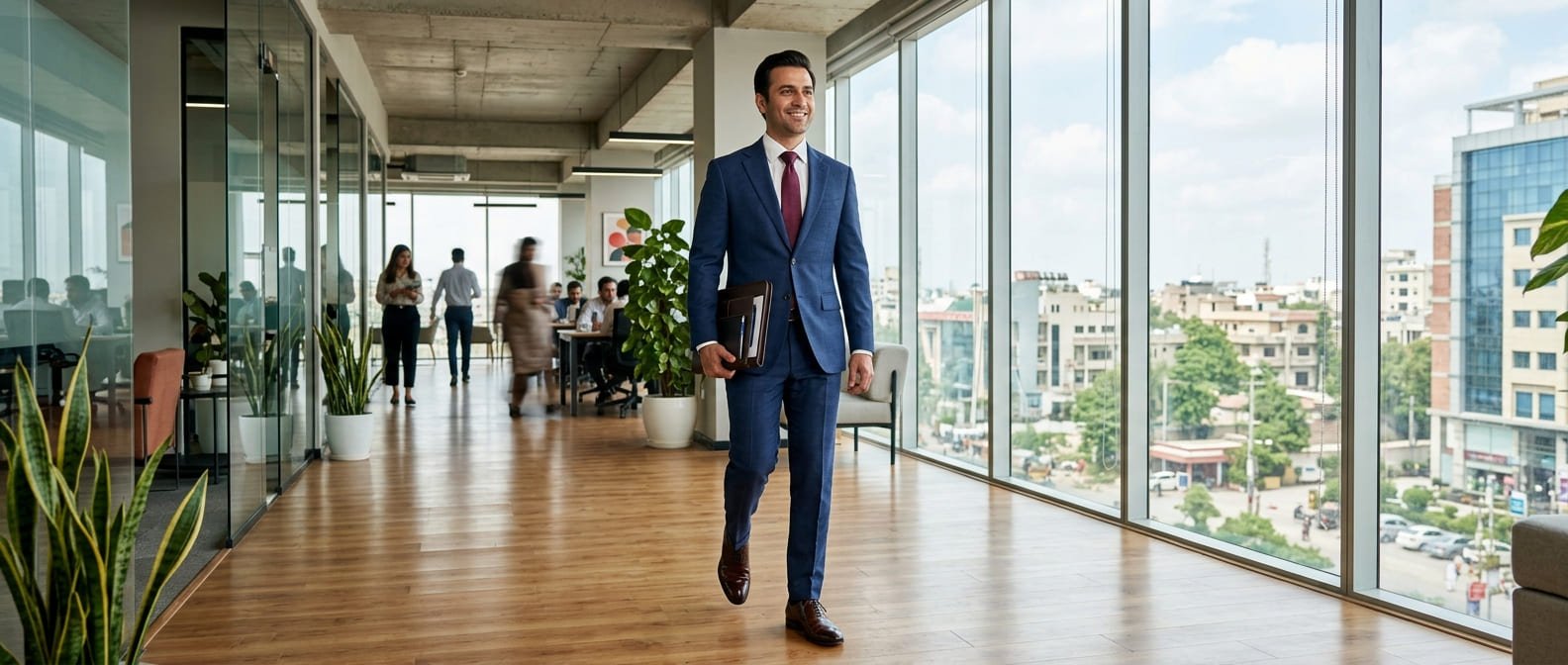
- Technology, media and start-ups, especially in Berlin: casual. Jeans, trainers and a jumper are normal.
- Everywhere: clean, pressed, understated clothes, and punctuality. Avoid loud colours and heavy fragrance.
For a first meeting, dress one level smarter than you expect your hosts to be. Our guides to business attire for men and business casual for men explain both levels.
Everyday dress codes
- Restaurants: neat casual is fine almost everywhere. Fine dining calls for smart casual.
- Opera, theatre and concerts: people dress up. A jacket is appropriate, and a suit is common at premieres.
- Churches: modest clothing, with hats removed.
- Clubs: in Berlin, dark, simple and unshowy clothes are the safest choice. Suits and obvious tourist outfits can be turned away.
- Beer gardens and festivals: casual. Traditional dress is welcome in Bavaria.
- Saunas and spas: German saunas are usually mixed and textile-free. Swimwear isn’t worn inside the sauna, and you sit on a towel.
- Weddings: a suit and tie for men, unless the invitation says otherwise.
German fashion for boys and kids
German parents dress children for play first.
- Weatherproof clothing. Waterproof dungarees, rain jackets and wellies are standard, because nurseries take children outdoors in all weather.
- Layers. Dressing in several layers that can be removed is a habit taught from the start.
- Practical fabrics. Soft, washable cotton, wool and fleece, often organic.
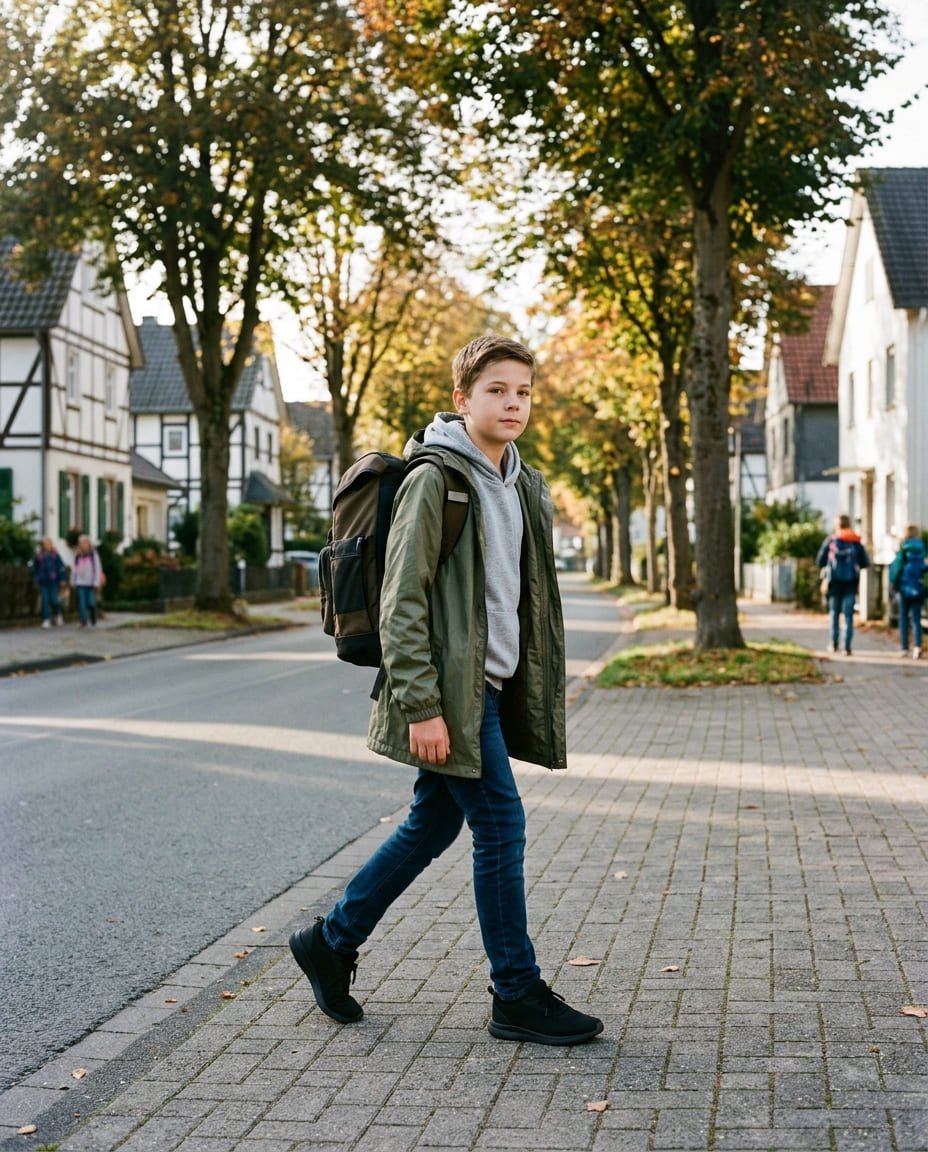
- No school uniforms. German schools have no uniforms, so children wear everyday clothes: jeans, T-shirts, hoodies and trainers.
- The first day of school. Six-year-olds dress up and carry a large decorated paper cone filled with sweets and school supplies, along with a sturdy satchel.
- Traditional dress for children. In Bavaria, boys wear small lederhosen and checked shirts at festivals.
- Yellow rain jacket Jacket
- Navy fleece jumper Layer
- Waterproof dungarees Trousers
- Rubber boots Shoes
See our Kids’ Fashion hub and our guide to clothes for teenage boys.
German fashion trends
What are people wearing in Germany now? Several directions have held steady.
- Technical outerwear in the city: shell jackets, light padded jackets and fleece.
- All black in Berlin, with wide trousers and heavy boots. See all black outfits for men.
- Clean trainers with everything, including tailoring.
- Workwear: chore jackets, overshirts and sturdy trousers.
- Second-hand and vintage, especially among younger people.
- Sustainable and locally made clothing.
- Modern Tracht: updated lederhosen, loden jackets and traditional knitwear worn with everyday clothes in the south.
How to dress like a local: a German capsule
- Waterproof shell or technical jacket
- Wool coat or insulated parka for winter
- Light padded jacket or gilet
- Two plain T-shirts and one long-sleeved top
- Two casual shirts
- Grey or navy crew-neck jumper
- Dark jeans
- Chinos or functional trousers
- Clean leather trainers
- Waterproof leather boots
- A backpack
- Hat, scarf and gloves from November to March
Compare it with your wardrobe using our Wardrobe Planner. For cobbled old towns, see walking shoes for Europe, and for jacket styles, read types of jackets for men.
Mistakes visitors make
| Mistake | Why it stands out | Do this instead |
|---|---|---|
| No rain jacket | Showers arrive in every season | Carry a light waterproof |
| Thin shoes in winter | Cold, wet pavements and Christmas markets | Lined boots with thick soles |
| Planning to shop on Sunday | Almost everything is closed | Shop on Saturday |
| Cheap costume lederhosen | Seen as disrespectful in Bavaria | Proper traditional pieces, or ordinary clothes |
| Overdressing in Berlin | The city is very casual | Dark, simple, relaxed clothes |
| Underdressing for the opera | Evenings out are formal | A jacket and leather shoes |
| Swimwear in the sauna | Against the rules in most German saunas | Follow the local custom and use a towel |
Frequently asked questions
People in Germany wear practical, understated clothes: jeans or plain trousers, T-shirts, shirts and jumpers, a weatherproof jacket and comfortable trainers or leather shoes, mostly in dark or neutral colours.
Germans dress for function and quality. Clothes are neat, comfortable and suited to the weather, with few logos. Dress is casual day to day and formal for business, the opera and weddings.
Traditional German clothing is called Tracht. The best-known examples are lederhosen for men and the dirndl for women, which come from Bavaria and the Alpine south.
The traditional German dress is called a dirndl. It consists of a fitted bodice, a white blouse, a full skirt and an apron.
In Bavaria, men wear lederhosen with braces, a checked or white shirt, knee-length wool socks, sturdy leather shoes, a wool jacket and a felt hat.
No. Lederhosen and dirndls are worn mainly in Bavaria for festivals, weddings and church holidays. Everyday clothing in Germany is modern and casual.
Adidas, Puma and Hugo Boss are the best known. Others include Birkenstock, Jil Sander, Marc O'Polo, s.Oliver, Tom Tailor, Bogner, Jack Wolfskin and Falke.
Karl Lagerfeld and Jil Sander are the most famous. Wolfgang Joop, Tomas Maier, Philipp Plein and Michael Michalsky are also well known.
An insulated coat, a wool jumper, a thermal base layer, a hat, scarf and gloves, and waterproof boots with thick soles.
It depends on the industry. Banking and law expect dark suits and ties, most companies are smart casual, and technology and creative firms are casual. Clothes should always be clean and understated.
Berlin fashion is relaxed, dark and individual. Black clothing, vintage pieces, streetwear and heavy boots are typical, and almost nobody dresses formally.
No. Almost all shops are closed on Sundays and public holidays, except those in large railway stations and airports.
Germany uses European sizes. A jacket size 50 is about a UK and US 40, and a shoe size 43 is about a UK 9 or US 10. Sizes vary between brands.
Fashion is "die Mode", clothing is "die Kleidung", style is "der Stil" and traditional costume is "die Tracht".