

Portuguese fashion is one of Europe’s quiet success stories. Portugal doesn’t have the fashion fame of Italy or France, yet a remarkable share of Europe’s good shoes, shirts, knitwear and jersey is made in its northern towns, and “Made in Portugal” has become a label that people look for. On the street, Portuguese fashion is neat, understated and practical, shaped by Atlantic weather, steep cobbled cities and a culture that values looking presentable without drawing attention. Behind it lies a rich tradition of regional costume, embroidery, wool, cork and gold filigree. This guide explains how people dress in Portugal today, style in Lisbon, Porto and the Algarve, what to wear each month, traditional Portuguese clothing, Portuguese brands and designers, and the practical details of shopping, sizes and dress codes.
Portuguese fashion at a glance
- Neat and understated. Clean, well-kept clothes in dark and neutral colours.
- Smart casual by habit. Shirts, polos, knitwear, jeans or chinos and leather shoes.
- Good shoes. Portugal is one of Europe’s leading shoemaking countries, and people wear proper footwear.
- Built for hills and cobbles. Flat shoes with grip are essential in Lisbon and Porto.
- Layered. The Atlantic keeps evenings cool, even in summer.
- Modest. Dress is a little more conservative than in Spain or Italy, especially away from the coast.
- Relaxed at the beach. Surf culture shapes how younger people dress on the coast.
- Made at home. Portuguese-made clothing, shoes and textiles are a source of pride.
How people dress in Portugal
Everyday clothes
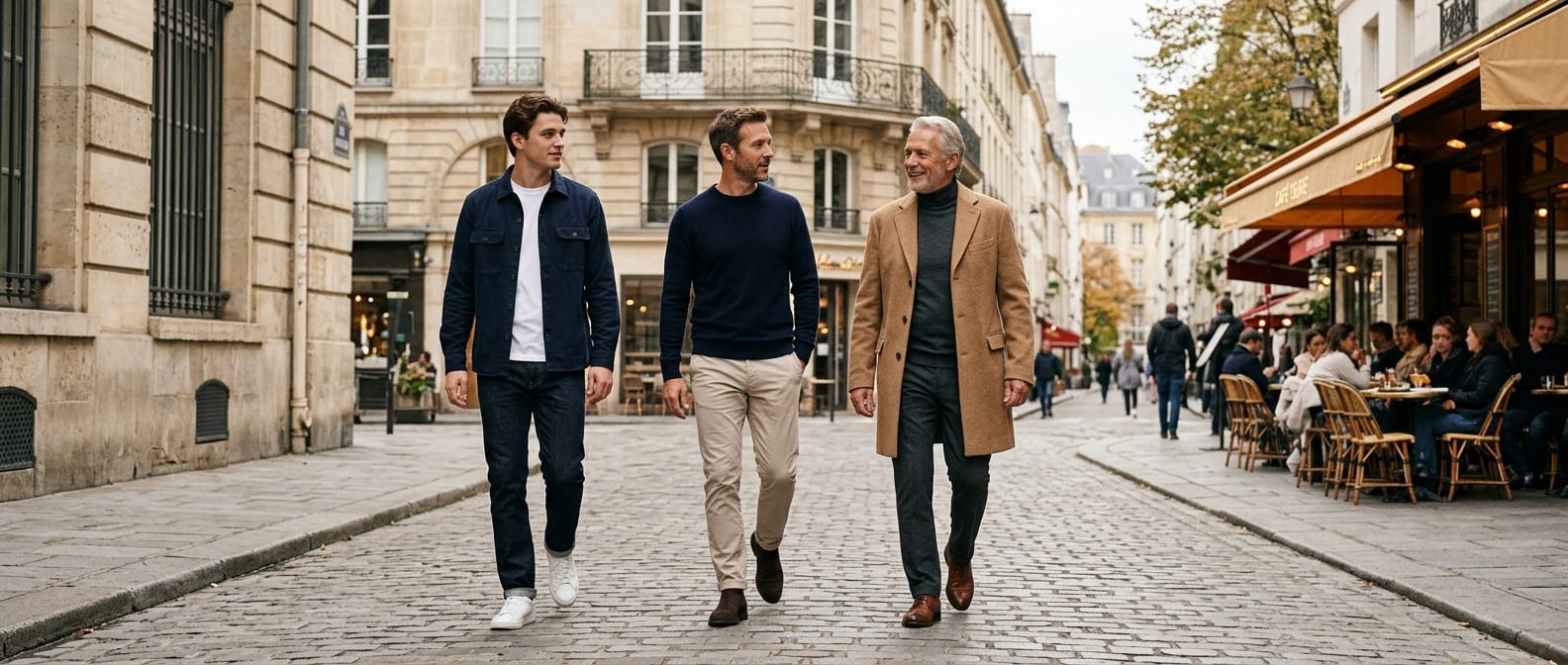
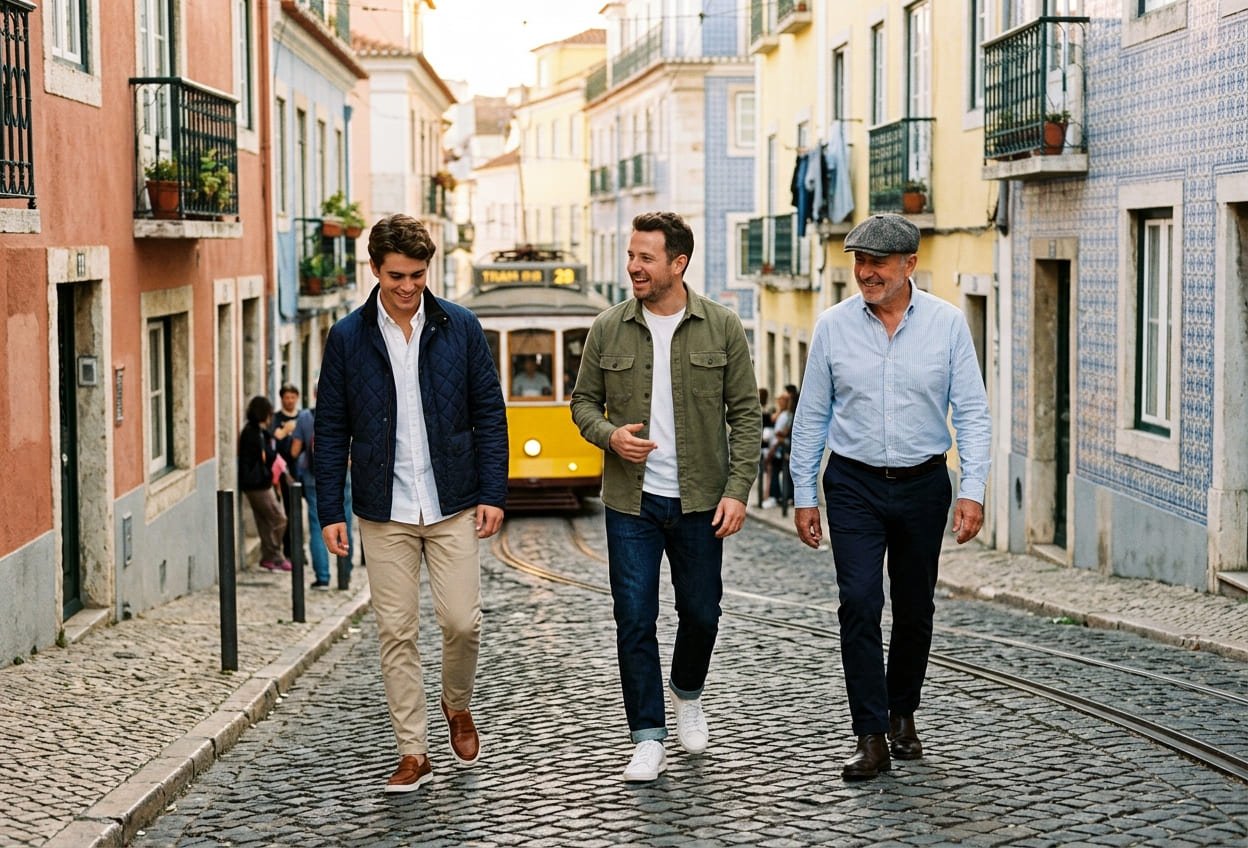
What do people wear in Portugal? In the cities, men wear dark jeans or chinos, a shirt, polo or jumper and leather shoes or clean trainers. Clothes are pressed and tidy. Sportswear is for sport, and beachwear is for the beach.
Understated and well-kept
Portuguese style avoids extremes. Colours are navy, grey, black, brown, olive and white, with little pattern. People care more about clothes being clean, ironed and in good condition than about trends or labels.
Generations
Older Portuguese men often wear a shirt, trousers, a jacket and a flat cap, even to the café. Younger people in Lisbon and Porto dress like their peers across Europe, with trainers, wide jeans and streetwear, but still tend to look put-together.
City, coast and countryside
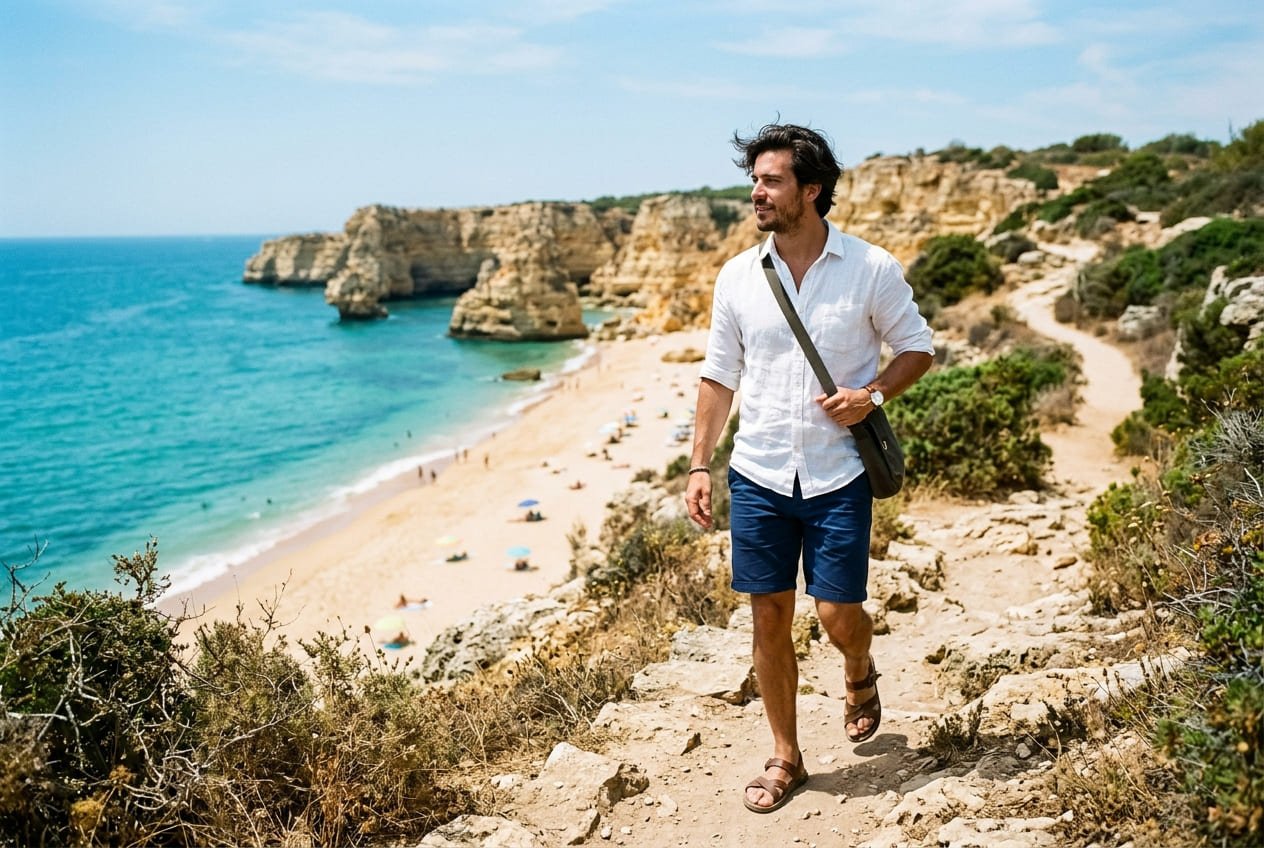
Lisbon and Porto are stylish and urban. The Algarve and the surf towns of the west coast are relaxed, with shorts, hoodies and sandals. In the rural interior and the north, dress is more traditional and conservative.
Dressing for the weather, not the calendar
Like their neighbours in Spain, the Portuguese dress by season. Locals keep their jackets and scarves on in spring sunshine while visitors are already in shorts.
Portuguese men’s style
- Shirts: plain or fine-striped cotton and, famously, soft flannel in the cooler months.
- Polos and knitwear: polo shirts by day, with a fine jumper in the evening.
- Trousers: dark jeans and chinos in navy, beige and olive.
- Jackets: quilted jackets, blazers, light padded jackets and wool coats in winter.
- Shoes: leather loafers, lace-ups, boots and plain trainers.
- Tailoring: navy and grey suits, well cut, for business and occasions.
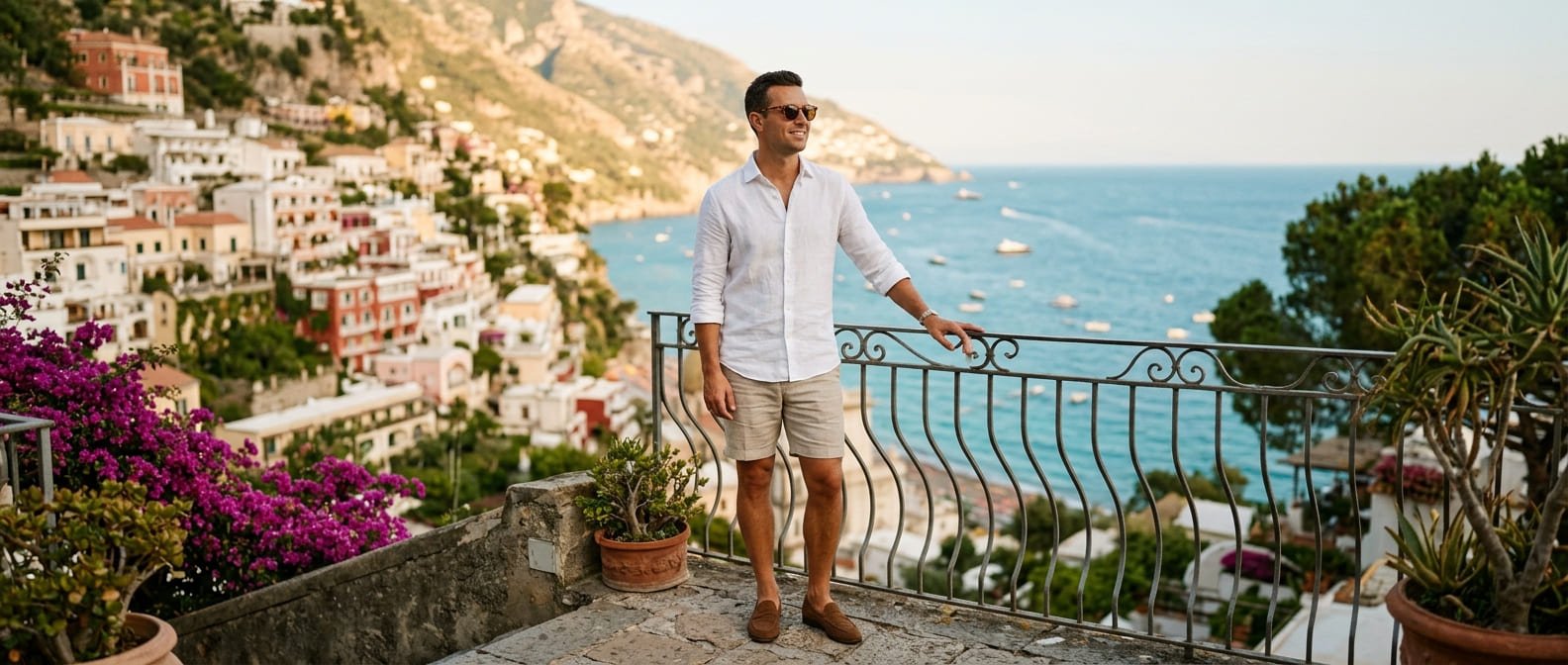
- On the coast: linen shirts, tailored shorts, espadrilles and sandals.
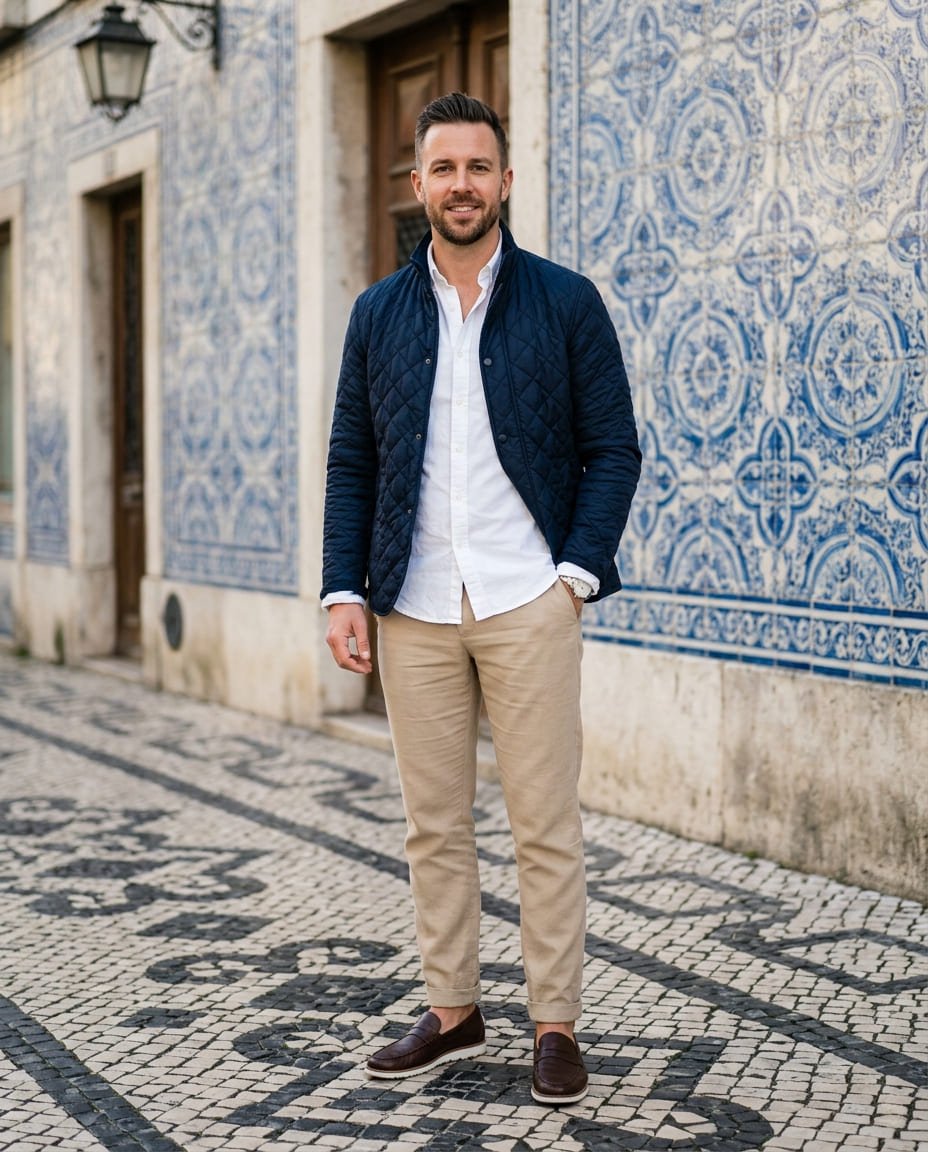
- Navy quilted jacket Jacket
- White cotton shirt Shirt
- Beige chinos Trousers
- Brown leather loafers Shoes
For a comparison with Spain, Italy and France, see our guide to European men’s fashion and the Spanish Fashion page.
Portuguese style by region
Lisbon
The capital is the most fashionable and international city in Portugal. Style is relaxed and creative in Príncipe Real, Chiado and Bairro Alto, with independent designers, concept shops and vintage. The city is built on seven hills and paved with polished limestone, so everyone wears flat, grippy shoes.
Porto
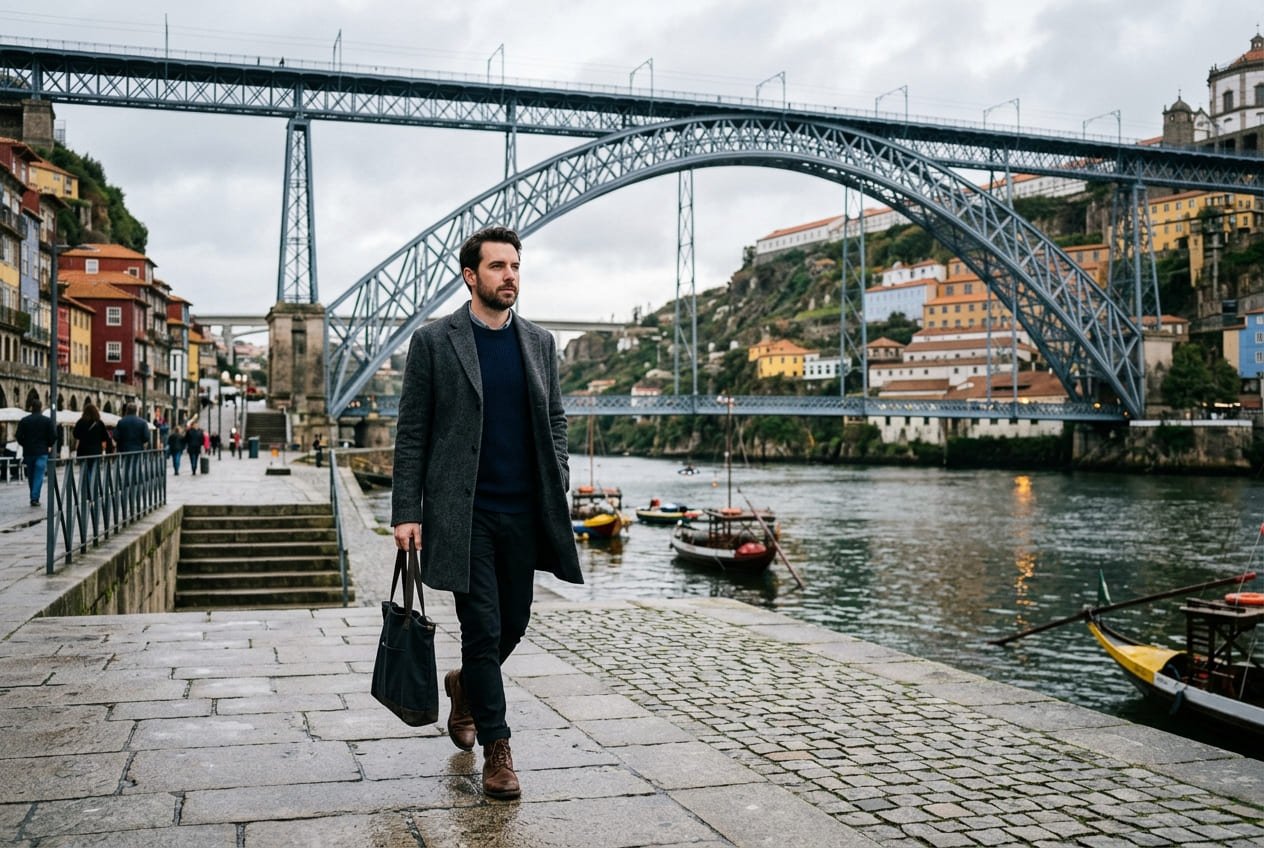
Porto is more traditional and a little more formal, with a cooler, wetter climate. Expect dark coats, knitwear and leather boots in winter. The city sits at the heart of the country’s textile and footwear industry, and it has a strong design scene.
The Algarve
The southern coast is resort country: linen, shorts, swimwear and sandals by day, and smart casual in the evening. It’s the warmest and driest part of mainland Portugal.
Coimbra
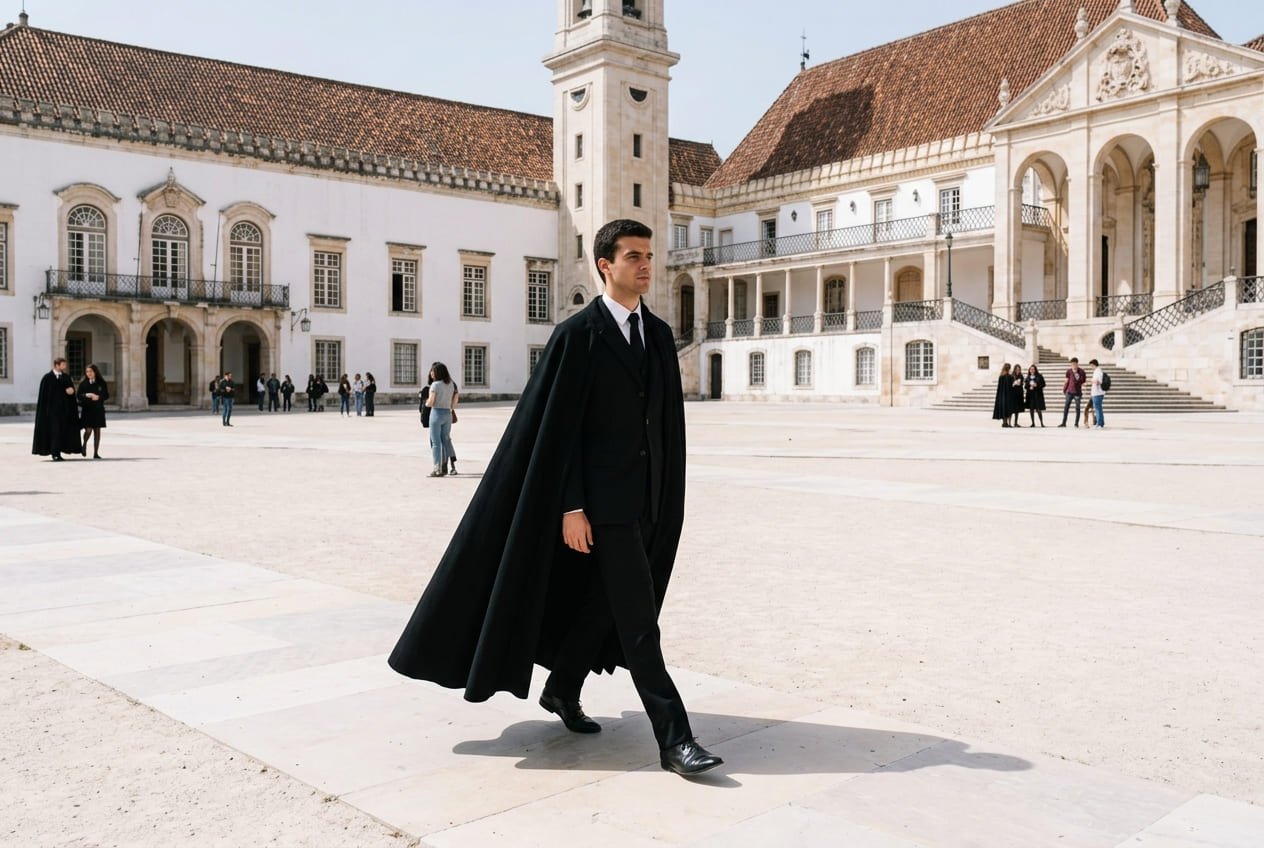
A historic university city, known for the black capes and suits of its students.
Braga, Guimarães and the Minho
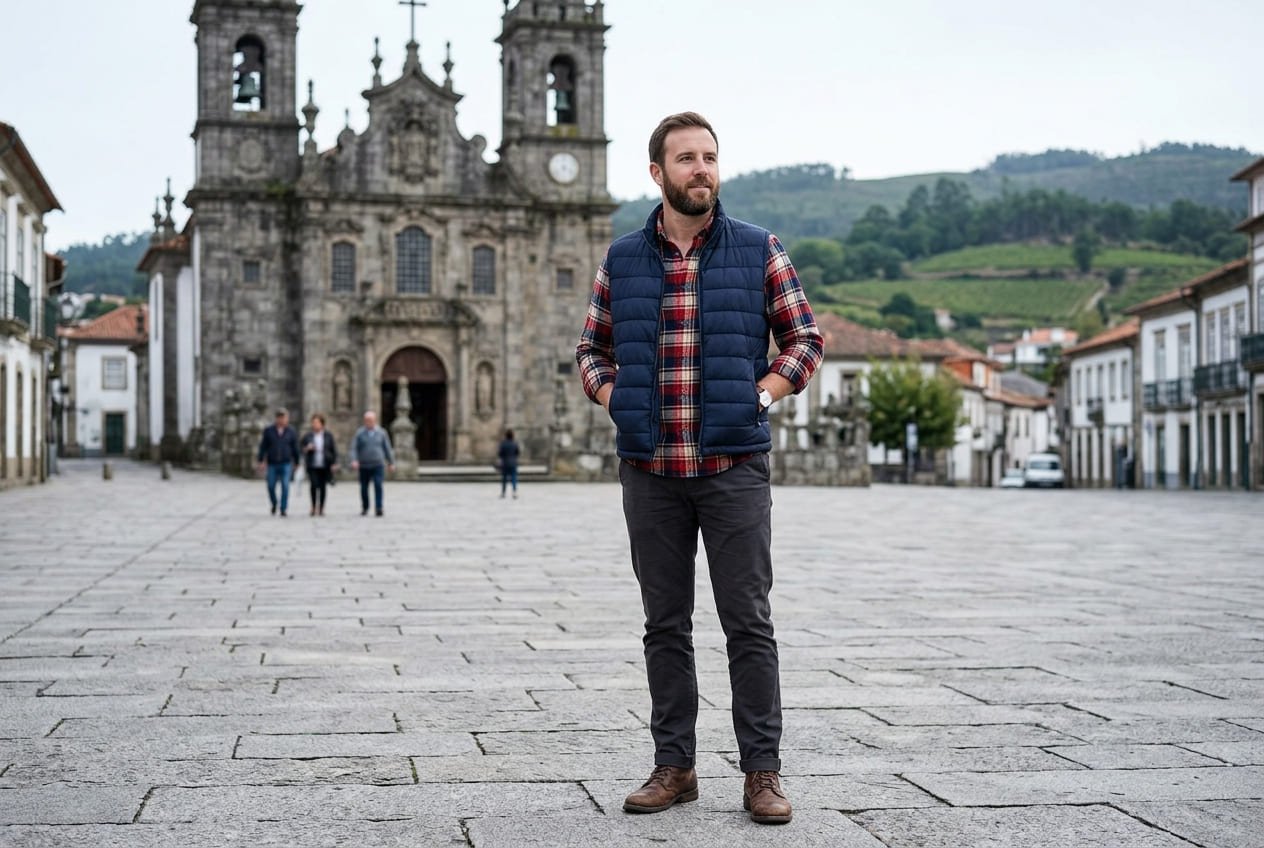
The green north-west is the most traditional region, with colourful folk costume at festivals and a long history of textiles, embroidery and filigree.
Madeira and the Azores
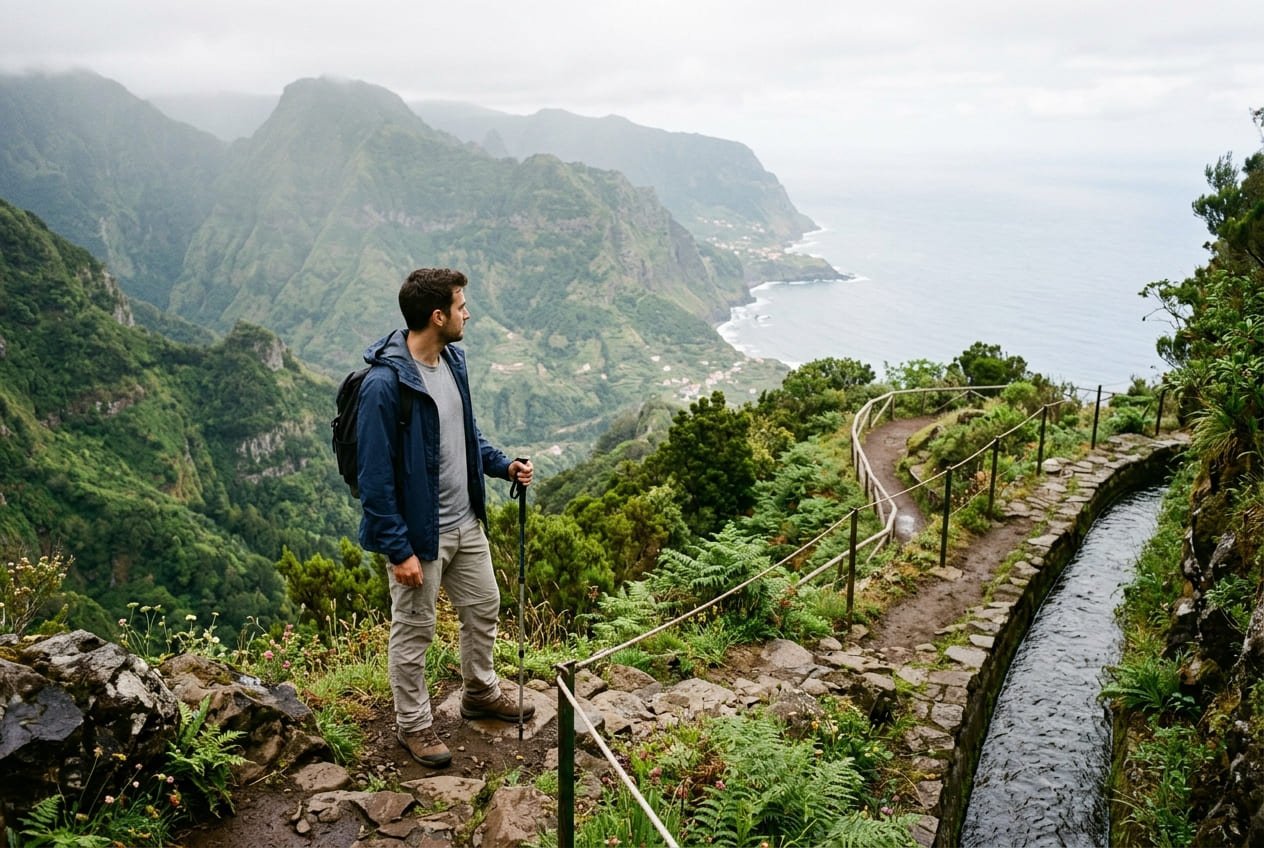
Madeira is mild all year, so light layers are always right. The Azores are greener and more changeable, with outdoor clothing the norm.
What to wear in Portugal, month by month
Portugal is milder than most of Europe, but it isn’t hot all year. The table uses typical daytime highs for Lisbon and Porto. The Algarve is a few degrees warmer and drier, the north is much wetter from October to April, and the interior is hotter in summer and colder in winter.
| Month | Lisbon | Porto | What to wear |
|---|---|---|---|
| January | about 15 °C | about 14 °C | Coat or padded jacket, jumper, scarf and waterproof shoes |
| February | about 16 °C | about 15 °C | As January. Rain is frequent in the north |
| March | about 19 °C | about 17 °C | Light jacket, jumper, long trousers and a rain layer |
| April | about 20 °C | about 18 °C | Layers and a rain jacket. Warm days, cool evenings |
| May | about 23 °C | about 20 °C | Shirts, T-shirts, chinos and a light knit |
| June | about 26 °C | about 23 °C | Summer clothes, with a layer for the evening |
| July | about 28 °C | about 25 °C | Linen and cotton, shorts, a hat and sun cream |
| August | about 29 °C | about 26 °C | As July. The hottest month, and the busiest on the coast |
| September | about 27 °C | about 24 °C | Summer clothes by day, a light jacket at night |
| October | about 23 °C | about 21 °C | Shirts, a light knit and a rain jacket |
| November | about 18 °C | about 17 °C | Jacket, jumper and closed shoes. Rain returns |
| December | about 15 °C | about 14 °C | Coat, knitwear and a scarf |
- Portugal in winter (December, January and February): mild by day and cold indoors. Many Portuguese homes and older hotels have little heating, so pack warm layers and something comfortable for the evening.
- Portugal in March and April: changeable. Bring a rain jacket, a jumper and one or two short-sleeved tops.
- Portugal in May and June: warm and pleasant. Light clothes with a layer for the breeze.
- Portugal in August: hot, especially inland. Wear linen and a hat. The Atlantic stays cool, and beaches can be windy.
- Portugal in November: mild and often wet. Waterproof shoes and a jacket matter most.
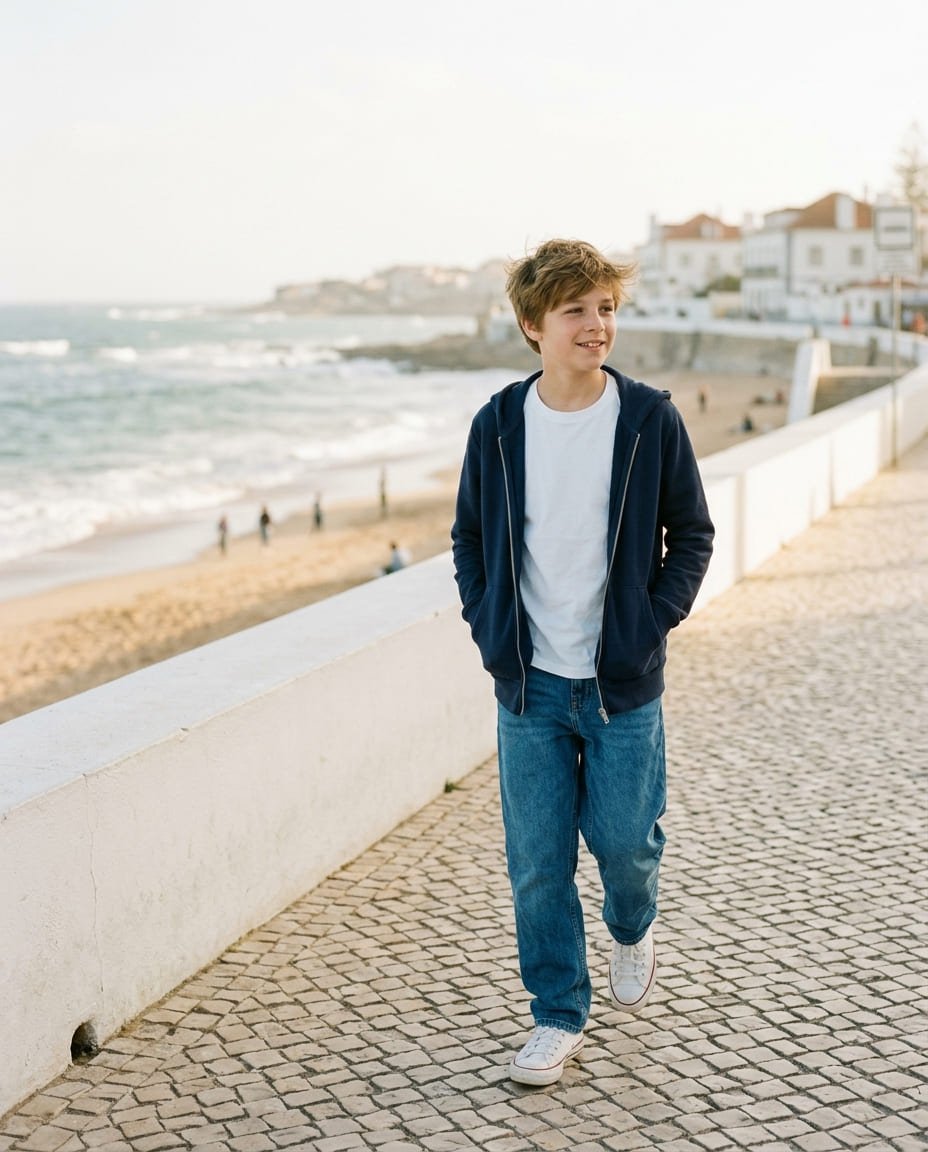
- Olive overshirt Layer
- White T-shirt Top
- Dark jeans Trousers
- Leather trainers with grip Shoes
- Sunglasses Accessory
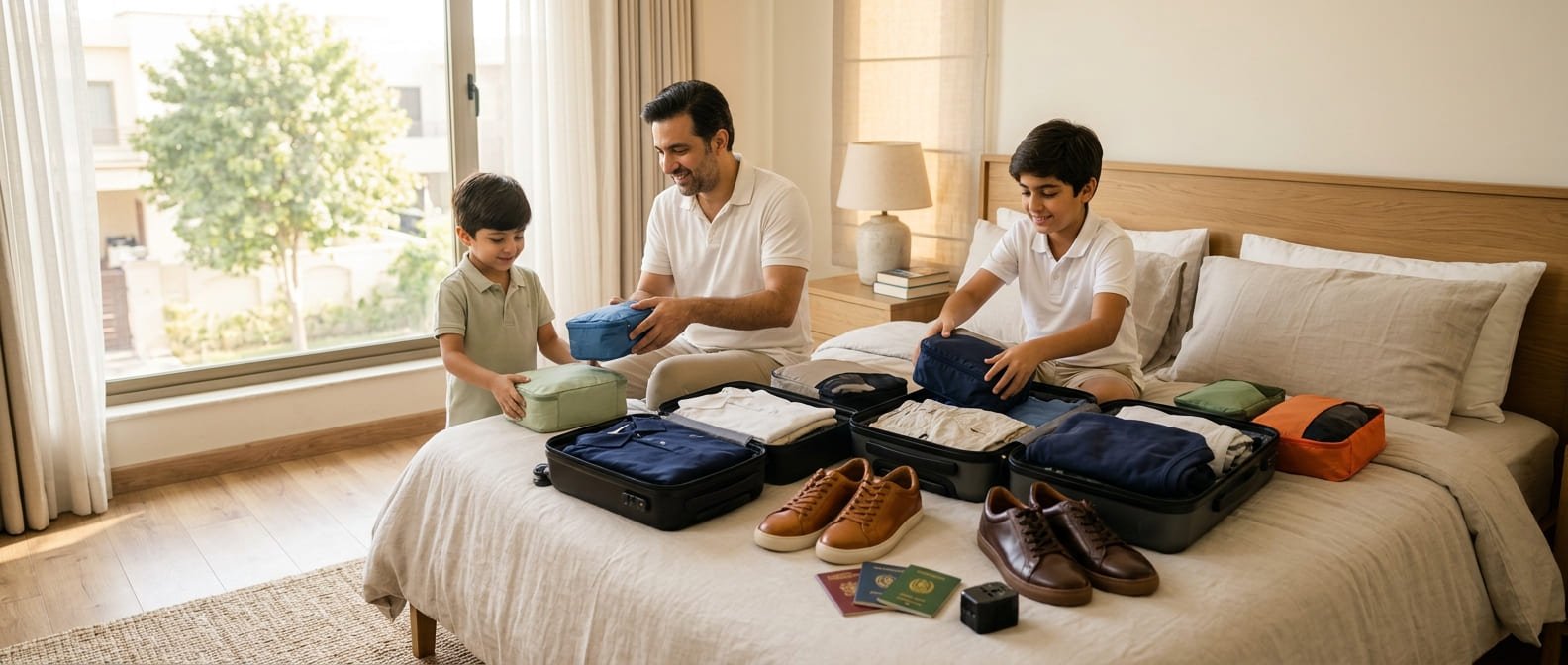
For packing, read what to pack for a Europe trip and walking shoes for Europe. Summer ideas are in European summer outfits for men and our guide to summer shoes for men.
What to wear for Portuguese places and occasions
Beaches and the Algarve
- Swim shorts, a T-shirt or linen shirt and sandals.
- A windproof layer. Atlantic beaches are breezy, and the water is cold.
- Water shoes for rocky coves.
- A cover-up for town. Some resort towns, including Albufeira, can fine people for walking through the streets in swimwear.
- Tailored shorts and a shirt for the evening. See our guide to white shorts for men.
Cobbled cities
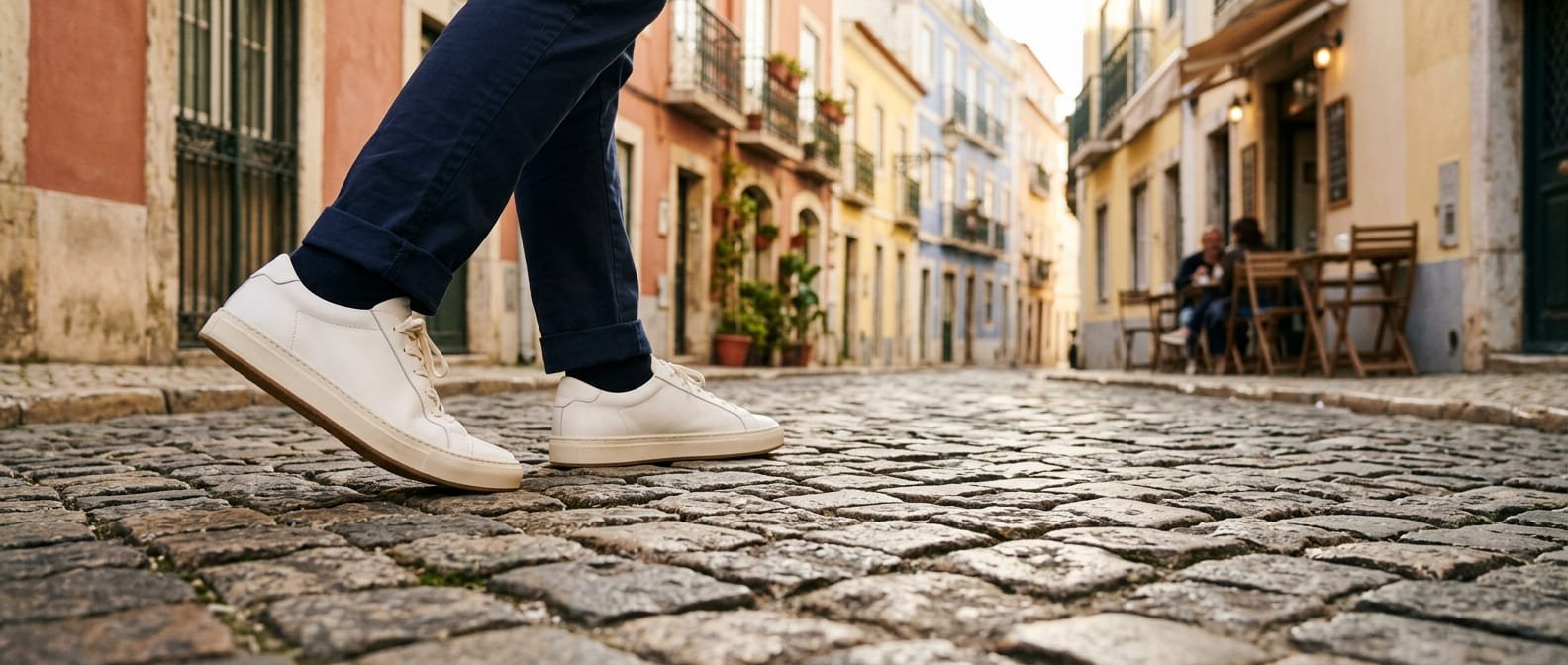
Portuguese pavements are made of small polished stones laid in patterns. They’re beautiful, uneven and slippery when wet. Wear flat shoes with rubber soles, and leave smooth leather soles at home.
The Douro Valley and wine tasting
- Smart casual clothes: a shirt or polo, chinos and comfortable shoes.
- Flat shoes for vineyard terraces and cellar steps.
- A hat and sun cream in summer. The valley is far hotter than the coast.
- A layer for cool cellars and boat trips.
- Dark colours hide wine splashes.
Castles, palaces and monasteries
Wear sturdy shoes for ramparts and steps, and cover shoulders and knees in churches, monasteries and at the shrine of Fátima.
Fado houses and restaurants
Smart casual is right. A shirt, long trousers and leather shoes fit in anywhere.
Festivals
Lisbon celebrates Santo António in mid-June, and Porto celebrates São João on 23 June. Both are crowded street parties, so wear casual clothes and comfortable shoes.
Traditional Portuguese clothing
Traditional Portuguese clothing varies from region to region. There’s no single national costume, but several are famous, and they’re still worn at festivals, pilgrimages and folk dances.
| Region | Traditional dress | Notes |
|---|---|---|
| Minho (Viana do Castelo) | Embroidered red, blue or green skirts, an apron, a fringed scarf and layers of gold filigree jewellery | The best-known Portuguese costume |
| Nazaré | Fishermen in checked shirts, wide trousers and a black stocking cap. Women in seven layered skirts | Still seen on the seafront |
| Ribatejo | The campino horseman: green stocking cap, red waistcoat, white shirt, blue breeches and white stockings | Worn at bull-running and horse fairs |
| Alentejo | Sheepskin-collared jackets, long capes, dark trousers and a flat black hat | Shepherds’ and farmers’ dress |
| Miranda do Douro | Stick dancers in white skirts, embroidered waistcoats and flowered hats. Richly decorated brown wool capes | From the remote north-east |
| Madeira | A small pointed cap, striped wool skirts, red waistcoats and soft leather boots | Worn by flower sellers and folk groups |
| Azores | A long dark cape with a large stiff hood | Once everyday dress for women |
| Coimbra | The students’ black suit and long black cape | Still worn at university ceremonies |
Traditional Portuguese clothing for men
- A white linen shirt with full sleeves.
- A waistcoat, often red, black or embroidered.
- Dark trousers or breeches, held with a wide sash, usually red or black.
- A stocking cap in black, green or red, or a flat black hat.
- Wool capes and sheepskin in the mountains and the south.
- Sturdy leather boots or clogs.
Fado dress
Fado, Portugal’s music of longing, has its own dress. Women singers traditionally wear black with a fringed shawl over the shoulders. Men wear a dark suit.
Portuguese crafts worn today
- Flannel: soft brushed cotton shirting, woven in the north.
- Fishermen’s sweaters: white wool jumpers from Póvoa de Varzim, embroidered in black and red with anchors, crowns and family marks.
- Burel: dense, water-resistant wool cloth from the Serra da Estrela mountains.
- Filigree: fine gold and silver wirework. The Heart of Viana is its best-known motif.
- Cork: Portugal is the world’s largest cork producer, and cork is made into bags, shoes, hats and wallets.
- Embroidery: from Viana do Castelo, Madeira and Castelo Branco, plus the embroidered “lovers’ handkerchiefs” of the Minho.
- Azulejo patterns: the blue and white of Portuguese tiles appears on scarves, shirts and swimwear.
- The Barcelos rooster: a colourful national symbol found on textiles and souvenirs.
The Portuguese fashion industry and “Made in Portugal”
- Where it is. Textiles and clothing are concentrated in the north, around Porto, Braga, Guimarães and the Ave valley. Footwear centres on São João da Madeira and Felgueiras.
- What it makes. Shoes, jersey, knitwear, shirting, flannel, denim and home textiles.
- Who it makes for. Portuguese factories produce for many international fashion and luxury labels, as well as for local brands.
- Why it’s valued. Skilled work, small production runs, European labour standards and short transport distances.
- Sustainability. The industry has invested in recycled fibres, organic cotton and cleaner dyeing.
- Fashion weeks. Lisbon and Porto each host a fashion week.
A “Made in Portugal” label on shoes, knitwear, shirts or towels is a reliable sign of quality.
Portuguese brands and designers
This section lists well-known Portuguese clothing brands and designers for reference. StyleGauge is independent: the names are not ranked, recommended or linked, and we earn nothing from any of them.
Portuguese clothing brands
| Brand | Known for |
|---|---|
| Salsa | Jeans and denim |
| Sacoor Brothers | Classic menswear and tailoring |
| Tiffosi | Affordable denim and casual wear |
| Decenio and Quebramar | Smart casual and nautical-inspired clothing |
| La Paz | Porto menswear inspired by the Atlantic and fishermen’s clothing |
| ISTO. | Lisbon-made basics with transparent pricing |
| Portuguese Flannel | Flannel and casual shirts from Guimarães |
| +351 | Relaxed, surf-influenced basics from Lisbon |
| Parfois | Bags, jewellery and accessories |
| Lanidor | Womenswear |
Portuguese shoe brands
- Carlos Santos: traditional men’s leather shoes from São João da Madeira.
- Fly London: chunky, colourful shoes and boots made in northern Portugal.
- Sanjo: canvas trainers first made in 1933.
- Lemon Jelly: moulded boots and shoes in bright colours.
- Luís Onofre: luxury women’s shoes.
Famous Portuguese fashion designers
| Designer | Known for |
|---|---|
| Ana Salazar | The pioneer of modern Portuguese fashion |
| Fátima Lopes | Bold, glamorous design |
| Nuno Gama | Menswear rooted in Portuguese heritage |
| Miguel Vieira | Elegant tailoring in a restrained palette |
| Luís Buchinho | Graphic knitwear and womenswear |
| Alexandra Moura | Conceptual, street-influenced collections |
| Marques’Almeida | Marta Marques and Paulo Almeida. Known for frayed denim |
| Felipe Oliveira Baptista | Azores-born designer who has led major French fashion houses |
Portuguese children’s brands
- Zippy: affordable everyday clothes for babies and children.
- Piupiuchick and Play Up: soft, simple children’s clothing made in Portugal.
- Wedoble and Laranjinha: baby knitwear and classic children’s clothes.
The Portugal jersey and football style
Searches for the Portugal jersey are among the most common about Portuguese clothing. The national team’s home shirt is red with green, the colours of the flag. Away and special shirts have appeared in white, black and other colours over the years. A new design is released for each major tournament, including the World Cup.
A football shirt has also become an everyday fashion item.
- Wear it with jeans or tailored trousers and plain trainers.
- Layer it over a long-sleeved T-shirt or under an open overshirt or jacket.
- Choose a vintage or retro shirt for a more relaxed look.
- Keep the rest of the outfit plain.
See our guide to Gen Z fashion for how sports shirts are worn off the pitch.
Shopping for clothes in Portugal
Where to shop
- Lisbon: Chiado and the Baixa for high-street and Portuguese brands, Avenida da Liberdade for luxury, Príncipe Real for concept shops and designers, and the Feira da Ladra flea market on Tuesdays and Saturdays for antiques and vintage.
- Porto: Rua de Santa Catarina for the high street, and the streets around Rua de Cedofeita and Rua Miguel Bombarda for independent shops and galleries.
- Across the country: large shopping centres, open late every day.
- What to buy: leather shoes, flannel shirts, knitwear, cork goods, filigree jewellery, wool blankets and towels.
Opening hours
Street shops usually open from about 10 am to 7 pm, and some smaller ones close for lunch and on Sundays. Shopping centres open every day, often until 10 pm or later.
Sales and tax-free shopping
The main sales (saldos) run in January and February and again in July and August. Visitors who live outside the European Union can usually reclaim VAT on larger purchases. Ask in the shop, and check the current rules.
Sizes
Portugal uses European sizes. These conversions are approximate.
| Item | Portugal and EU | UK | US |
|---|---|---|---|
| Jackets and suits | 48 | 38 | 38 |
| Jackets and suits | 50 | 40 | 40 |
| Jackets and suits | 52 | 42 | 42 |
| Shirts (collar) | 39 cm | 15.5 in | 15.5 in |
| Shirts (collar) | 41 cm | 16 in | 16 in |
| Shoes | 42 | 8 | 9 |
| Shoes | 43 | 9 | 10 |
| Shoes | 44 | 9.5 | 10.5 |
Clothing words in Portuguese
Fashion in Portuguese is “moda”, and clothes are “roupa”.
| English | Portuguese |
|---|---|
| Shirt | A camisa |
| T-shirt | A T-shirt |
| Jumper or sweater | A camisola |
| Jacket or coat | O casaco |
| Suit | O fato |
| Trousers | As calças |
| Jeans | As calças de ganga |
| Shorts | Os calções |
| Dress | O vestido |
| Skirt | A saia |
| Shoes | Os sapatos |
| Trainers | Os ténis |
| Boots | As botas |
| Sandals | As sandálias |
| Swimsuit | O fato de banho |
| Hat | O chapéu |
| Scarf | O cachecol |
| Belt | O cinto |
| Socks | As meias |
| Size | O tamanho |
| Fitting room | O provador |
| Sales | Os saldos |
| Cork | A cortiça |
| Traditional costume | O traje tradicional |
These are European Portuguese words. Several differ in Brazil.
Dress codes in Portugal
- Churches and shrines: cover shoulders and knees.
- Beach towns: wear swimwear on the beach only, and put on a shirt and shorts for town.
- Restaurants: casual or smart casual. A collared shirt and long trousers suit the evening.
- Offices: fairly conservative. Suits and ties are still common in banking, law and government, and business casual elsewhere. See business casual for men.
- Weddings: formal. A dark suit and tie for men.
- Casinos and smart hotels: long trousers and closed shoes.
- Golf clubs: a collared shirt and tailored shorts or trousers.
- Theatres and concert halls: smart casual.
Our guide to smart casual for men explains the level that suits most evenings.
Portuguese fashion for boys and kids
- Classic children’s clothing. Portugal shares the Iberian tradition of dressing young children smartly: collared shirts, knitwear, tailored shorts and leather shoes for Sundays and family events.
- Quality knitwear and cotton. Much of Europe’s children’s clothing is made in northern Portugal.
- School. State schools have no uniform. Many private schools do.
- Beach life. Children spend long summers at the beach in swimwear, sun hats and UV tops.
- Occasions. First Communion and weddings call for a suit or a shirt and smart trousers.
- For visitors: light cotton, a sun hat, a fleece for windy beaches and shoes with grip.
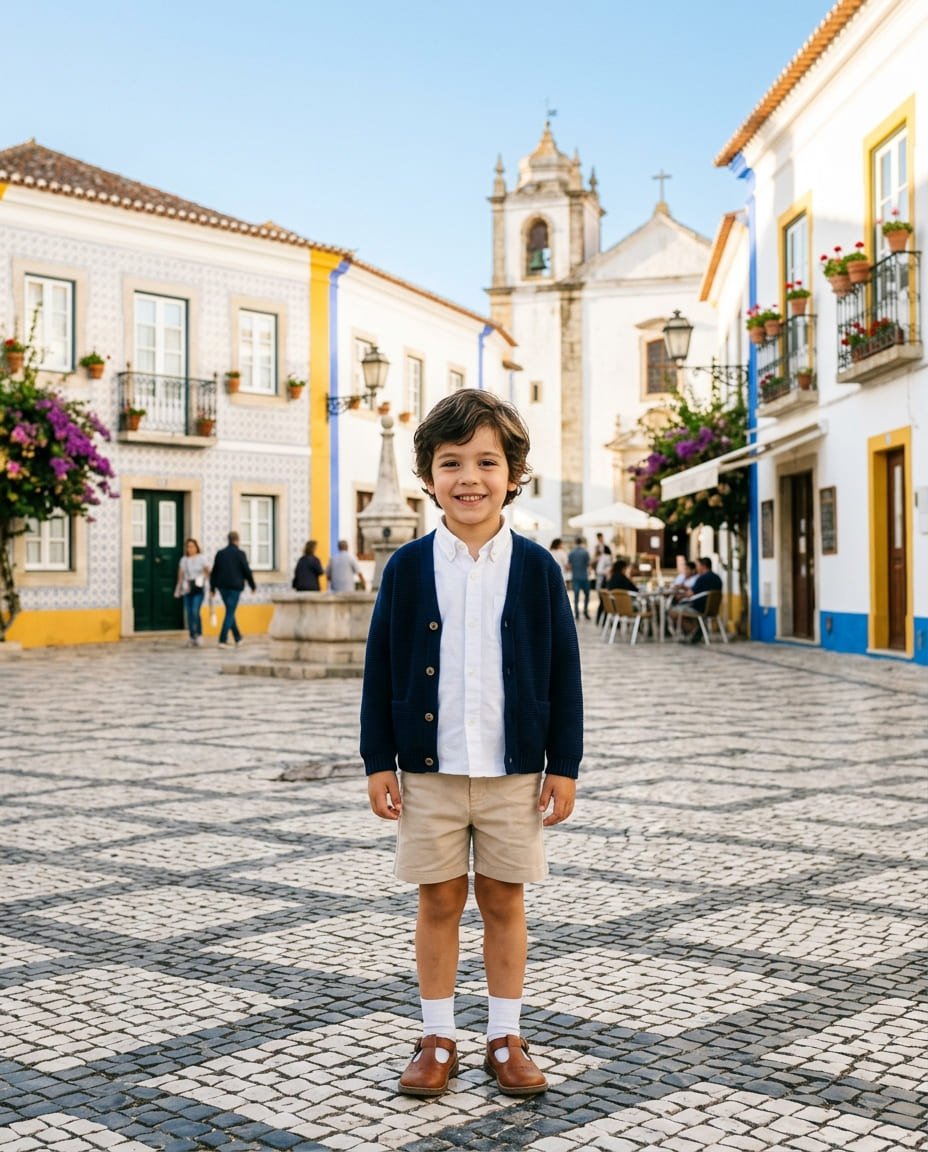
- White collared shirt Shirt
- Navy knitted cardigan Knit
- Beige tailored shorts Shorts
- Brown leather shoes Shoes
See our Kids’ Fashion hub and our guide to clothes for teenage boys.
Portuguese fashion trends
- Made in Portugal basics: well-made T-shirts, sweatshirts and shirts from local labels.
- Flannel and overshirts.
- Surf and skate style on the coast: relaxed shorts, hoodies and canvas shoes.
- Linen in summer, often as matching sets.
- Heritage crafts reworked: burel wool, cork and fishermen’s knitwear.
- Clean leather trainers and loafers.
- Sustainable fashion and small local production.
For the wider picture, see men’s fashion trends 2026.
How to dress like a local: a Portuguese capsule
- Navy quilted jacket or light padded jacket
- Unstructured blazer
- Two cotton shirts, in white and light blue
- Flannel shirt for cooler months
- Polo shirt
- Fine crew-neck jumper
- Dark jeans
- Beige and navy chinos
- Tailored shorts for the coast
- Leather loafers or lace-ups with rubber soles
- Plain leather trainers with grip
- Rain jacket for the north and for winter
Check your wardrobe against the list with our Wardrobe Planner.
Mistakes visitors make
| Mistake | Why it stands out | Do this instead |
|---|---|---|
| Smooth-soled shoes | Polished cobbles are slippery | Rubber soles with grip |
| Packing only for heat | Evenings are cool, and winters are damp | Bring a jumper and a jacket |
| Swimwear in town | Seen as disrespectful, and fined in some resorts | A shirt and shorts |
| Expecting a warm Atlantic | The sea is cold, and beaches are windy | A windproof layer |
| No rain jacket in the north | Porto is wet from autumn to spring | A light waterproof |
| Thin clothes in winter | Buildings are often unheated | Warm indoor layers |
| Shorts in churches | Entry may be refused | Covered knees and shoulders |
Frequently asked questions
Portuguese fashion is neat, understated and practical. People wear clean, well-kept smart casual clothes in dark and neutral colours, with good leather shoes.
Dark jeans or chinos, shirts, polos or jumpers and leather shoes or plain trainers in the cities. On the coast, people wear linen, shorts and sandals.
It varies by region. The best known is the embroidered costume of Viana do Castelo in the Minho, worn with gold filigree. Others include the dress of Nazaré's fishermen and the Ribatejo horseman.
A white linen shirt, a waistcoat, dark trousers or breeches with a wide sash and a stocking cap or flat black hat, with wool capes or sheepskin in colder regions.
Smart casual clothes, layers for the breeze and flat shoes with rubber soles for the hills and polished cobbles.
Linen and cotton shirts, light trousers or shorts, a hat and sunglasses, plus a light layer for cool, windy evenings on the coast.
A coat or padded jacket, a jumper, a scarf and waterproof shoes. It's mild outdoors, but many buildings have little heating.
There is no general dress code. Churches expect covered shoulders and knees, resort towns expect you to cover swimwear away from the beach, and restaurants expect neat clothes in the evening.
Salsa, Sacoor Brothers, Tiffosi, Parfois, La Paz, ISTO., Portuguese Flannel and the shoe brands Carlos Santos and Fly London are among the best known.
Yes. Portugal is known for well-made shoes, knitwear, shirts, jersey and home textiles, and its factories produce for many international labels.
The national football team's home shirt is red with green, the colours of the flag. Away shirts have appeared in white, black and other colours.
Flat shoes with rubber soles and good grip. Leather trainers, loafers with rubber soles and sandals with a back strap all work.
Smart casual clothes, flat comfortable shoes, a hat and sun cream in summer and a light layer for cool cellars and boat trips.
Clothes are "roupa", fashion is "moda", a shirt is "camisa" and shoes are "sapatos".