

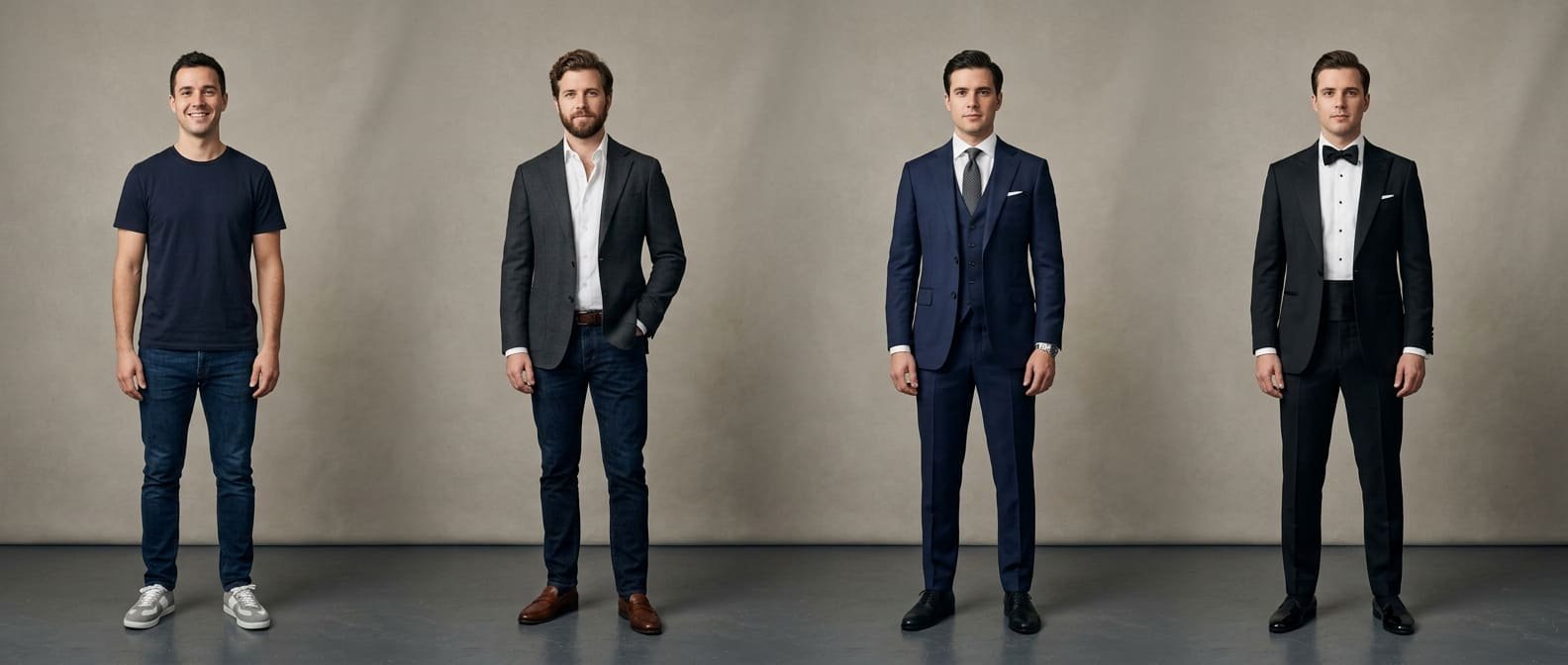
Dress codes are meant to help, yet few things cause more confusion than a line on an invitation reading “smart casual” or “black tie optional”. This guide has dress codes explained in plain terms, from casual at one end to white tie at the other. For each of the seven main dress codes for men, it sets out what the code means, what to wear, where you’ll meet it and the mistake people make most often. It also covers the in-between codes (cocktail, festive, lounge suit, business formal), the terms used on invitations in France, Italy, Germany, Spain and Scandinavia, what the codes mean for boys and children, and what to do when no dress code is given at all.
Dress codes explained: the quick answer
| Dress code | In one line | Jacket | Tie |
|---|---|---|---|
| Casual | Neat everyday clothes | No | No |
| Smart casual | Casual pieces, upgraded | Optional | No |
| Business casual | Office wear without a suit | Usually | Optional |
| Business formal (lounge suit) | A dark suit | Yes | Yes |
| Cocktail (semi-formal) | A suit with some flair | Yes | Optional |
| Black tie | Dinner suit and black bow tie | Dinner jacket | Black bow tie |
| White tie | Tailcoat and white bow tie | Tailcoat | White bow tie |
When in doubt, dress one step smarter than you think is needed. It’s easier to remove a tie than to find one.
The formality scale
Dress codes form a ladder. Each step up adds structure: a collar, then a jacket, then a matching suit, then a tie, then evening dress.
- Casual
- Smart casual
- Business casual
- Business formal
- Cocktail
- Black tie
- White tie
Several things signal formality: darker colours, smoother fabrics, leather shoes, sharper tailoring and less pattern.
1. Casual
- What it means: relaxed clothes that are clean, fit well and suit the setting. It doesn’t mean gym wear.
- Wear: jeans or chinos, a T-shirt, polo or casual shirt, a jumper or casual jacket, and trainers or boots.
- Where: weekends, informal gatherings, most travel.
- Common mistake: torn, faded or sports clothes at an event where others have made an effort.
2. Smart casual
- What it means: casual clothes with at least one smart element.
- Wear: dark jeans or chinos, a shirt, polo or fine knit, a blazer or neat jacket, and leather shoes, loafers or clean leather trainers.
- Where: restaurants, dates, relaxed offices, parties.
- Common mistake: treating it as casual. Leave the hoodie and running shoes at home.
Full guide: smart casual for men. One step up: dressy casual for men.
3. Business casual
- What it means: professional, without a full suit.
- Wear: tailored trousers or chinos, a collared shirt, a blazer or fine knitwear, and leather shoes. A tie is optional.
- Where: most offices, client meetings in relaxed sectors, conferences.
- Common mistake: jeans and trainers in an office that hasn’t said they’re acceptable.
Full guide: business casual for men.
4. Business formal, or lounge suit
- What it means: a matching suit and tie. On British invitations, “lounge suit” means the same thing.
- Wear: a navy or charcoal suit, a white or light-blue shirt, a silk tie and black or dark brown Oxford shoes.
- Where: law, finance, interviews, formal meetings, daytime weddings and funerals.
- Common mistake: a poor fit. See how should a suit jacket fit.
Full guide: business attire for men.
5. Cocktail, or semi-formal
- What it means: a suit, worn with more personality than at work.
- Wear: a dark suit, a shirt, an optional tie and polished shoes. Velvet jackets, richer colours and pocket squares are welcome.
- Where: evening receptions, parties, many weddings.
- Common mistake: arriving in office clothes with no change at all.
“Semi-formal” on an invitation means a suit or a jacket with tailored trousers. “Festive” means cocktail with a seasonal touch. See work Christmas party outfits for men.
6. Black tie
- What it means: formal evening dress. In Britain it’s a dinner suit, and in America a tuxedo.
- Wear: a black or midnight-blue dinner jacket with silk-faced lapels, matching trousers with a silk stripe, a white dress shirt, a black silk bow tie, and black patent or highly polished Oxford shoes.
- Where: galas, balls, formal dinners, some weddings and opera first nights.
- Common mistake: a black business suit with a long black tie. It isn’t the same thing.
- Black tie optional: a dinner suit is preferred, and a dark suit with a tie is acceptable.
7. White tie
- What it means: the most formal dress code, now rare.
- Wear: a black evening tailcoat, matching trousers with two silk stripes, a white wing-collar shirt, a white waistcoat, a white bow tie and black patent shoes.
- Where: state banquets, a few balls and ceremonies, such as the Nobel banquet in Stockholm.
- Common mistake: improvising. Hire the complete outfit.
Morning dress
A daytime equivalent of formal dress, worn at some weddings and at race meetings in Britain: a morning coat with tails, striped or grey trousers, a waistcoat and a tie.
Dress codes by occasion
| Occasion | Usual dress code |
|---|---|
| Job interview | Business formal, or business casual for relaxed sectors |
| Office, most sectors | Business casual |
| Daytime wedding | Business formal or cocktail, as stated |
| Evening wedding | Cocktail or black tie, as stated |
| Funeral | A dark suit and dark tie |
| Restaurant | Smart casual |
| Theatre and opera | Smart casual to cocktail |
| Graduation | Business formal under the gown |
| Work Christmas party | Smart casual to cocktail |
| Religious ceremony | A suit, or smart casual with a jacket |
See graduation outfit ideas and date night outfits for men.
Dress codes on European invitations
The codes are similar across Europe, but the words change.
| Country | Term | Meaning |
|---|---|---|
| France | Tenue de ville | Business or lounge suit |
| France | Tenue de soirée | Evening dress: dinner suit or dark suit |
| France | Tenue correcte exigée | Smart dress required |
| Italy | Abito scuro | Dark suit |
| Italy | Cravatta nera | Black tie |
| Germany | Dunkler Anzug | Dark suit |
| Germany | Smoking | Black tie |
| Spain | Traje oscuro | Dark suit |
| Spain | Etiqueta | Formal evening dress |
| Sweden | Kavaj | Lounge suit, tie optional |
| Sweden | Mörk kostym | Dark suit and tie |
| Sweden | Frack or högtidsdräkt | White tie. Folk costume is also accepted |
| Denmark | Mørk påklædning | Dark suit |
| Denmark | Galla | White tie |
Across most of the continent, “smoking” means a dinner suit, not a smoking jacket. For local customs, see our guides to French, Italian, German, Swedish and Danish fashion.
How formality differs around Europe
- Italy and Spain: people dress up for the evening as a matter of habit.
- France: understated, with a jacket for most occasions.
- Britain: the widest range, from morning dress to very casual.
- Germany and the Netherlands: practical and fairly relaxed, with suits kept for formal business.
- Scandinavia: casual day to day, and precise when an invitation states a code.
Dress codes for boys and children
Children follow the adult code in a simpler, more comfortable form.
| Adult code | Boys and children |
|---|---|
| Casual | Clean everyday clothes |
| Smart casual | Chinos or dark jeans, a polo or shirt, clean shoes |
| Business formal or cocktail | A blazer or suit, shirt and smart shoes. A tie if he’ll tolerate it |
| Black tie | A dark suit with a bow tie |
| White tie | Children rarely attend. A dark suit is acceptable |
See our boys’ suits guide and clothes for teenage boys.
What to do when no dress code is given
- Look at the venue. A hotel, a formal restaurant or a place of worship means a jacket.
- Check the time. Evening events are smarter than daytime ones.
- Read the invitation. Heavy card and formal wording suggest formal dress.
- Ask the host, or someone who went last year.
- Choose the middle: a blazer, shirt, tailored trousers and leather shoes suit almost anything.
Details that change the level
- A tie raises any outfit one step.
- A pocket square adds polish without formality.
- Shoes set the ceiling: trainers cap an outfit at smart casual.
- A belt that matches your shoes matters from business casual upwards. See how to match belt and shoes.
- Dark, plain fabrics read as more formal than light or patterned ones.
For personal style within the codes, see styles of dressing.
Frequently asked questions
From least to most formal: casual, smart casual, business casual, business formal, cocktail, black tie and white tie.
Smart casual is for social occasions and allows dark jeans and clean trainers. Business casual is for work and expects tailored trousers, a collared shirt and leather shoes.
A dark suit with a shirt and polished shoes. A tie is optional, and richer colours or a velvet jacket are welcome.
Black tie is a dinner suit with a black bow tie. White tie is more formal: a tailcoat, white waistcoat and white bow tie.
A dinner suit is preferred, but a dark suit with a tie is acceptable.
A matching business suit with a shirt and tie. It's the British term for business formal.
A blazer, a shirt, tailored trousers and leather shoes. It's smart enough for most events and easy to dress down.