

This kids’ clothes size guide explains how children’s sizes work in Europe and the UK, so you can buy the right size the first time, in a shop, online or abroad. The two systems look different and measure the same thing. Most of Europe labels children’s clothes by height in centimetres (92, 104, 116). Britain, France, Italy and Spain usually label by age (3 to 4 years, 6 ans, 6 anni). Height is the more reliable guide, because children of the same age vary so much. The guide includes a kids’ clothing size chart from newborn to teenager, instructions for measuring, how to buy for growth without clothes looking oversized, which fastenings suit which age, and the safety rules worth knowing.
Kids’ clothes size guide: the quick answer
- Measure your child’s height. It’s the best single predictor of size.
- European sizes are the child’s height in centimetres. Size 116 fits a child about 116 cm tall.
- UK sizes are age ranges. “5 to 6 years” is made for a child about 116 cm tall.
- Sizes step up every 6 cm.
- Between sizes, go up, and adjust the waist.
- Buy for the height your child is now, plus one size at most.
How children’s sizes work
| System | Label shows | Used in | Example |
|---|---|---|---|
| European height sizing | Height in centimetres | Germany, the Netherlands, Scandinavia, Austria, Switzerland and many international brands | 116 |
| Age sizing | Age in years or months | United Kingdom and Ireland | 5-6 years |
| Age sizing, local language | Age | France (ans, mois), Italy (anni, mesi), Spain (años, meses) | 6 ans, 6 anni |
| Dual labels | Both | Many international retailers | 116 / 5-6Y |
Europe’s height-based system follows a European standard for clothing size labels, which bases sizes on body measurements instead of arbitrary numbers. For children, the key measurement is height.
Baby clothes size chart: birth to 2 years
| EU size (height) | UK label | France and Italy | Typical weight |
|---|---|---|---|
| 50 | Newborn | Naissance, 0 mesi | Up to about 3.5 kg |
| 56 | Up to 1 month | 1 mois, 1 mese | 3.5 to 4.5 kg |
| 62 | 0-3 months | 3 mois, 3 mesi | 4.5 to 6 kg |
| 68 | 3-6 months | 6 mois, 6 mesi | 6 to 8 kg |
| 74 | 6-9 months | 9 mois, 9 mesi | 8 to 9 kg |
| 80 | 9-12 months | 12 mois, 12 mesi | 9 to 11 kg |
| 86 | 12-18 months | 18 mois, 18 mesi | 11 to 12.5 kg |
| 92 | 18-24 months | 2 ans, 2 anni | 12.5 to 14 kg |
Weights are typical values to help with gifts for a baby you can’t measure. Go by length where you can.
Kids’ clothing size chart: 2 to 16 years
| EU size (height in cm) | UK label | France and Italy | Height range |
|---|---|---|---|
| 92 | 1.5-2 years | 2 ans, 2 anni | 87 to 92 cm |
| 98 | 2-3 years | 3 ans, 3 anni | 93 to 98 cm |
| 104 | 3-4 years | 4 ans, 4 anni | 99 to 104 cm |
| 110 | 4-5 years | 5 ans, 5 anni | 105 to 110 cm |
| 116 | 5-6 years | 6 ans, 6 anni | 111 to 116 cm |
| 122 | 6-7 years | 7 ans, 7 anni | 117 to 122 cm |
| 128 | 7-8 years | 8 ans, 8 anni | 123 to 128 cm |
| 134 | 8-9 years | 9 ans, 9 anni | 129 to 134 cm |
| 140 | 9-10 years | 10 ans, 10 anni | 135 to 140 cm |
| 146 | 10-11 years | 11 ans, 11 anni | 141 to 146 cm |
| 152 | 11-12 years | 12 ans, 12 anni | 147 to 152 cm |
| 158 | 12-13 years | 13 ans, 13 anni | 153 to 158 cm |
| 164 | 13-14 years | 14 ans, 14 anni | 159 to 164 cm |
| 170 | 14-15 years | 15 ans, 15 anni | 165 to 170 cm |
| 176 | 15-16 years | 16 ans, 16 anni | 171 to 176 cm |
How to read it: the European size is the top of the height range. A child who is 113 cm tall wears 116. Age labels assume an average child, so a tall five-year-old may need “6 to 7 years”. Retailers set their own ranges, and they can differ by a few centimetres from this chart. Check the brand’s chart when one is available.
Some makers use double sizes, such as 98/104 or 110/116. They fit both heights, loosely on the smaller.
How to measure your child
| Measurement | How |
|---|---|
| Height | Barefoot, back against a wall, book flat on the head. Mark and measure |
| Chest | Round the fullest part, under the arms, tape level |
| Waist | Round the natural waist, usually just above the navel |
| Hips | Round the fullest part of the seat |
| Inside leg | From crotch to ankle bone |
Measure every three to four months. Keep the numbers on your phone for shopping.
Height decides the size. Chest and waist decide the fit. A tall, slim child and a short, sturdy child of the same height both start at the same size, then need a slim or generous cut.
Buying for growth without looking oversized
Children grow about 6 cm a year between the ages of four and ten on average, which is one size. A little room is sensible. Too much looks sloppy, is uncomfortable and can be unsafe.
Where extra room works
- Trouser length: turn up the hem once or twice, and let it down later.
- Sleeve length: up to 2 cm of extra sleeve can be folded back.
- Coats and outerwear: one size up leaves room for jumpers, and lasts two winters.
- Knitwear and sweatshirts: forgiving by nature.
- Pyjamas and playwear.
Where the fit must be right now
- Shoulders: an oversized shoulder is the clearest sign of clothes that are too big.
- Waist: trousers that fall down are a nuisance and a trip hazard.
- Neck openings: too wide, and the top slips off the shoulder.
- Shoes. See our kids’ shoe size guide.
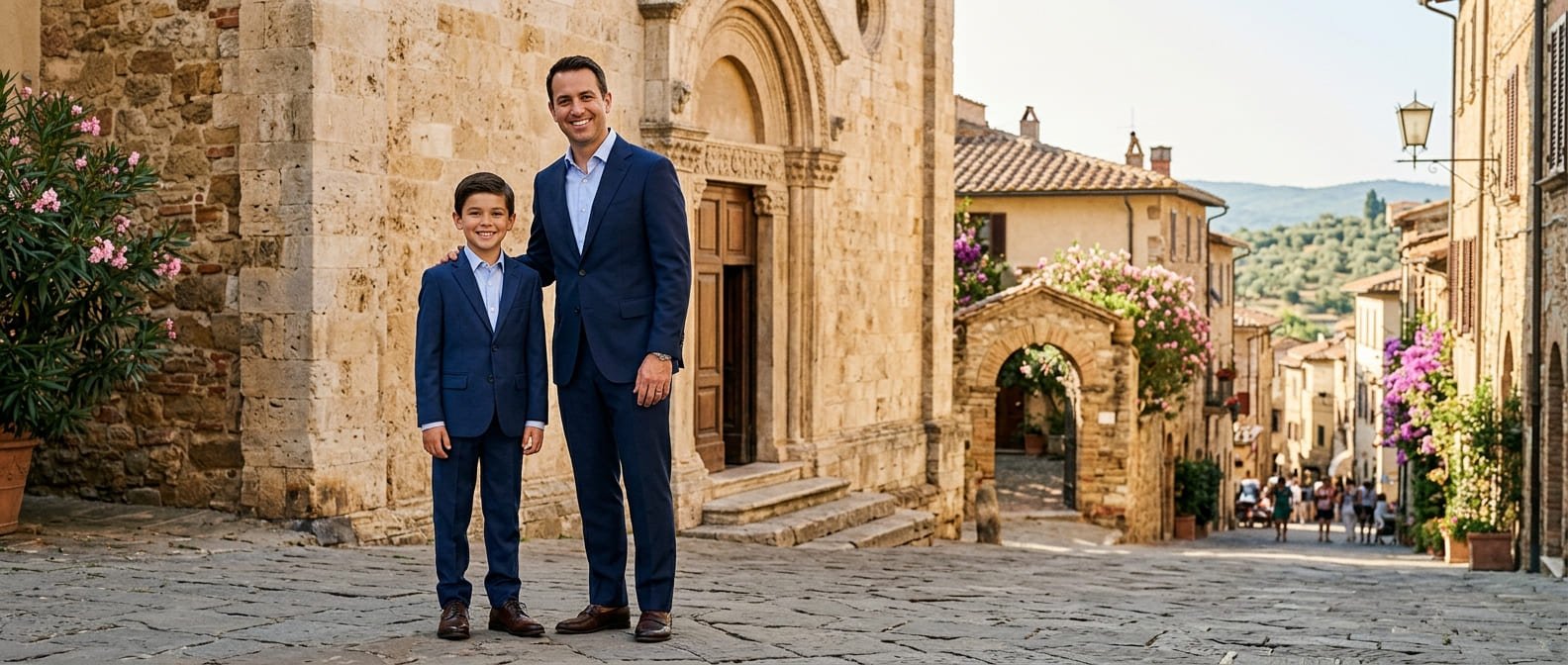
- Occasion wear. See our boys’ suits guide.
Features that grow with the child
- Adjustable waistbands with button elastic inside.
- Deep hems that can be let down.
- Turn-back cuffs.
- Stretch fabrics and ribbed cuffs.
- Braces and dungaree straps with several button positions.
For snowsuits with grow-with-me features, see our guide to kids’ snowsuits and snow pants.
A simple rule
Buy the size for your child’s current height. If they’re in the top half of that height range, or the season is just beginning, buy the next size. Never go up two.
Easy fastenings by age
The right fastening lets a child dress without help, which matters at nursery and school.
| Age | Can usually manage | Choose |
|---|---|---|
| Under 1 | Nothing | Poppers at the crotch and shoulder, envelope necks, zips with a chin guard |
| 1 to 2 | Pulling off socks and hats | Elastic waists, wide necks, poppers |
| 2 to 3 | Pulling trousers up and down, large zips once started | Elastic waists, hook-and-loop shoes |
| 3 to 4 | Large buttons, zips with help | Big buttons, chunky zips, pull-on trousers |
| 4 to 5 | Most zips and buttons | Zips, front buttons, hook-and-loop or elastic laces |
| 5 to 7 | Small buttons, buckles, starting to tie laces | Shirt buttons, belts, laces for practice |
| 7 and over | Laces and ties with practice | Anything, with a clip-on tie as a back-up |
Children develop at different rates, so treat the ages as a guide. For school, choose clothes your child can fasten alone, especially for PE and the toilet.
Safety rules worth knowing
- Cords and drawstrings. European safety rules restrict cords on children’s clothing. Clothes for young children shouldn’t have drawstrings or functional cords in the hood or neck, because they can catch.
- Small parts. For under-threes, check that buttons, bows and decorations are firmly attached.
- Nightwear. Look for the fire-safety information on children’s nightwear labels.
- Fit. Very long trousers and sleeves cause trips and catch on play equipment.
Sizing differences around Europe
- Scandinavia and the Netherlands: height sizing, cut generously in length. See our guides to Swedish and Danish fashion.
- Germany: height sizing, practical cuts.
- France: age sizing in *ans*, cut slim. See French fashion.
- Italy: age sizing in *anni*, cut close to the body. See Italian fashion.
- United Kingdom: age ranges, with slim and generous fits for school wear. See British fashion.
If a brand comes from a country known for a slim cut, consider one size up for a sturdier child.
From children’s to adult sizes
Around 164 to 176 cm, teenagers move into adult sizes: XS or S in tops, and waist and leg measurements in trousers. Many makers offer a “teen” range that bridges the two. See clothes for teenage boys and how should clothes fit.
Buying children’s clothes online and second-hand
- Use the brand’s own size chart and your child’s measurements.
- Read reviews for comments such as “runs small”.
- Check garment measurements when they’re given, and compare with something that fits.
- Second-hand clothes may have shrunk. Compare against a current garment, not the label.
- Buy ahead with care. Seasons and sizes need to line up: a winter coat bought in spring should fit next winter’s height.
For fabrics, see the best fabrics for kids’ clothes. For a small, mix-and-match children’s wardrobe, see our capsule wardrobe guide.
How this chart was made
European children’s sizes follow the height intervals of the European clothing-size standard, EN 13402, which labels garments by body measurement. UK and continental age labels are matched to those heights using the ranges most retailers publish. Individual brands vary, so use this chart to find your starting point.
Frequently asked questions
The size is the child's height in centimetres. Size 116 is made for a child about 116 cm tall, and sizes go up in steps of 6 cm.
About 5 to 6 years. UK sizes are age ranges, and each is made for a typical height.
French "6 ans" and Italian "6 anni" both mean age six, which corresponds to a height of about 116 cm.
By height. Children of the same age can differ by two sizes, so measure and use the height on the chart.
One size at most. Allow extra in trouser and sleeve length and in coats, and keep shoulders and waists fitting now.
The larger one, with an adjustable waist or a turned-up hem.
Usually between about 164 and 176 cm in height, around the ages of 13 to 16.