
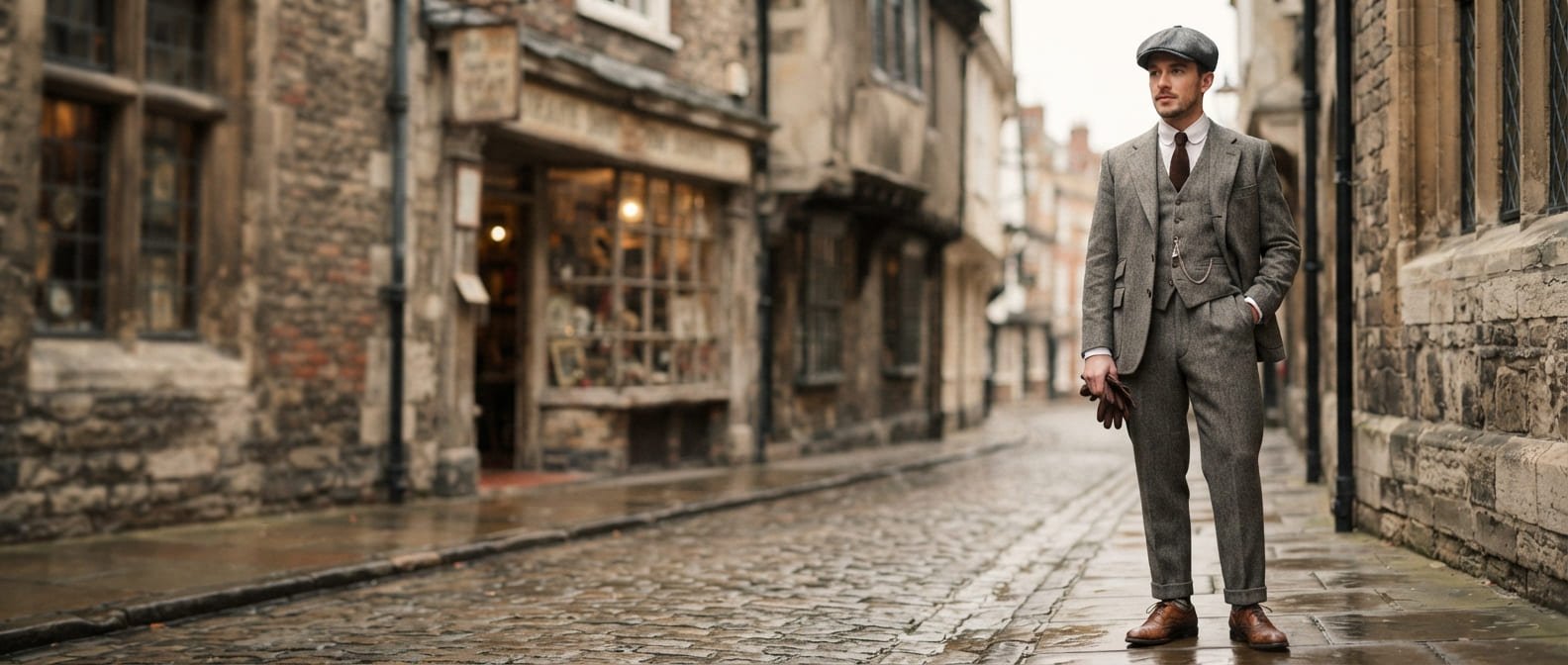
1920s men’s fashion is where modern menswear begins. After the First World War, men wanted clothes that were lighter, softer and easier to move in. Detachable stiff collars gave way to soft shirt collars, wristwatches replaced pocket watches, and sportswear such as knitted sweaters and plus fours moved from the golf course into everyday life. At the same time, the decade kept a level of polish we rarely see today: almost every man wore a suit, a tie and a hat when he left the house. This guide explains what men actually wore in the roaring twenties, how the look changed from the start of the decade to the end, the differences between Britain, France and America, and how to wear 1920s style now, from a Gatsby party to a Peaky Blinders look or a modern suit with a vintage touch.
What shaped 1920s men’s fashion
- The end of the war: millions of men had worn uniforms, and many came home wanting comfort. Trench coats and wristwatches, both made popular by the army, stayed in civilian wardrobes.
- A younger mood: students and young professionals set trends for the first time, with wide trousers, bright knitwear and loud socks.
- Sport and leisure: golf, tennis, motoring and seaside holidays created a new category of casual clothes.
- Royal influence: the Prince of Wales, later Edward VIII, was the most copied dresser of the decade. He made Fair Isle sweaters, soft collars, suede shoes and plus fours fashionable.
- Jazz, cinema and Prohibition: in America, speakeasies and dance halls encouraged sharper evening clothes, and film stars spread styles faster than ever before.
The 1920s suit
The suit was the centre of a man’s wardrobe, and most men owned two or three: a dark suit for work and Sunday, and a lighter or tweed suit for weekends.
| Detail | Early 1920s | Late 1920s |
|---|---|---|
| Jacket | Short, high-waisted and close-fitting | Longer and roomier, with a fuller chest |
| Shoulders | Natural and narrow | Slightly wider, still soft |
| Lapels | Narrow notch lapels, high buttoning | Wider lapels, peak lapels more common |
| Trousers | Slim, high-waisted, often with turn-ups | Wider legs, sometimes very wide Oxford bags |
| Waistcoat | Almost always worn | Still common, but sometimes left out |
Three-piece suits were standard, and trousers sat high on the waist, held up with braces rather than a belt. Popular fabrics were wool flannel, worsted, tweed and, in summer, linen and seersucker. Navy, charcoal, brown and grey dominated, often with a chalk stripe, pinstripe, herringbone or windowpane check.
The early “jazz suit” was tight and youthful, with a pinched waist and short jacket. By the middle of the decade the cut relaxed. In 1925, Oxford students began wearing Oxford bags, trousers so wide that the legs could measure more than 50 cm around the hem. Most men never went that far, but wider trousers stayed for the next twenty years. For how a modern jacket should sit, see our guide to how a jacket should fit.
Shirts, collars and ties
At the start of the decade, many men still wore shirts with detachable collars fixed with studs. Stiff, starched collars were slowly replaced by soft attached collars, which were cheaper and much more comfortable. Shirts were white, light blue, pale pink or finely striped, and many had double cuffs worn with cufflinks.
- Collar pins and bars: a pin under the tie pushed the collar points up and made the knot stand out.
- Ties: shorter and wider than today, in silk with stripes, small geometric patterns or club colours. Knitted ties were popular for casual wear.
- Bow ties: common for both day and evening, especially with younger men.
- Collarless shirts: working men often wore band-collar shirts without the collar attached, which is the look now linked with Peaky Blinders.
Knitwear and casual clothes
The 1920s gave men their first real casual wardrobe, most of it borrowed from sport.
- Fair Isle sweaters: patterned knits from the Shetland Islands, made famous by the Prince of Wales around 1922.
- Sleeveless pullovers and cardigans: worn under a jacket or over a shirt and tie for golf and weekends. See cardigans for men.
- Plus fours: loose knickerbockers ending about 10 cm below the knee, worn with long patterned socks for golf and country walks.
- Blazers and white flannels: striped or navy blazers with cream flannel trousers for tennis, cricket, boating and summer parties.
- Argyle socks: bright patterned socks became a small, popular way to show personality.
- Fair Isle knitted pullover Knit
- White soft-collar shirt Shirt
- Brown tweed plus fours Trousers
- Brown leather brogues Shoes
Hats: the finishing touch
Going out without a hat was almost unthinkable in the 1920s. The hat showed both class and occasion.
| Hat | Who wore it | When |
|---|---|---|
| Fedora | City men of all classes | Every day, all year |
| Homburg | Businessmen and politicians | Smart day wear |
| Bowler (derby) | Office workers and the City | Business, especially in London |
| Flat cap (newsboy or baker boy) | Working men, and everyone in the country | Casual, sport, driving |
| Straw boater | Young men and students | Summer only |
| Top hat | The upper classes | Formal day events and weddings |
Shoes and accessories
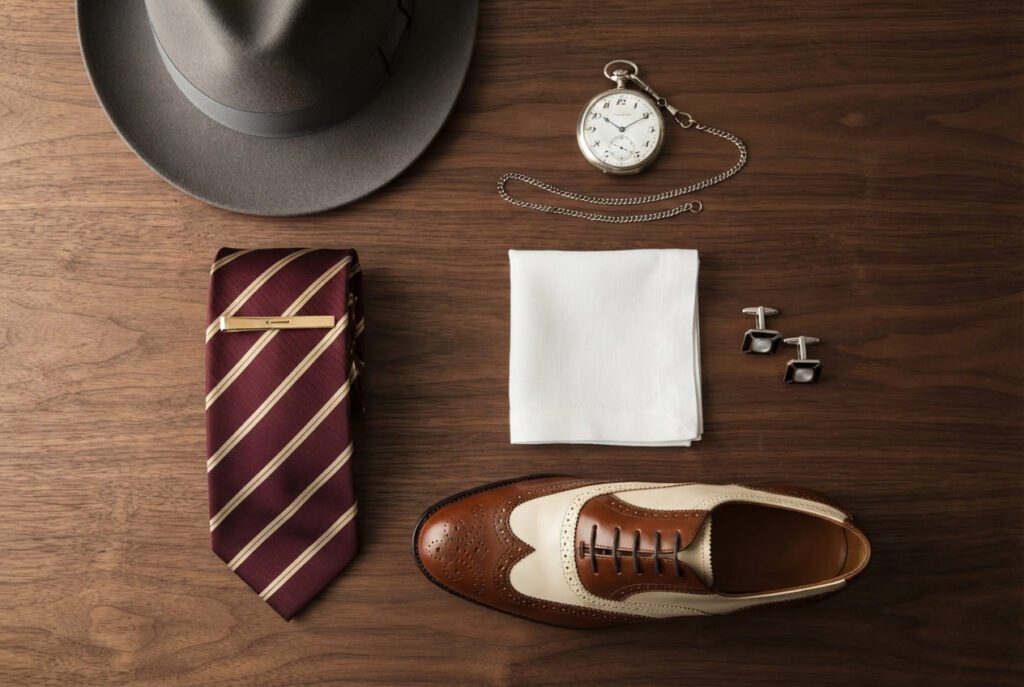
- Shoes: black or brown oxfords and brogues for town, and two-tone spectator shoes (also called co-respondent shoes) for summer and the dance floor. Suede shoes, once seen as daring, became acceptable thanks to the Prince of Wales.
- Spats: short fabric covers over the shoes, still worn early in the decade but fading by 1930.
- Wristwatches: soldiers had found them practical in the trenches, and they slowly replaced pocket watches, although many men kept a pocket watch on a chain with a three-piece suit.
- Pocket squares, cufflinks and tie bars: small details that every smart man used.
- Canes and gloves: leather gloves and a walking stick finished a formal outfit.
Coats and evening wear
The main overcoats were the knee-length Chesterfield with its velvet collar, the belted ulster, the trench coat and, at the end of the decade, the camel polo coat. In American universities, long raccoon fur coats were a famous fad.
For evenings, the formal choice was white tie: a black tailcoat, white waistcoat, wing collar and white bow tie. The dinner jacket, or tuxedo, worn with a black bow tie, became widely accepted for less formal dinners and nightclubs. That is the look most people mean by a “1920s party outfit” today. See our guide to dress codes explained for how black tie and white tie compare now.
- Black dinner jacket with peak lapels Jacket
- White wing-collar shirt Shirt
- Black silk bow tie Tie
- Black patent leather shoes Shoes
1920s style in Britain, France and America
- Britain: Savile Row tailoring set the standard. City men wore dark suits, bowler hats and rolled umbrellas, while country clothes meant tweed, flat caps and brogues. Oxford and Cambridge students pushed the fashion for wide trousers and colourful knits.
- France: Paris was more relaxed and artistic. Men in the cafés and on the Riviera wore lighter suits, striped sailor tops, espadrilles and soft linen in summer. See French style for men.
- America: Ivy League students wore sack suits, raccoon coats and saddle shoes, while jazz musicians and nightclub owners wore sharp pinstripes, bold ties and spectator shoes.
The colours of the 1920s
Everyday menswear was mostly dark and earthy, with colour added through ties, socks, pocket squares and knitwear. Summer brought cream, sand and pale grey.
How to wear 1920s style today
You don’t need a full costume to borrow from the decade. Choose one or two period details and keep the rest modern.
- Wear a waistcoat: a three-piece suit, or a waistcoat with odd trousers, is the easiest nod to the twenties.
- Try higher, wider trousers: a high-rise, pleated trouser with turn-ups gives the 1920s line without looking like fancy dress.
- Add texture: tweed, herringbone, flannel and a Fair Isle or cable knit all feel period-correct.
- Use small details: a collar bar, a pocket square, a tie bar or a flat cap.
- Keep the fit clean: the twenties were roomy, but jackets still followed the body. Avoid anything sloppy.
For a modern version at the office, see smart casual for men.
- Grey herringbone waistcoat Waistcoat
- White oxford shirt Shirt
- Navy pleated wool trousers Trousers
- Brown suede derby shoes Shoes
A 1920s party outfit: Gatsby and Peaky Blinders
Themed parties usually ask for one of two looks.
The Gatsby look is based on F. Scott Fitzgerald’s novel, published in 1925, and its film versions. Think light suits in cream, ivory or pale grey, white or striped shirts, a bow tie or silk tie, two-tone shoes and slicked-back hair. A black dinner jacket also works for an evening event. It’s a popular choice for New Year’s Eve outfits for men.
The Peaky Blinders look is set in Birmingham just after the war. It’s rougher and darker: a brown or grey tweed three-piece suit, a collarless shirt with a collar stud, a heavy wool overcoat, a flat cap and leather boots.
| Element | Gatsby | Peaky Blinders |
|---|---|---|
| Suit | Cream, ivory or pale grey, two or three pieces | Brown, grey or charcoal tweed, three pieces |
| Shirt | White or striped with a soft collar | Collarless band-collar shirt |
| Neck | Bow tie or silk tie | Collar stud, no tie |
| Hat | Boater or light fedora | Flat cap |
| Shoes | Two-tone spectators | Dark leather boots |
| Extras | Pocket square, cufflinks | Pocket watch chain, long overcoat |
For other themes, see our guides to men’s fashion by decade, 1950s men’s fashion and masquerade ball outfit ideas for men.
Hair and grooming
Men wore their hair short at the back and sides and longer on top, combed straight back or parted to the side. It was set with brilliantine or pomade for a glossy finish. Most men were clean-shaven. Small, neat moustaches were common, but full beards had gone out of fashion.
Common mistakes with 1920s style
| Mistake | Why it looks wrong | Better choice |
|---|---|---|
| Gangster costume clichés | Plastic hats and fake pinstripes look cheap | A real wool waistcoat, tie and simple hat |
| Low-rise skinny trousers | The period line was high and fuller | High-rise trousers with pleats and turn-ups |
| Too many accessories at once | Looks like fancy dress | Pick two or three details |
| Black shirt with white tie | A 1930s film cliché, not 1920s | White or pale shirt with a darker tie |
| Trainers with a period suit | Breaks the whole look | Brogues, oxfords or two-tone shoes |
Frequently asked questions
Most men wore a three-piece suit, a white or pale shirt, a tie, leather oxfords or brogues and a hat, usually a fedora, bowler or flat cap. Casual clothes included knitted sweaters, plus fours and blazers.
The relaxed, sportier style of the 1920s: softer collars, wider trousers, colourful knitwear, two-tone shoes and evening dinner jackets for the jazz age.
Very wide-legged trousers first worn by Oxford University students around 1925. The hems could be more than 50 cm around.
The fedora, homburg, bowler and flat cap were the main hats, with the straw boater in summer and the top hat for formal events.
Wear a cream or light grey suit or a black dinner jacket, a white shirt, a bow tie or silk tie, two-tone shoes and slicked-back hair.
A tweed three-piece suit, a collarless shirt with a collar stud, a long wool overcoat, a flat cap and dark leather boots.
Mostly not with suits. Trousers were high-waisted and held up with braces, although belts became more common with casual clothes.
Navy, charcoal, grey and brown for suits, with cream and pale grey in summer and brighter colours in ties, socks and knitwear.
Yes, in small doses: a waistcoat, high-rise pleated trousers, tweed textures or a collar bar look smart without looking like a costume.