
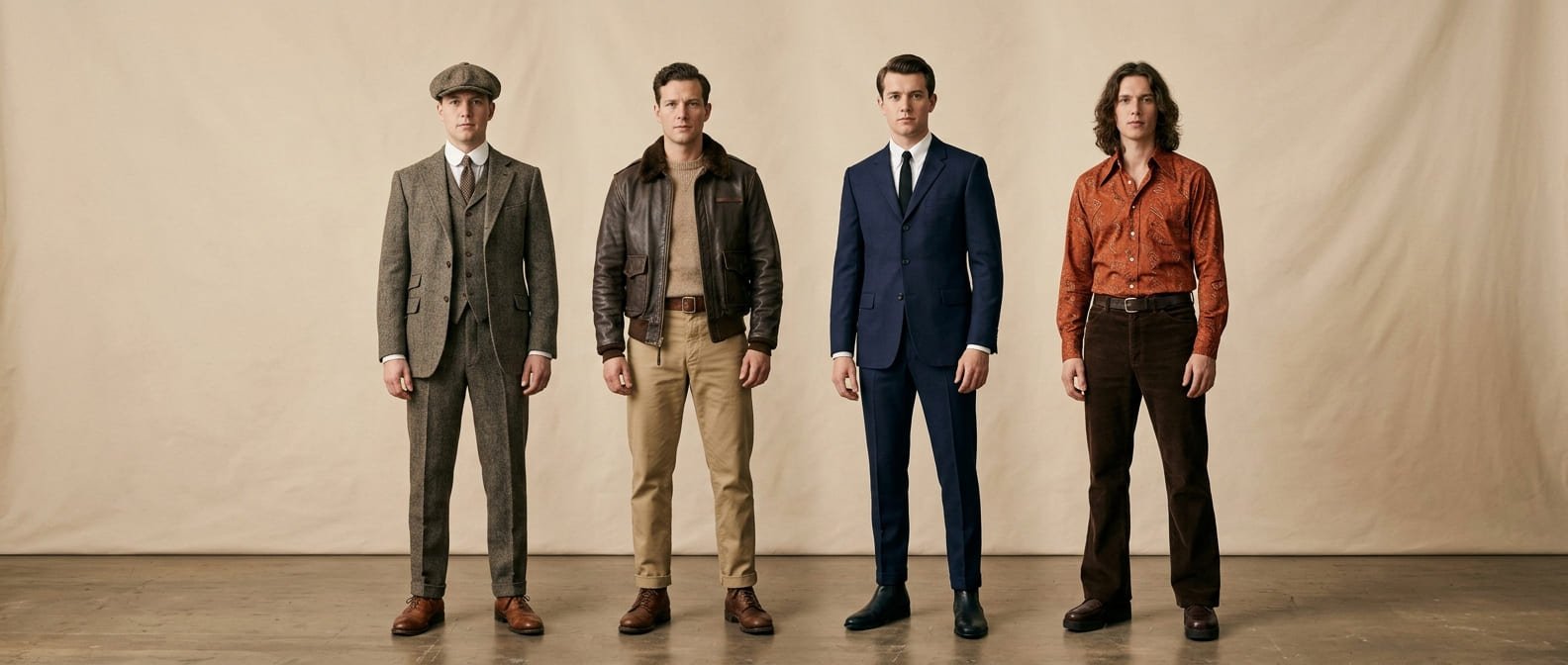
Men’s fashion by decade tells the story of the twentieth century as clearly as any history book. In 1900, a respectable man wore a stiff collar, a waistcoat and a hat every day of his life. By 1979, he might be in flared jeans, a printed shirt open at the neck and platform shoes, or in ripped leather held together with safety pins. Wars rationed cloth, prosperity loosened collars, teenagers invented their own clothes, and each generation reacted against the one before. Following men’s fashion by decade also explains the wardrobe you own now, because almost every modern garment, from the trench coat to the T-shirt, the bomber jacket and blue jeans, entered everyday dress in these years. This guide covers fashion trends by decade from the 1900s to the 1970s, with the key pieces, colours and influences of each.
Men’s fashion by decade: the quick answer
| Decade | The look | Key pieces |
|---|---|---|
| 1900s and 1910s | Formal and upright | Three-piece suit, stiff collar, bowler hat, trench coat |
| 1920s | Youthful and relaxed | Wide trousers, soft collars, knitted pullovers, two-tone shoes |
| 1930s | Elegant and athletic | Broad shoulders, double-breasted suits, wide pleated trousers, fedora |
| 1940s | Rationed, then bold | Plain utility suits, flight jackets, then wide ties and broad lapels |
| 1950s | Conformist and rebellious | Grey flannel suit, Ivy style, leather jacket, jeans and T-shirt |
| 1960s | Slim, then colourful | Narrow suits, Chelsea boots, then paisley, flares and long hair |
| 1970s | Wide and expressive | Flared trousers, big collars, leisure suits, platforms, denim, punk |
1900s and 1910s: the formal years
What men wore
At the start of the century, dress followed strict rules by time of day and class.
- The lounge suit: a matching jacket, waistcoat and trousers in dark wool, worn by day.
- Morning coats and frock coats for business and formal occasions.
- Stiff, detachable collars, high and starched.
- Hats: bowlers, homburgs, top hats and straw boaters in summer.
- Boots, laced or buttoned.
- Pocket watches on a chain.
Fashion trends in 1914 and the First World War
The 1914 fashion trends were the last of the old order. The First World War, from 1914 to 1918, changed men’s clothes permanently.
- The trench coat, designed for officers, entered civilian wardrobes.
- The wristwatch replaced the pocket watch, because it was practical in the field.
- Soft collars and simpler suits replaced stiff formality.
- Khaki and military details became familiar.
- Clothes were worn longer and repaired.
1920s: the Jazz Age
The 1920s men’s fashion trends belonged to the young. After the war, suits became lighter and more relaxed.
- Soft, attached shirt collars.
- Wide trousers: by the mid-1920s, students wore very wide “Oxford bags”.
- Plus fours: baggy knee breeches for golf and the country.
- Knitted pullovers, including Fair Isle patterns.
- Two-tone shoes.
- Flat caps and boaters.
- The dinner jacket, which began to replace the tailcoat in the evening.
- Lighter colours and patterns in summer.
For women, the decade meant dropped waists, shorter hems and bobbed hair. The 1929 fashion trends marked the end of the era, as the stock market crash that autumn ushered in a more sober decade.
- Tweed three-piece suit Suit
- White soft-collar shirt Shirt
- Fair Isle pullover Knit
- Two-tone brogues Shoes
- Flat cap Accessory
1930s: elegance in hard times
The Great Depression limited what men could buy, yet the 1930s produced what many tailors still consider the most flattering suit.
- The drape cut: broad shoulders, a full chest and a narrow waist, to give an athletic outline.
- Double-breasted jackets with wide lapels.
- High-waisted, wide trousers with pleats and turn-ups.
- The fedora.
- Sportswear: polo shirts, knitted swimwear, blazers and flannels.
- Film stars as style models.
The 1930 fashion trends were still close to the 1920s. By the 1939 fashion trends, on the eve of war, shoulders were at their widest.
1940s: war and after
Fashion trends in the 1940s: the war years
The Second World War dominated 1940s fashion trends. Cloth was rationed in Britain from 1941, and the United States restricted fabric use from 1942.
- Single-breasted suits with narrow lapels.
- No waistcoats, pleats or turn-ups, to save cloth.
- Utility clothing: simple, hard-wearing and price-controlled.
- “Make do and mend”: repairing and altering old clothes.
- Uniforms for millions of men.
- The zoot suit: an oversized suit with a long jacket and wide, pegged trousers, worn by young men in American cities as an act of defiance.
Military clothes that stayed
Several military garments entered civilian life after 1945 and never left.
- Flight and bomber jackets.
- Chinos.
- The T-shirt, issued as underwear and then worn alone.
- Duffle coats and peacoats.
- Aviator sunglasses.
The late 1940s
The 1947 and 1948 fashion trends reacted against austerity. Men’s suits grew broad again, with wide lapels and bold, wide ties. Printed holiday shirts became popular. For women, a famous 1947 collection brought back full skirts and narrow waists.
- Brown leather flight jacket Jacket
- White T-shirt Top
- Khaki chinos Trousers
- Brown leather boots Shoes
1950s: conformity and rebellion
The 1950s male fashion trends split in two: the respectable adult and the new teenager.
The establishment look
- The grey flannel suit: plain, single-breasted and worn with a white shirt and narrow tie.
- Hats were still worn, though less each year.
- Ivy style, from American universities: soft-shouldered jackets, button-down shirts, chinos and penny loafers.
- Cardigans, knitted polo shirts and casual slacks at the weekend.
- Printed holiday and bowling shirts.
The rebels
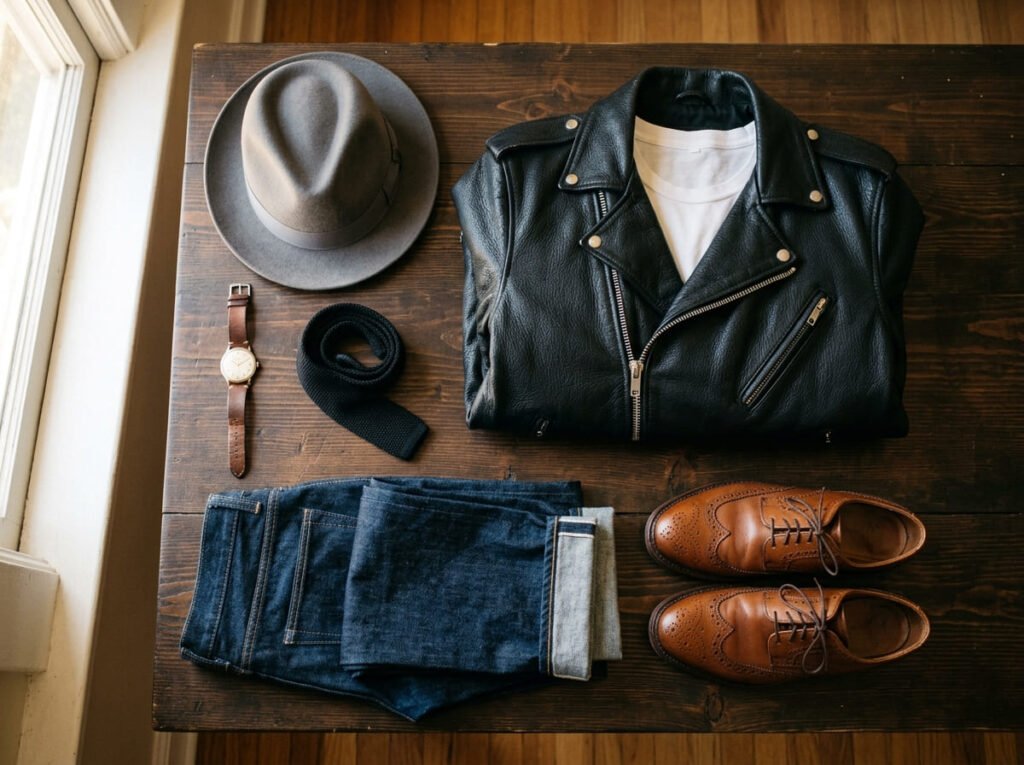
- The leather motorcycle jacket, white T-shirt and blue jeans, made famous by film stars of the mid-1950s.
- Teddy Boys in Britain: long drape jackets with velvet collars, narrow trousers and thick-soled shoes.
- Rock and roll style: slicked hair, bright shirts and suede shoes.
The 1953, 1956 and 1957 fashion trends follow this pattern, with teenage style growing louder each year. Jeans, once workwear, became a symbol of youth.
- Black leather motorcycle jacket Jacket
- White T-shirt Top
- Dark blue jeans, turned up Trousers
- Black leather boots Shoes
1960s: from slim suits to flower power
No decade changed more. The 60s fashion trends for men began in a narrow grey suit and ended in beads and bell-bottoms.
Early 1960s
- Slim suits with narrow lapels and narrow ties.
- Short, neat hair.
- Continental tailoring from Italy and France.
- Ivy style at its height.
Mid-1960s: mods and the British Invasion
The 1964 fashion trends were led by British bands and London’s young designers.
- Collarless and high-buttoned suits.
- Chelsea boots.
- Roll necks.
- Mods: sharp three-button suits, parkas, desert boots and scooters.
- Longer hair.
Late 1960s: the peacock revolution
By the 1967 and 1968 fashion trends, colour and pattern had exploded. Men’s clothing became expressive for the first time in more than a century.
- Paisley, floral and psychedelic shirts.
- Flared trousers and hipsters.
- Nehru jackets and velvet suits.
- Hippie style: tie-dye, beads, fringe, kaftans, sandals and military surplus.
- Denim as everyday dress.
- Long hair, moustaches and sideburns.
- Slim navy three-button suit Suit
- White button-down shirt Shirt
- Narrow black knitted tie Accessory
- Black Chelsea boots Shoes
1970s: wide, loud and free
The men’s fashion trends of the 1970s took the freedom of the late 1960s and made it mainstream.
- Flared and bell-bottom trousers.
- Wide lapels and long, pointed shirt collars.
- Shirts worn open at the neck, often in bold prints.
- The leisure suit: a casual matching jacket and trousers, usually in polyester.
- Three-piece suits for the disco, sometimes in white.
- Platform shoes.
- Denim everywhere: jeans, jackets and waistcoats.
- Knitted tank tops, roll necks and tight T-shirts.
- Safari jackets, sheepskin coats and leather jackets.
- Earth tones: brown, rust, orange, mustard and olive.
- Long hair and moustaches.
Black fashion in the 1970s
African American fashion trends of the 70s influenced style worldwide. The “Black is beautiful” movement celebrated natural Afro hairstyles and African-inspired clothing such as the dashiki. Music television, soul and funk musicians, and films of the period popularised wide-collared printed shirts, flared suits in strong colours, long leather coats, wide-brimmed hats and platform shoes. Much of what the world remembers as 1970s style began here.
Punk and the end of the decade
In 1976 and 1977, punk rejected everything that came before: ripped T-shirts, leather jackets, safety pins, tartan, studs and narrow trousers. Alongside it, early hip-hop style was taking shape in New York, with tracksuits and trainers. Both would define the next decade.
- Rust wide-collar printed shirt Shirt
- Brown flared trousers Trousers
- Tan suede jacket Jacket
- Brown platform boots Shoes
European menswear through the decades
Each decade also had a European centre of style.
- London: the home of the tailored suit at the start of the century, and of mods, the peacock revolution and punk in the 1960s and 1970s. See our guide to British fashion.
- Paris: the leader in women’s fashion throughout, and from the 1960s a source of designer ready-to-wear for men.
- Italy: from the 1950s, tailors in Rome and Naples made lighter, softer, shorter jackets that offered an alternative to the structured English suit. See our guide to Italian men’s fashion.
- The Riviera: striped jerseys, espadrilles and linen trousers became summer classics from the 1920s onwards.
- Scandinavia: patterned knitwear and practical outdoor clothing spread across Europe from the 1950s.
The colours of each decade
How the suit changed
| Decade | Shoulders | Lapels | Trousers | Tie |
|---|---|---|---|---|
| 1920s | Natural | Medium | Wide, high-waisted | Medium, or bow tie |
| 1930s | Broad | Wide | Wide, pleated | Medium to wide |
| 1940s (war) | Natural | Narrow | Plain, no turn-ups | Narrow |
| Late 1940s | Very broad | Wide | Full | Very wide |
| 1950s | Natural | Narrow | Tapered | Narrow |
| Early 1960s | Narrow | Very narrow | Slim | Very narrow |
| 1970s | Wide | Very wide | Flared | Very wide |
Lapels, ties and trouser widths have moved together for a century. When one narrows, the others follow.
What changed men’s fashion
- War: rationing simplified clothes, and military garments entered civilian life.
- Sport: polo shirts, trainers, blazers and knitwear all came from sport.
- Work: jeans, chore jackets and boots came from labour.
- Film and music: stars and bands set the styles for each generation.
- Teenagers: from the 1950s, young people had money and their own taste.
- Technology: zips, synthetic fibres and mass production changed what was possible.
- Social change: the decline of formal dress codes freed men to choose.
Clothes we still wear, and where they came from
| Garment | Entered everyday wear | Origin |
|---|---|---|
| Trench coat | 1910s | Military officers |
| Wristwatch | 1910s | The trenches |
| Polo shirt | 1930s | Tennis and polo |
| T-shirt | 1940s and 1950s | Military underwear |
| Bomber jacket | 1940s | Air force crews |
| Chinos | 1940s | Army uniform |
| Blue jeans | 1950s | Workwear |
| Leather motorcycle jacket | 1950s | Motorcyclists |
| Chelsea boot | 1960s | Victorian riding boot, revived in London |
| Parka | 1960s | Military cold-weather gear |
| Trainers as daywear | 1970s | Athletics |
Our guides to the types of jackets for men and winter coats for men explain how to wear these today.
Retro fashion trends: how to wear vintage style now
Retro fashion trends return constantly. The skill is in borrowing, not copying.
- Take one idea per outfit. A 1970s wide collar, a 1950s leather jacket or 1930s pleated trousers.
- Use modern fit and fabric. Vintage shapes in today’s proportions.
- Keep the rest plain.
- Buy real vintage for coats, knitwear and leather, which age well.
- Avoid full costume unless it’s a themed party.
| Era | What’s worth reviving | How to wear it now |
|---|---|---|
| 1920s and 1930s | Pleated wide trousers, knitted polos, tweed | With a plain knit and loafers |
| 1940s | Flight jackets, chinos, T-shirts | As everyday casual wear |
| 1950s | Ivy style, leather jackets, turned-up jeans | With trainers or loafers |
| 1960s | Slim suits, roll necks, Chelsea boots | For smart evenings |
| 1970s | Suede, earth tones, wide collars, flares | One piece at a time |
The current taste for relaxed tailoring, brown tones and wide trousers owes a great deal to the 1930s and 1970s. See men’s fashion trends 2026.
Decade costumes for parties and school
- 1920s: a waistcoat, flat cap, braces and wide trousers.
- 1940s: a plain suit with a wide tie, or a flight jacket and chinos.
- 1950s: a white T-shirt, turned-up jeans and a leather jacket, with slicked hair.
- 1960s: a slim suit and narrow tie, or a tie-dye shirt, beads and a headband.
- 1970s: a wide-collar shirt, flared trousers and a moustache.
For later decades, see our 90s outfit ideas, 2000s fashion trends and 2010s fashion trends.
Boys’ clothes through the decades
- 1900s to 1930s: sailor suits, knee breeches and shorts with long socks. Long trousers marked the move to adulthood.
- 1940s: short trousers, knitted jumpers and hand-me-downs.
- 1950s: jeans and T-shirts for play, and a jacket and tie for best.
- 1960s: brighter colours, and the same slim trousers as older brothers.
- 1970s: flares, striped T-shirts, tank tops and trainers.
After the 1970s
- 1980s: power suits with wide shoulders, sportswear, preppy style and new romantics.
- 1990s: grunge, hip-hop, minimalism and sportswear. See our 90s outfit ideas.
- 2000s and 2010s: covered in our separate guides.
Frequently asked questions
Men's fashion moved from formal three-piece suits and stiff collars in the 1900s to relaxed wide trousers in the 1920s, broad-shouldered suits in the 1930s, rationed simplicity in the 1940s, grey flannel and teenage rebellion in the 1950s, slim suits then colour in the 1960s and flares in the 1970s.
Three-piece suits with wide trousers, soft-collared shirts, knitted pullovers, plus fours, flat caps, boaters and two-tone shoes.
During the war, plain single-breasted suits without waistcoats or turn-ups, and uniforms. Afterwards, broad suits with wide ties, plus flight jackets, chinos and T-shirts from military service.
Grey flannel suits, Ivy style with button-down shirts and loafers, and for teenagers the leather jacket, white T-shirt and blue jeans.
Slim suits and narrow ties early in the decade, then collarless suits, Chelsea boots and roll necks, and by the late 1960s paisley shirts, flared trousers, denim and long hair.
Flared trousers, wide lapels and collars, printed shirts, leisure suits, platform shoes, denim, earth tones and, at the end of the decade, punk.
It celebrated Afro hairstyles and African-inspired clothing, and popularised wide-collared printed shirts, bold flared suits, long leather coats and platform shoes that shaped 1970s style worldwide.
They simplified suits, introduced rationing and brought military garments into civilian life, including the trench coat, wristwatch, bomber jacket, chinos and T-shirt.
Jeans were workwear until the 1950s, when teenagers adopted them. By the late 1960s and 1970s they were everyday dress for all ages.
Retro fashion trends are styles revived from earlier decades, such as 1970s flares or 1950s leather jackets. They work best when one vintage idea is combined with modern clothes.
It depends on taste. Many tailors favour the 1930s for its flattering suits, while the 1960s are admired for slim tailoring and the 1970s for colour and freedom.