

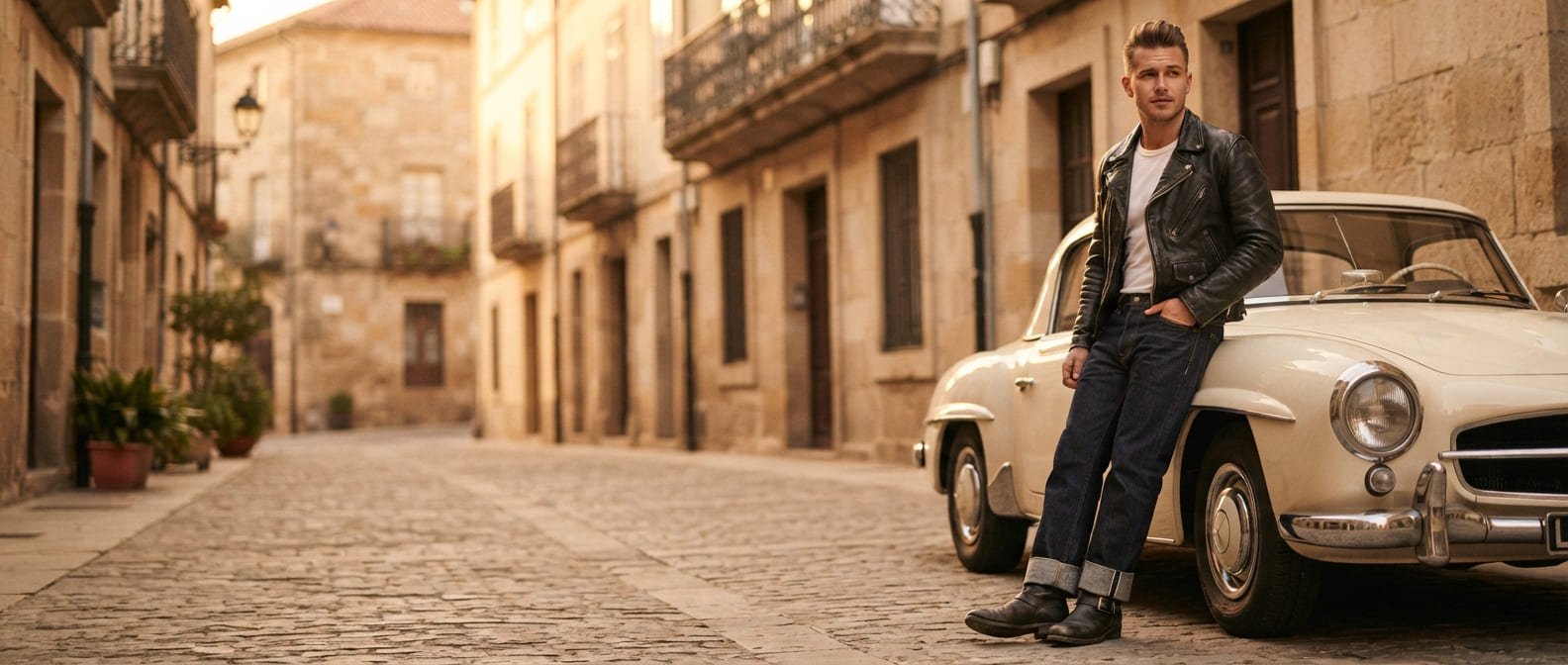
1950s men’s fashion had two faces. On one side was the respectable man in a grey flannel suit, narrow tie and felt hat, catching the train to the office. On the other were the young rebels in white T-shirts, leather jackets and rolled-up jeans, copying film stars and rock and roll singers. Both looks are still everywhere today. The plain white T-shirt, dark denim, the Harrington jacket, penny loafers, the knitted polo and the short-sleeved camp collar shirt all became men’s staples in this decade. This guide covers the main 1950s fashion trends for men, the suits, casual clothes and youth styles of the decade, how style differed in America, Britain and Italy, and how to wear a 1950s look now, either for every day or for a themed party.
The 1950s at a glance
| Style | Key pieces | Inspired by |
|---|---|---|
| The grey flannel suit | Charcoal or grey suit, white shirt, narrow tie, fedora | Office workers and businessmen |
| Ivy League | Sack jacket, oxford button-down, chinos, penny loafers | American university students |
| Rebel and greaser | White T-shirt, leather jacket, cuffed jeans, boots | James Dean and Marlon Brando |
| Rockabilly | Bowling shirt, high-waisted trousers, pompadour | Elvis Presley and early rock and roll |
| Teddy Boy | Long drape jacket, drainpipe trousers, crepe-soled shoes | British working-class youth |
| Continental | Short, slim Italian suit, slim trousers, slip-on shoes | Rome and Italian tailoring |
What shaped men’s fashion in the 1950s
- Peace and prosperity: after years of war and rationing, men had more money and more choice. Clothes became a way of showing a comfortable, settled life.
- Office life: more men worked in offices than ever, and the conservative suit became a uniform.
- The teenager: for the first time, young people had their own money and their own music, and they dressed differently from their parents.
- Hollywood and television: films such as The Wild One (1953) and Rebel Without a Cause (1955) turned simple workwear into fashion.
- New fabrics: nylon, rayon and polyester blends made shirts drip-dry and easy to care for, and lighter suits became possible thanks to central heating.
The 1950s suit
At the start of the decade, suits still followed the late 1940s “bold look”, with wide shoulders, full trousers and wide, colourful ties. As the decade went on, the cut became slimmer and more restrained.
| Detail | Early 1950s | Late 1950s |
|---|---|---|
| Jacket | Broad, padded shoulders, longer length | Natural shoulders, shorter and slimmer |
| Lapels | Medium to wide | Narrow |
| Trousers | Full, high-waisted and pleated | Slimmer, flat-fronted, ending higher on the shoe |
| Ties | Wide with bold patterns | Narrow, often about 5 to 6 cm, in plain colours or stripes |
| Colours | Grey, navy, brown, some bolder tones | Charcoal, mid-grey, navy, olive |
The classic office look was a single-breasted charcoal or mid-grey suit, a white shirt with a point collar, a narrow tie and black oxfords. Mid-century fabrics included flannel, sharkskin, tweed and lightweight worsted. In summer, men wore lighter suits in linen, seersucker or tropical wool. For the modern equivalent, see our guide to the two-piece suit.
- Charcoal flannel suit Suit
- White point-collar shirt Shirt
- Narrow navy tie Tie
- Black leather oxfords Shoes
Ivy League style
On the campuses of Harvard, Yale and Princeton, students wore a softer, more casual version of tailoring that later became known as “Ivy” or preppy style.
- The sack jacket: an unstructured, straight-cut jacket with natural shoulders and three buttons.
- The oxford button-down shirt: worn with a tie or open at the neck.
- Chinos: khaki cotton trousers, often worn slightly short.
- Knitwear: crew-neck Shetland sweaters, cardigans and letterman sweaters.
- Shoes: penny loafers, saddle shoes and white bucks, often with white socks.
This is the look that most “old money” outfits borrow from today. For how a modern cardigan fits in, see cardigans for men.
- Navy Shetland crew neck Knit
- Light blue oxford button-down Shirt
- Khaki chinos Trousers
- Brown penny loafers Shoes
Casual clothes: the 1950s invent the modern weekend
Casual dressing grew quickly as men had more free time for sport, holidays and driving.
- The white T-shirt: once underwear, it became an outer garment after Brando and Dean wore it on screen.
- Jeans: dark, stiff denim with wide turn-ups, worn by teenagers, bikers and workers.
- Camp collar shirts: short-sleeved shirts with a flat, open collar, including bowling shirts with contrast panels and Hawaiian shirts with tropical prints.
- The Harrington jacket: a short cotton jacket with a stand collar and tartan lining, worn by golfers and made famous by Elvis Presley in King Creole (1958).
- The knitted polo and short-sleeved knits: smart enough for a club or a summer evening.
- Cardigans: worn by everyone from fathers to crooners, often with a shirt and tie.
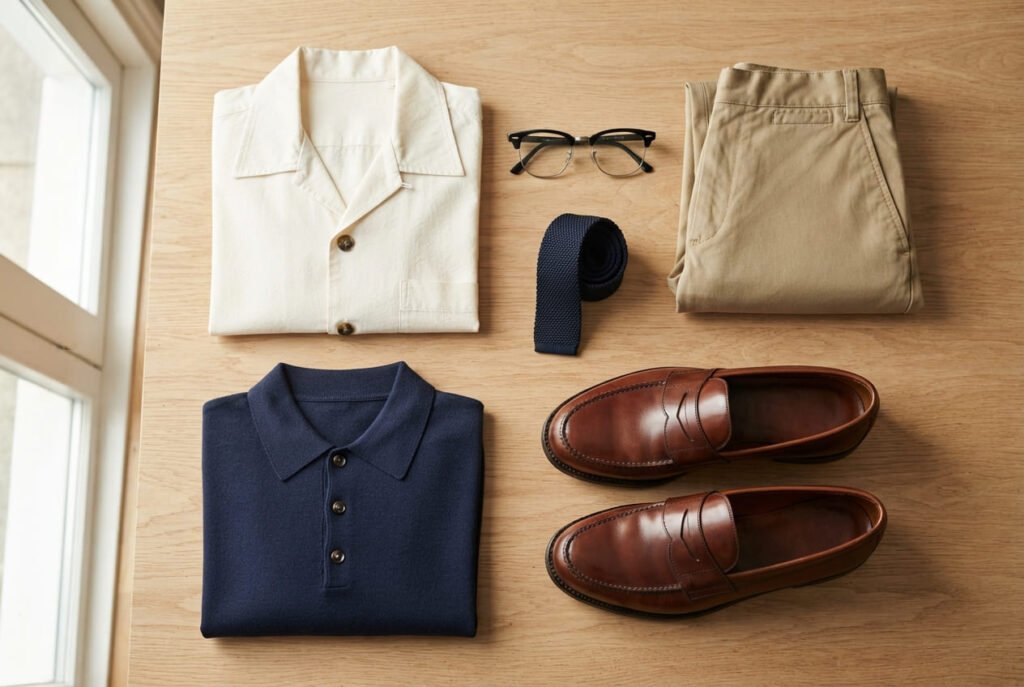
- Cream camp collar shirt Shirt
- White crew-neck T-shirt T-shirt
- Dark indigo jeans, rolled cuffs Trousers
- Brown suede desert boots Shoes
Rebels, greasers and rockabilly
The most copied 1950s look today belongs to the young men who rejected the suit.
The rebel look came from the cinema. Marlon Brando’s black leather biker jacket in The Wild One and James Dean’s red jacket, white T-shirt and jeans in Rebel Without a Cause made rebellion look cool. The pieces were simple and cheap: a leather jacket, a T-shirt, jeans and engineer or work boots. For the jacket, see black jackets for men.
Rockabilly, inspired by Elvis Presley and early rock and roll, was louder: bowling shirts, two-tone shirts, high-waisted pleated trousers, contrast stitching, bright socks and a tall pompadour held in place with plenty of pomade.
- Black leather biker jacket Jacket
- White crew-neck T-shirt T-shirt
- Dark indigo jeans, cuffed Trousers
- Black leather engineer boots Shoes
1950s style in Britain and Italy
In Britain, rationing only ended in 1954, so new fashion arrived a little later. The most famous British look was the Teddy Boy. Working-class young men took the long “Edwardian” drape jacket that Savile Row had tried to bring back, and wore it with velvet collars, very slim drainpipe trousers, bootlace ties, brocade waistcoats and thick crepe-soled shoes known as brothel creepers.
In Italy, tailors in Rome and Milan developed a short, slim, light suit with narrow lapels and slim trousers. This “continental” look spread across Europe and to America by the end of the decade, and it led directly to the sharp Mod style of the early 1960s. For more on Italian tailoring, see Italian men’s fashion trends.
Hats, shoes and accessories
- Hats: the fedora and trilby were still common at the start of the decade, with narrower brims than before. The pork pie hat was popular with jazz fans. By the end of the 1950s, younger men wore hats less and less.
- Shoes: oxfords and brogues for work, penny loafers and saddle shoes for students, desert boots and crepe-soled shoes for casual wear, and engineer boots for bikers.
- Ties: narrow knitted ties, skinny plain ties and the bolo tie in the American West.
- Glasses: thick browline and acetate frames, an icon of the decade. See our guide to men’s eyeglasses.
- Small details: tie clips, cufflinks, pocket squares folded straight and a wristwatch on a leather strap.
Hair and grooming
Short hair was the norm. Office men wore a neat side parting, while the crew cut and flat top were popular with students and servicemen. Young rebels grew their hair longer on top and combed it into a pompadour, a quiff or a ducktail, using a lot of hair cream or pomade. Most men were clean-shaven.
The colours of the 1950s
Office clothes were grey, charcoal and navy. Casual and holiday wear was much brighter, with pastels, two-tone combinations and tropical prints.
How to wear 1950s style today
Many 1950s pieces never left the modern wardrobe, so the look is easy to wear without a costume.
- Start with the basics: a white T-shirt, dark straight jeans and a leather or Harrington jacket.
- Try a camp collar shirt: a plain or subtly patterned short-sleeved shirt is one of the easiest summer pieces.
- Wear a knitted polo: smart enough for dinner, relaxed enough for the weekend.
- Choose a slim tie: a plain narrow tie with a grey suit gives an instant mid-century look.
- Keep trousers clean and straight: high-rise trousers or straight jeans with a small turn-up.
- Use loafers or desert boots: both feel period-correct and still look modern.
For the wider picture of how these pieces fit into today’s wardrobe, see men’s fashion by decade and smart casual for men.
A 1950s party or decade day outfit
For a themed party, sock hop or school decade day, pick one of these:
- Greaser: white T-shirt, black leather jacket, cuffed jeans, boots and slicked-back hair.
- Rockabilly: bowling shirt, high-waisted trousers, bright socks, two-tone or crepe-soled shoes and a pompadour.
- Ivy student: oxford shirt, sweater or cardigan, chinos, loafers with white socks.
- Crooner: grey or navy suit, white shirt, narrow tie and a trilby.
For other decades, see our guides to 1920s men’s fashion, 80s and 90s fashion trends and 90s outfit ideas.
Common mistakes
| Mistake | Why it doesn’t work | Better choice |
|---|---|---|
| Skinny low-rise jeans | The 1950s line was straighter and higher | Straight or relaxed high-rise jeans with a turn-up |
| Wide modern ties | Late 1950s ties were narrow | A slim plain or knitted tie |
| Distressed denim | 1950s jeans were dark and clean | Raw or dark rinse denim |
| Too many retro pieces at once | Looks like fancy dress | One or two period pieces with modern basics |
| Logo T-shirts | Breaks the clean look | Plain white, grey or navy T-shirts |
Frequently asked questions
For work, a grey or charcoal suit, white shirt, narrow tie, oxfords and a hat. For leisure, chinos or jeans, camp collar shirts, knitted polos, cardigans, white T-shirts and leather or Harrington jackets.
The grey flannel suit, Ivy League style, the rebel look with leather jackets and jeans, rockabilly, Teddy Boys in Britain and the slim Italian suit.
Camp collar and bowling shirts, white T-shirts, cuffed jeans or chinos, knitted polos, cardigans, Harrington jackets, loafers and desert boots.
Oxfords and brogues for work, penny loafers and saddle shoes for students, desert boots and crepe-soled shoes for casual wear and engineer boots for bikers.
A style inspired by early rock and roll: bowling or two-tone shirts, high-waisted pleated trousers, bright socks, crepe-soled shoes and a pompadour.
A young British man of the 1950s who wore a long drape jacket with a velvet collar, drainpipe trousers, a bootlace tie and crepe-soled shoes.
A white T-shirt, black leather jacket, dark cuffed jeans, boots and slicked-back hair.
Side partings, crew cuts and flat tops for most men, and the pompadour, quiff and ducktail for young rebels.
Yes. White T-shirts, dark denim, camp collar shirts, knitted polos, Harrington jackets and loafers are all modern staples that started in the 1950s.