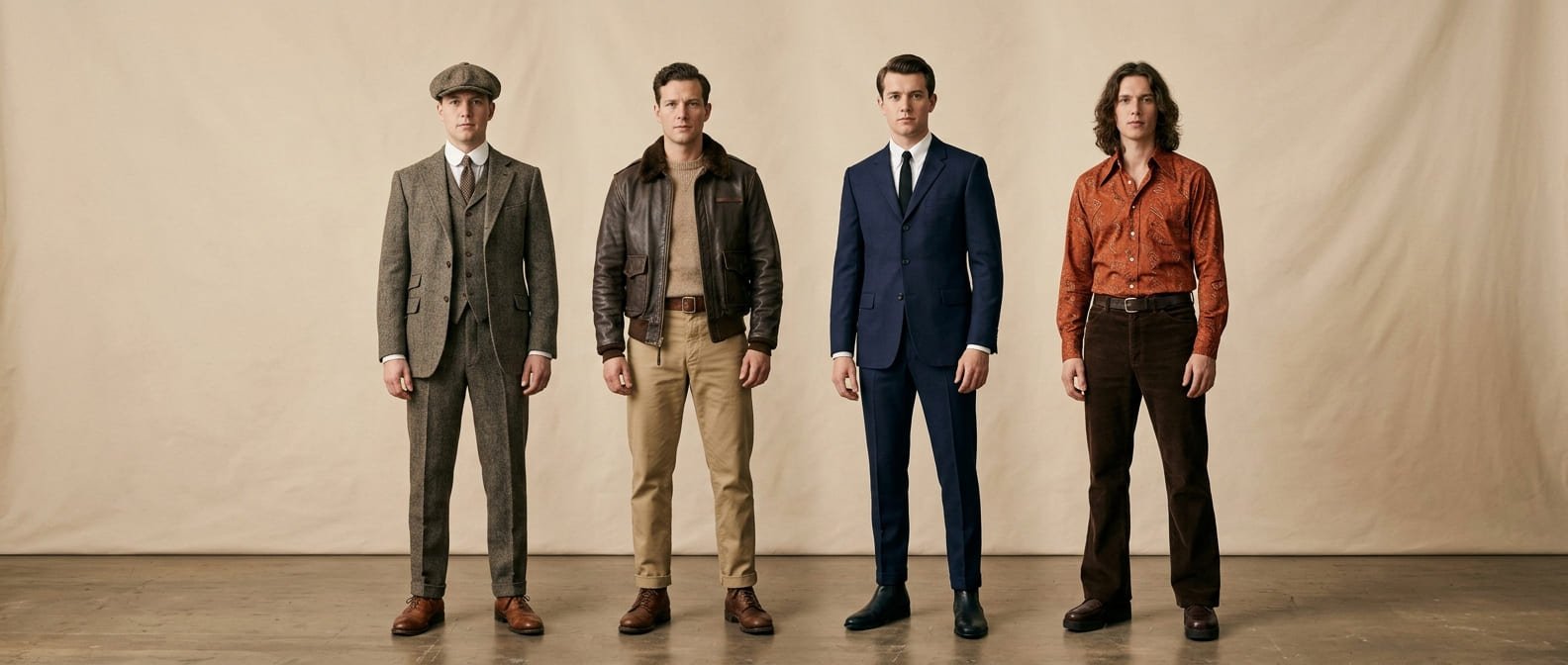

1940s men’s fashion was shaped by one event more than any other: the Second World War. For the first half of the decade, men across Europe wore uniforms, mended old suits and lived with clothing rationing, while factories made parachutes and greatcoats instead of fashion. When peace came, menswear swung the other way, with broad-shouldered suits, wide ties, bold prints and a new appetite for comfort. The decade gave us the trench coat as everyday wear, the bomber jacket, the T-shirt as a garment in its own right, chinos, the duffle coat and the high-waisted, pleated trouser that still comes back every few years. This guide explains the main 40s men’s fashion trends, how the war changed what men wore, the “demob” suit, the zoot suit and the post-war Bold Look, casual 1940s men’s fashion, hats and hair, and how to wear a 1940s look today.
The 1940s at a glance
| Period | The look | Key pieces |
|---|---|---|
| 1940 to 1945 | Wartime austerity and uniform | Utility suits, no turn-ups, knitwear, military coats, hats |
| 1945 to 1947 | Demob and return to civilian life | Demob suits, trench coats, bomber jackets, chinos |
| 1948 to 1949 | The Bold Look | Wide-shouldered suits, wide patterned ties, spread collars, two-tone shoes |

How the war changed men’s clothing
- Rationing. In Britain, clothes were rationed from 1941 by a points system, and most of Europe had similar rules. A man’s suit used a large share of his yearly coupons, so most men wore what they already owned for years.
- Utility clothing. British and American rules limited fabric for civilian suits: no turn-ups, fewer pockets, narrower lapels, no double-breasted jackets and no waistcoat with a double-breasted suit.
- Make do and mend. Collars were turned, elbows patched and old suits re-cut. Knitting at home was common, so hand-knitted pullovers and sleeveless vests became everyday wear.
- Uniforms everywhere. Millions of men spent years in uniform, and many military pieces stayed in their wardrobes afterwards.
- New materials. Rayon and other early synthetics replaced silk and some wool, especially in shirts, ties and linings.
The wartime suit
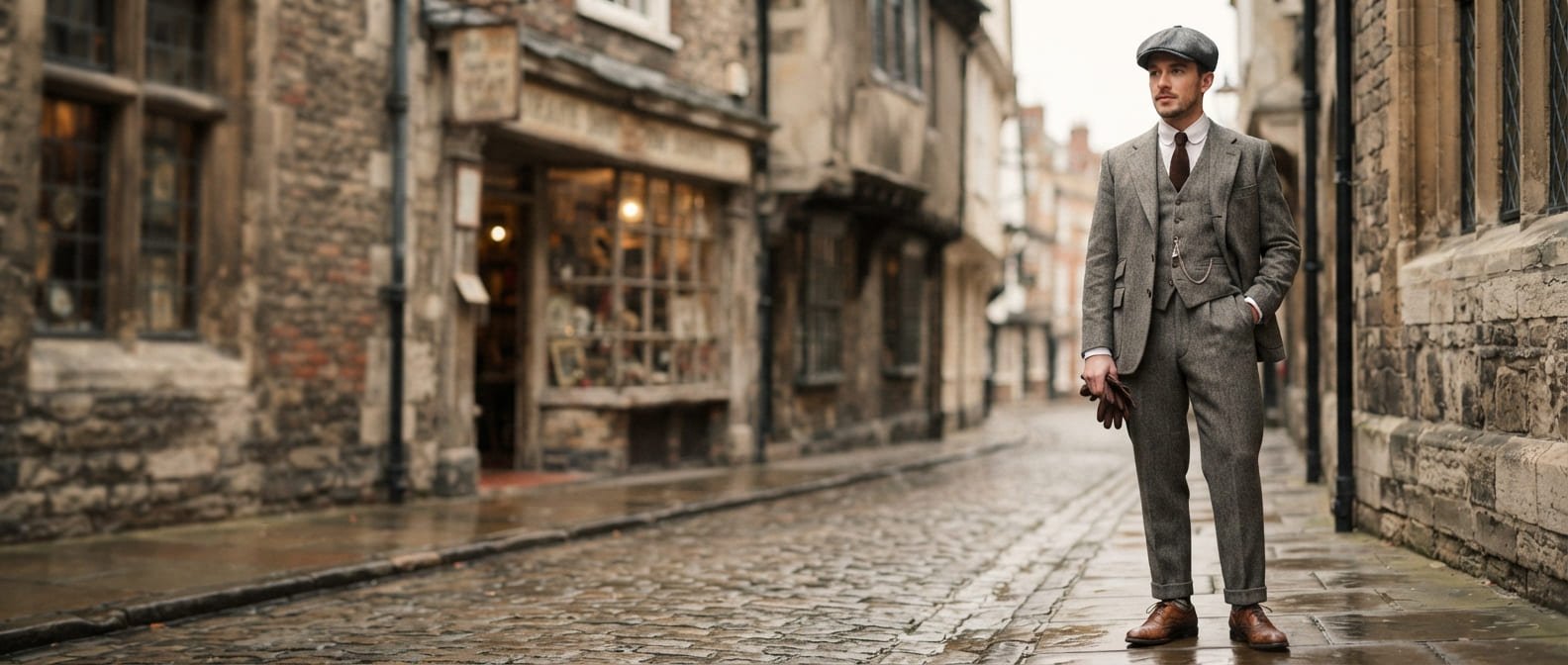
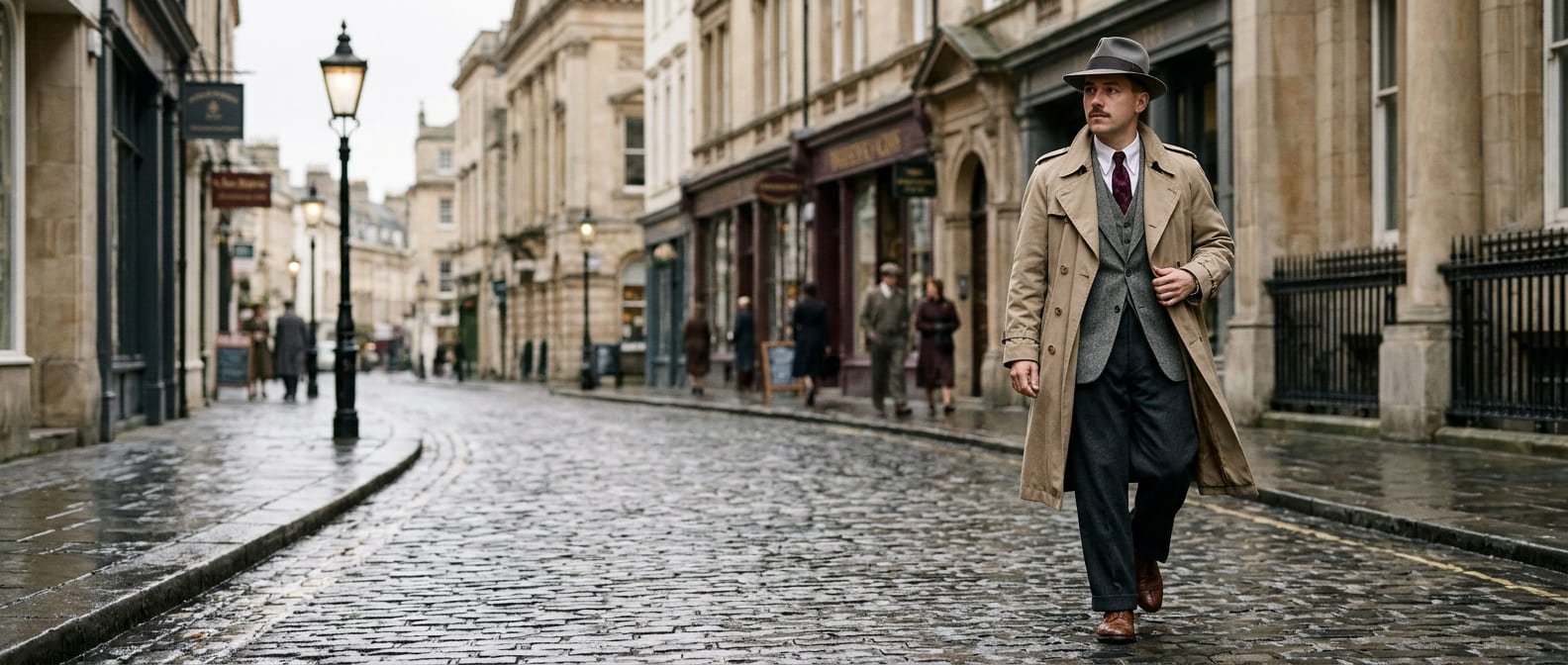
The typical early 1940s suit was a single-breasted, two- or three-button jacket in grey, brown or navy wool, with slightly padded shoulders, a defined waist and moderately wide lapels. Trousers sat high on the natural waist, held up by braces, and had one or two pleats and a straight, fairly wide leg. Under utility rules, turn-ups (cuffs) disappeared, and many men simply let the trousers fall plain. Waistcoats were still common with single-breasted suits, but they slowly faded out during the decade.
Shirts were white or pale blue with a point collar, sometimes with a detachable collar for older men. Ties were medium width, often in small geometric patterns or stripes. For more on how tailoring developed, see our guide to the two-piece suit.
- Grey wool three-button suit Suit
- White point-collar shirt Shirt
- Burgundy patterned tie Tie
- Brown leather oxford shoes Shoes
Military style in civilian life
When the war ended, men came home with greatcoats, flight jackets and field clothes, and many of these pieces became civilian classics.
- The trench coat: first a First World War officer’s coat, it became the businessman’s raincoat of the 1940s, double-breasted with a belt and epaulettes. See our guide to long coats for men.
- The bomber jacket: the leather flight jacket with a fur or shearling collar, later in nylon, became everyday wear for young men.
- The pea coat and duffle coat: naval coats that were sold as surplus after the war and worn by students and artists.
- Chinos: cotton khaki trousers from army uniforms became casual wear, especially in America.
- The T-shirt: issued to sailors and soldiers as an undershirt, it began to appear on its own by the end of the decade.
- Boots: sturdy leather service boots were worn for work and the outdoors.
- Brown leather flight jacket Jacket
- White crew-neck T-shirt T-shirt
- Khaki pleated chinos Trousers
- Brown leather service boots Boots
The demob suit
In Britain, every man leaving the forces received a set of civilian clothes, nicknamed the “demob suit”. It usually included a suit or a jacket and trousers, a shirt, a tie, shoes, a raincoat and a hat. Quality varied, sizes were limited and many men were seen wearing the same few patterns, but for millions it was their first new suit in years.
The zoot suit
At the other extreme was the zoot suit, worn by young men in American cities. In occupied Paris, the “zazous” wore their own version. It was a deliberate rejection of wartime fabric rules.
- A very long jacket reaching mid-thigh or the knee, with wide, padded shoulders.
- High-waisted trousers that were very wide at the knee and narrow at the ankle.
- A long watch chain hanging from the belt.
- A wide-brimmed hat, often with a feather.
- Bright colours and bold stripes.
Because it used so much fabric, it was seen as unpatriotic during the war, and it became a symbol of youth culture and swing music. Its exaggerated shape influenced swing dancers and, much later, revival styles.
The Bold Look of the late 1940s
From 1948, menswear magazines promoted the “Bold Look”: a confident, masculine style for a richer post-war world. The suit grew bigger again.
- Wide, padded shoulders and a drape cut with a fuller chest.
- Double-breasted jackets returned, often with six buttons and long, wide lapels.
- Wide ties, around 10 cm, in bright hand-painted designs, abstract patterns, tropical scenes and bold stripes.
- Spread collars and shirts in pale colours as well as white.
- Two-tone shoes and heavier brogues.
- Big wristwatches, cufflinks and tie bars.
- Navy double-breasted suit Suit
- Pale blue spread-collar shirt Shirt
- Wide patterned silk tie Tie
- Brown and white two-tone shoes Shoes
Casual 1940s men’s fashion
Weekend clothes in the 1940s were still neat by modern standards, but they were becoming softer and more relaxed.
- Knitwear: V-neck pullovers, sleeveless sweater vests and cardigans, often hand-knitted in Fair Isle or cable patterns. See cardigans for men.
- Open-collar shirts: the camp-collar shirt with a flat, open collar, worn untucked in summer.
- Hawaiian shirts: bright printed rayon shirts that soldiers brought back from the Pacific.
- High-waisted trousers in flannel, gabardine or corduroy, with pleats and a wide leg.
- Work clothes: denim jeans, dungarees and chore jackets for farm and factory work.
- Leather jackets and casual sports jackets in tweed.
- Cream cable-knit sweater vest Knit
- White open-collar shirt Shirt
- Brown high-waisted wool trousers Trousers
- Brown leather brogues Shoes
Hats, shoes and accessories
- Hats: almost every man wore one outdoors. The fedora in grey, brown or navy felt was the standard, with the trilby, the homburg for formal wear, the flat cap for working men and the straw panama in summer.
- Shoes: brown or black oxfords and derbies, brogues, two-tone shoes for leisure and heavy boots for work.
- Braces rather than belts held up high-waisted suit trousers.
- Pocket squares, tie bars and tie clips, and cufflinks with French cuffs.
- Wristwatches replaced pocket watches during the decade, helped by their use in the military.
- Spectacles were often round or with thin metal frames.
Hair and grooming
Short hair was the rule. Most men had a short back and sides with a side parting, slicked down with hair cream or oil. Military haircuts were even shorter. Pencil moustaches were popular, inspired by film stars, while full beards were rare. Men shaved daily with safety razors, and aftershave and hair tonic were part of the routine.
1940s style in Britain, Italy and France
- Britain: clothes rationing lasted until 1949, so British men lived with utility suits and make-do clothing longest. The tweed jacket, the flat cap and the duffle coat were common. See our guide to British fashion.
- Italy: after the war, Italian tailors in Rome, Naples and Florence began building the softer, lighter style that would make them famous in the 1950s. See Italian men’s fashion trends.
- France: under occupation, the zazous wore long jackets, narrow trousers and thick-soled shoes as a quiet protest, and after liberation Paris slowly rebuilt its fashion industry. See French style for men.
The colours of the 1940s
Wartime clothes were dull for practical reasons: dyes were scarce and dark colours hid wear. After the war, ties and casual shirts became bright.
How to wear 1940s style today
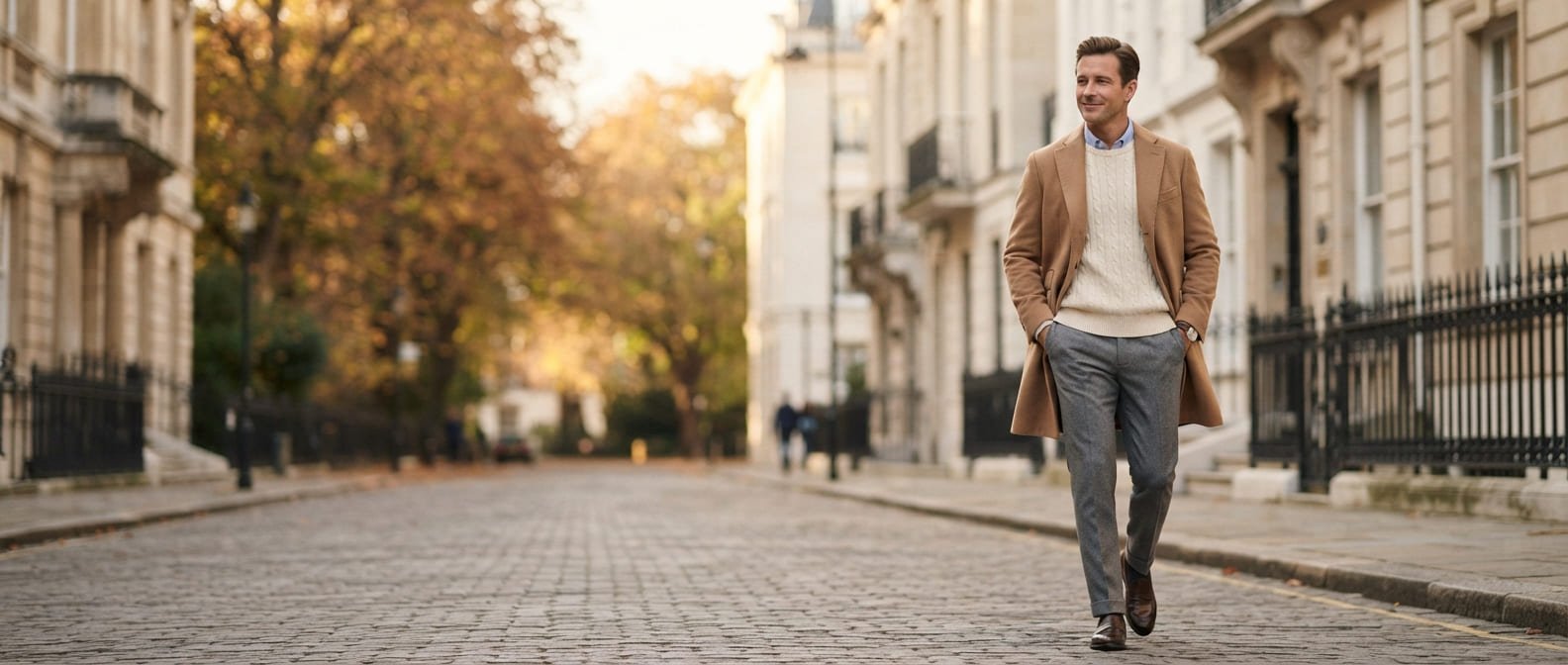
Many 1940s pieces sit comfortably in a modern wardrobe, and the high-waisted, wide-leg trouser is back in fashion.
- Wear high-waisted pleated trousers with a tucked-in shirt or knit polo and a short jacket.
- Choose a trench coat or a duffle coat as your main coat. See winter coats for men.
- Try a camp-collar shirt in summer, in a plain colour or a muted print.
- Add a sweater vest over a shirt for a smart, slightly vintage look.
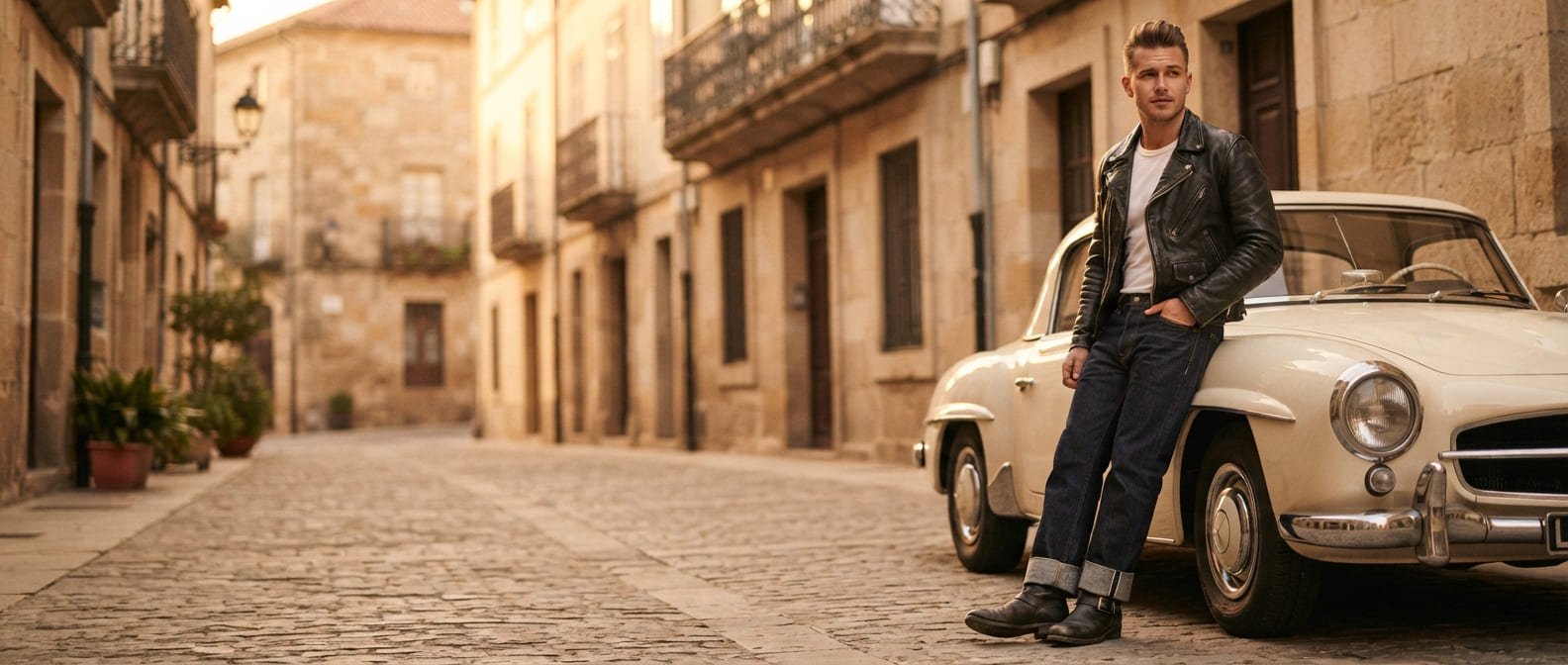
- Wear a leather flight jacket with a white T-shirt, chinos and boots.
- Keep it to one or two period pieces. A full suit, fedora and braces together reads as a costume.
For a polished everyday version, see smart casual for men and old money style for men, which borrows heavily from this era.
A 1940s party or decade day outfit
- Wartime gentleman: a grey three-piece suit, a white shirt, a patterned tie, braces, brown brogues and a fedora.
- Swing dancer: high-waisted wide trousers, a short-sleeved shirt, braces, two-tone shoes and slicked hair.
- Airman off duty: a leather flight jacket, a white T-shirt, khaki chinos and boots.
- Bold Look: a wide double-breasted suit, a spread-collar shirt and a loud wide tie.
For other eras, see our guides to 1920s men’s fashion, 1950s men’s fashion and men’s fashion by decade.
Common mistakes
| Mistake | Why it doesn’t work | Better choice |
|---|---|---|
| Low-rise slim trousers | The 1940s waist was high and the leg was full | High-waisted trousers with pleats |
| Skinny ties | Ties were medium to wide all decade | A tie around 8 to 10 cm |
| Short, tight jackets | Jackets were longer, with padded shoulders | A jacket that covers the seat |
| Mixing wartime and zoot details | Austerity and excess were opposites | Pick one look and commit to it |
| Costume-shop gangster outfits | Pinstripes and spats in one look feel fake | Real wool tailoring and one period accessory |
Frequently asked questions
Suits with padded shoulders and high-waisted, pleated trousers, white shirts, medium or wide ties, fedoras and leather oxfords. Casual wear included knitwear, open-collar shirts, chinos, leather jackets and work clothes.
Utility suits, military coats such as the trench and pea coat, bomber jackets, sweater vests, camp-collar and Hawaiian shirts, the zoot suit and, from 1948, the wide-shouldered Bold Look.
Rationing and fabric rules removed turn-ups, extra pockets and double-breasted jackets for a time, men repaired old clothes, and many military garments later became civilian classics.
The set of civilian clothes, usually a suit, shirt, tie, shoes, raincoat and hat, given to British servicemen when they left the forces after the war.
A suit with a very long jacket, wide padded shoulders and high-waisted trousers that ballooned at the knee and narrowed at the ankle, worn by young men as a symbol of youth culture.
High-waisted flannel or corduroy trousers, knitted pullovers, sweater vests and cardigans, open-collar or Hawaiian shirts, tweed jackets, leather jackets and, for work, denim and chore jackets.
Mostly fedoras, plus trilbies, homburgs for formal occasions, flat caps for working men and straw panamas in summer.
Short back and sides with a side parting, slicked with hair cream, often with a pencil moustache.
Wear high-waisted pleated trousers, a camp-collar shirt or sweater vest, a trench or duffle coat, or a leather flight jacket with a white T-shirt, and keep it to one or two period pieces.