
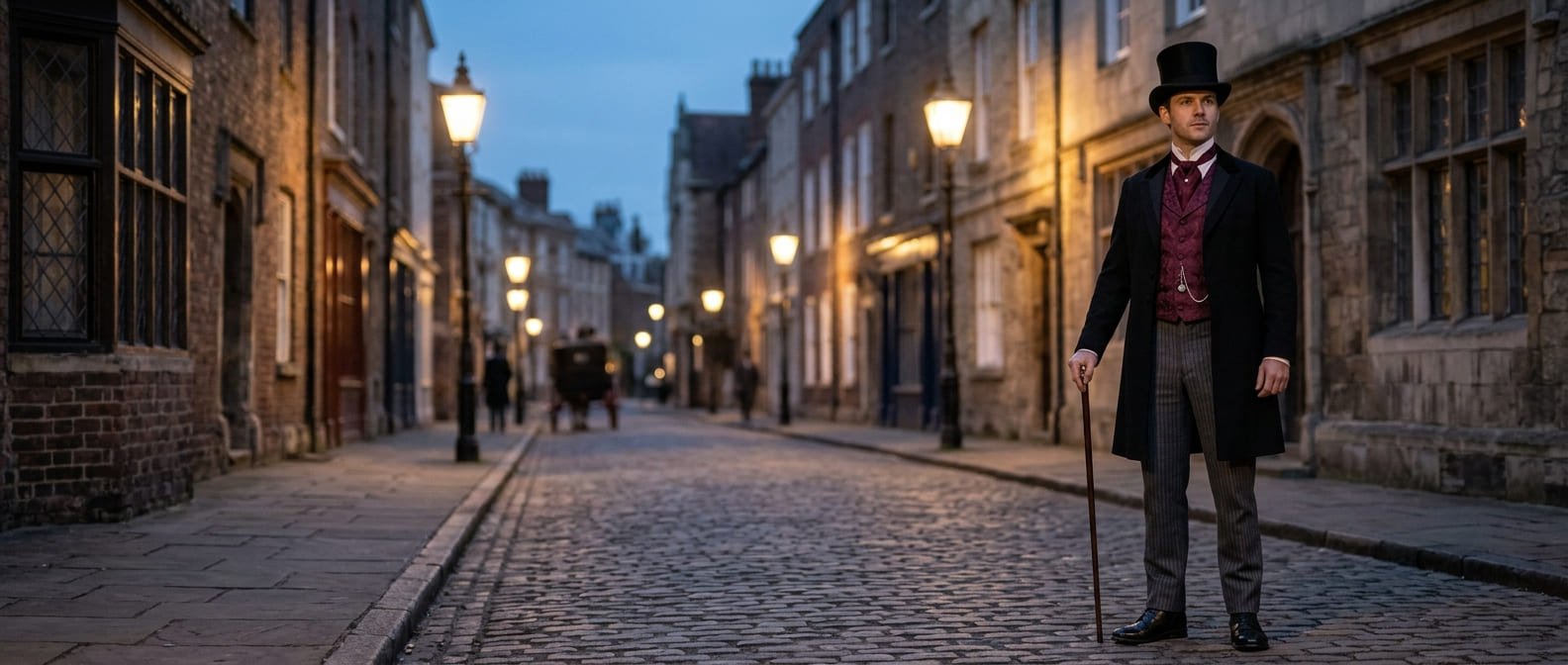
Victorian men’s fashion gave us the modern man’s wardrobe. Over the 1800s, menswear moved from the colourful silks of the 18th century to the dark wool suit, the overcoat, the waistcoat, the white shirt and the necktie, pieces that men still wear in only slightly changed form. Queen Victoria reigned from 1837 to 1901, but to understand her era you need the whole century: the elegant Regency dandies before her and the relaxed Edwardians after her. This guide explains how 1800s men’s fashion developed decade by decade, the coats, hats and accessories of a Victorian gentleman, how working men dressed, and how to wear a Victorian look today, for a themed party, a Dickens-style Christmas, a steampunk event or a touch of period style in everyday clothes.
The 1800s at a glance
| Period | Dates | The look |
|---|---|---|
| Regency | About 1800 to 1837 | Tailcoat, light breeches or pantaloons, high cravat, tall boots |
| Early Victorian | 1837 to 1860 | Frock coat, colourful waistcoat, strapped trousers, top hat, side whiskers |
| Mid Victorian | 1860 to 1880 | Morning coat, matching suits, the bowler hat, full beards |
| Late Victorian | 1880 to 1901 | Lounge suit, high starched collar, homburg, dinner jacket, moustache |
| Edwardian | 1901 to 1910 | Relaxed lounge suits, boaters, flat caps, motoring coats |
Regency: the age of the dandy
Before Victoria, fashion was led by the Regency dandies, above all the famous trendsetter Beau Brummell. He replaced flashy colours and lace with perfect cut and spotless linen, and that idea shaped menswear for the next 200 years.
- The tailcoat: cut straight across the front at the waist, with long tails behind, in dark blue, black or brown wool.
- Breeches or pantaloons: close-fitting, pale buff or cream, tucked into tall riding boots.
- The cravat: a long white linen band wrapped high around the neck and tied with care.
- The waistcoat: short, often white or pale.
- The top hat, which replaced the tricorn and bicorn.
Early Victorian: the frock coat
When Victoria came to the throne in 1837, the frock coat became the standard garment for respectable men. It had a full skirt that reached the knee all the way round, a fitted waist and a high collar.
- Waistcoats were the one place for colour and pattern: silk brocade, tartan and bold checks.
- Trousers replaced breeches, often with straps under the foot to keep them smooth.
- Shirts had high, stiff collars, and the cravat became a wide, bow-tied neckcloth called a stock.
- The top hat was worn for almost every occasion, in black silk or beaver.
- Facial hair: side whiskers and, from the 1850s, full beards, made popular by soldiers returning from the Crimean War.
- Black wool frock coat Coat
- Burgundy patterned silk waistcoat Waistcoat
- Grey striped trousers Trousers
- Black leather boots Shoes
Mid Victorian: the suit is born
From the 1860s, menswear became darker, plainer and more practical.
- The morning coat, cut away at the front in a curve, became the everyday smart coat. It survives today as formal wedding wear.
- The sack or lounge jacket, a loose, short coat without a waist seam, appeared for leisure and the countryside.
- Matching suits: for the first time, jacket, waistcoat and trousers in the same cloth became common. This was the beginning of the modern three-piece suit.
- The bowler hat, invented in London in 1849 for a gamekeeper, spread to clerks and city men.
- Detachable collars and cuffs let men keep shirts looking fresh without washing the whole garment.
- Overcoats: the Chesterfield with a velvet collar, the Inverness cape with its shoulder cape, and heavy greatcoats.
Late Victorian: the modern gentleman
By the 1880s and 1890s, the lounge suit was acceptable for business in the city, and the look we now call “Victorian gentleman” was complete.
- Very high, starched stand or wing collars, sometimes 7 cm tall.
- Neckties tied in a four-in-hand knot, as well as bow ties and wide ascots.
- Single- and double-breasted waistcoats.
- The homburg hat, made fashionable by the Prince of Wales.
- The dinner jacket, a short, tailless evening jacket, first worn at informal dinners from the 1860s, and the ancestor of the tuxedo.
- The Norfolk jacket, a belted tweed jacket with pleats, for shooting and the new craze of cycling.
- The straw boater for summer and the seaside.
- Moustaches, often waxed, replaced full beards for younger men.
- Charcoal three-piece lounge suit Suit
- White shirt with wing collar Shirt
- Burgundy silk cravat Tie
- Black leather boots Shoes
Evening and formal wear
For formal evenings, Victorian men wore white tie: a black tailcoat, black trousers with a silk stripe, a white waistcoat, a stiff white shirt with a wing collar and a white bow tie. Black was also the colour of mourning, which Victorian society took very seriously, and men wore black armbands or black hatbands after a death in the family. For how these codes survive today, see dress codes explained.
Accessories of a Victorian gentleman
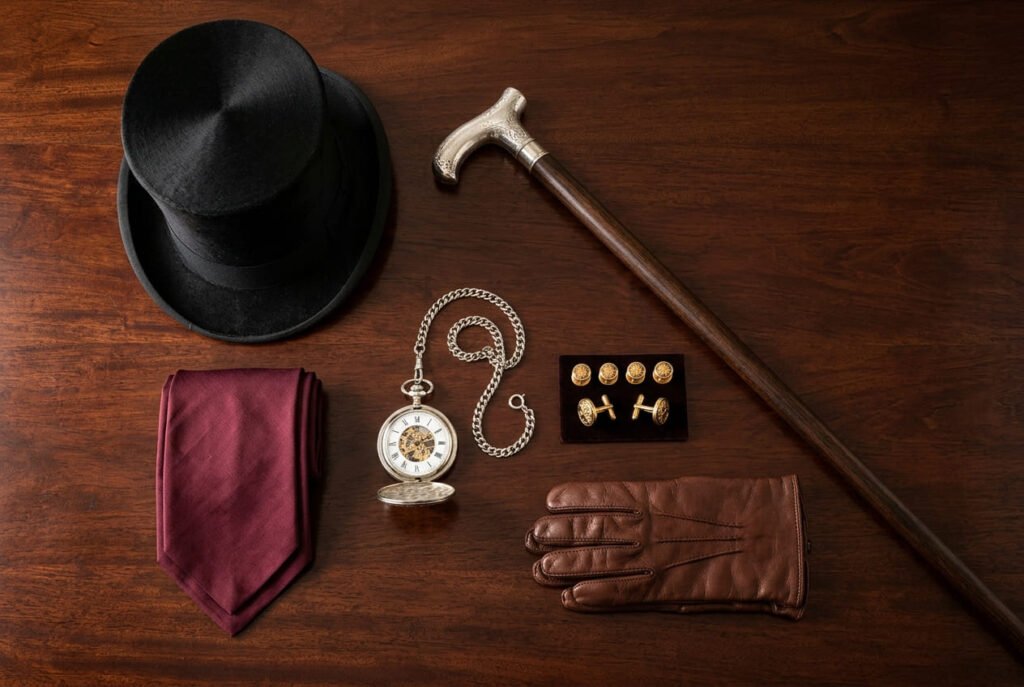
- The pocket watch, worn in the waistcoat pocket on a chain across the front. The chain is often called an albert, after Queen Victoria’s husband.
- Walking canes, with silver, ivory or wooden handles.
- Gloves, in leather for day and white for evening.
- Hats: the top hat, bowler, homburg, boater and, for the country, the deerstalker and the flat cap.
- Cufflinks, tie pins and collar studs.
- Elastic-sided boots, the ancestor of today’s Chelsea boots, introduced in the 1830s and 1840s.
- Umbrellas carried tightly rolled.
For modern versions of these details, see winter accessories for men.
How working men dressed
Most Victorian men were not gentlemen, and their clothes were practical and long-lasting.
- Collarless shirts in cotton or flannel, fastened with a stud.
- Waistcoats, worn even when the jacket came off.
- Corduroy, moleskin or heavy wool trousers, held up with braces.
- Neckerchiefs knotted at the throat.
- Flat caps, which spread among working men in the late 19th century.
- Hobnailed leather boots.
- Smocks for farm workers in the early part of the century.
Clothes were mended, passed down and sold second-hand many times. This working wardrobe is the root of many modern pieces, from the waistcoat-and-shirt look to the grandad collar shirt.
Victorian style across Europe
- Britain set the rules for menswear. London tailors on Savile Row became the world’s reference for cut. See British fashion.
- France led women’s fashion, and Parisian men were known for slightly more flamboyant waistcoats and ties.
- Germany and Austria followed British tailoring for city wear, while traditional regional dress stayed strong in the country.
- Russia’s upper classes dressed in the same European style, with heavy fur-lined coats and hats for the winter.
The colours of Victorian menswear
The century moved from colour to darkness. Early waistcoats were bright; by the end, a respectable man dressed almost entirely in black, grey, navy and brown, with colour only in a tie or waistcoat.
How to wear Victorian style today
You can borrow from the 1800s without looking like you’ve walked off a film set.
- Wear a waistcoat, with a suit or with a shirt and trousers. See our guide to the two-piece suit and three-piece options.
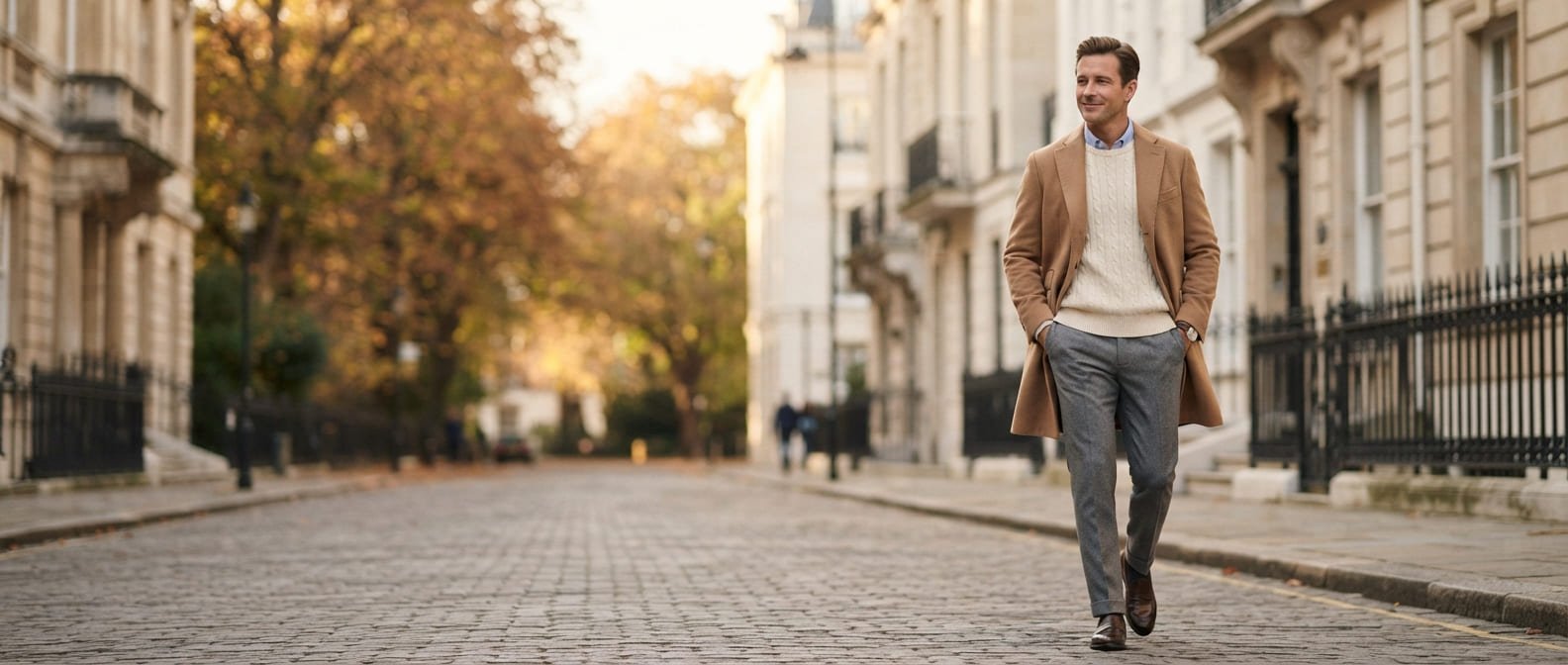
- Choose a long overcoat: a Chesterfield or a dark wool coat that reaches the knee. See long coats for men.
- Try a grandad collar shirt, the descendant of the detachable collar shirt.
- Wear Chelsea boots, which come directly from the Victorian elastic-sided boot.
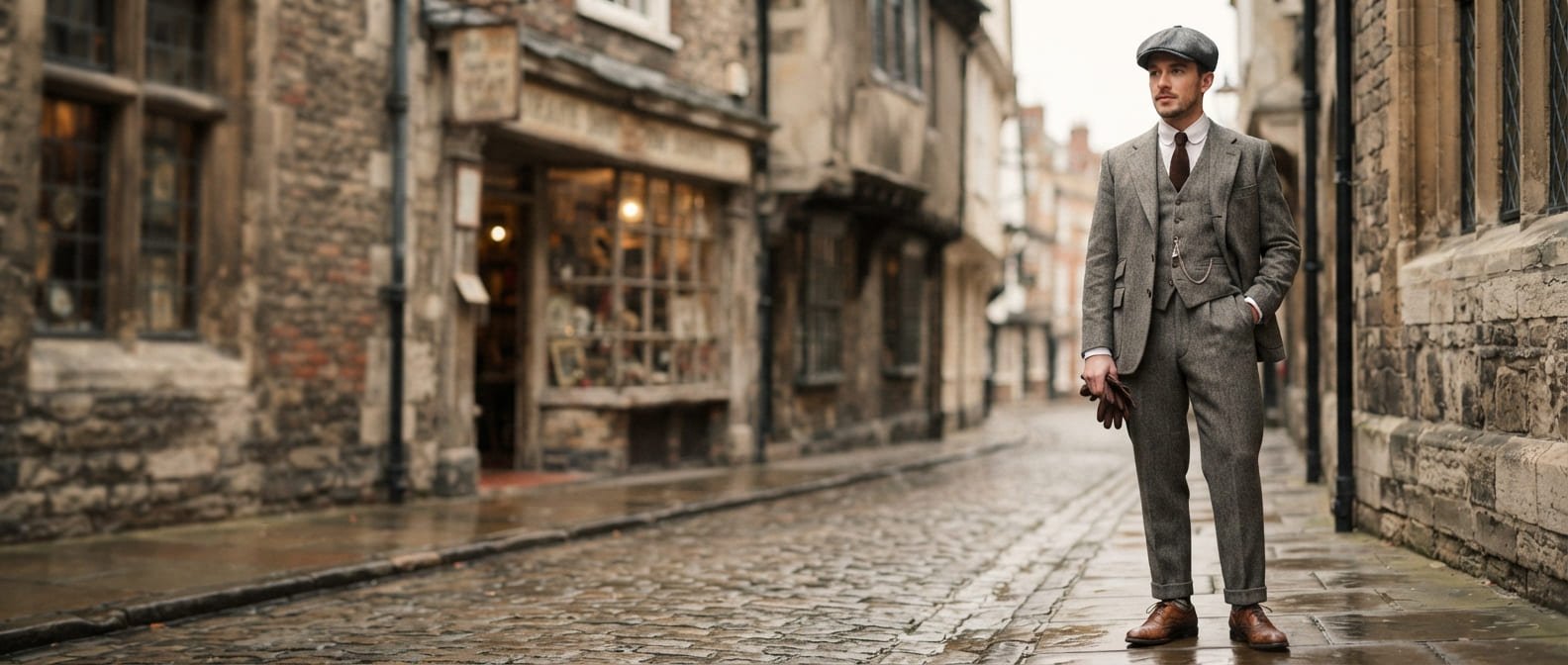
- Add one detail: a pocket watch chain, a silk scarf worn like a cravat, or a flat cap.
- Choose texture: tweed, flannel, corduroy and moleskin.
For a classic everyday version of this look, see old money style for men.
A Victorian costume for a party or event
- Victorian gentleman: a black frock coat or long jacket, a patterned waistcoat, a white shirt with a high collar, a cravat, a top hat, gloves and a cane.
- Dickens Christmas: a tweed suit with a waistcoat, a woollen scarf, a top hat or bowler and fingerless gloves.
- Steampunk: a Victorian base of waistcoat, frock coat and boots, with brass goggles, leather straps and mechanical details added.
- Regency ball: a dark tailcoat, pale breeches or slim trousers, a white cravat and tall boots.
Fancy dress and masked balls are covered in our guide to masquerade ball outfit ideas for men, and other eras in men’s fashion by decade and 1920s men’s fashion.
Common mistakes
| Mistake | Why it looks wrong | Better choice |
|---|---|---|
| Mixing Regency and late Victorian | Breeches with a homburg spans 80 years | Pick one period |
| Shiny synthetic costume fabrics | Victorians wore wool, linen and silk | Wool, tweed and cotton |
| A modern low-collared shirt | Collars were high and stiff | A wing or high stand collar |
| Too many accessories | Looks like a costume | Two or three details |
| Trainers with a period outfit | Breaks the whole look | Black or brown leather boots |
Frequently asked questions
A frock coat or morning coat, later a lounge suit, a waistcoat, trousers, a white shirt with a high collar, a cravat or necktie, leather boots and a hat such as a top hat or bowler.
Regency men wore tailcoats, pale breeches and tall boots. Victorian men wore frock coats, long trousers and, by the end of the century, dark matching suits.
The top hat, the bowler, the homburg, the straw boater in summer and the deerstalker and flat cap in the country.
Collarless shirts, waistcoats, heavy corduroy or wool trousers with braces, neckerchiefs, flat caps and hobnailed boots.
Matching jackets, waistcoats and trousers became common from the 1860s, and the lounge suit was accepted for city business by the 1890s.
A knee-length coat with a fitted waist and a full skirt all the way round, the standard smart coat of the early and mid Victorian period.
Side whiskers early on, full beards from the 1850s, and waxed moustaches later in the century.
Combine a long dark jacket, a patterned waistcoat, a white shirt, a scarf tied as a cravat, a pocket watch chain and black boots, and add a hat if you can.
Yes, in small doses: a waistcoat, a long wool overcoat, a grandad collar shirt or Chelsea boots all work in a modern wardrobe.