
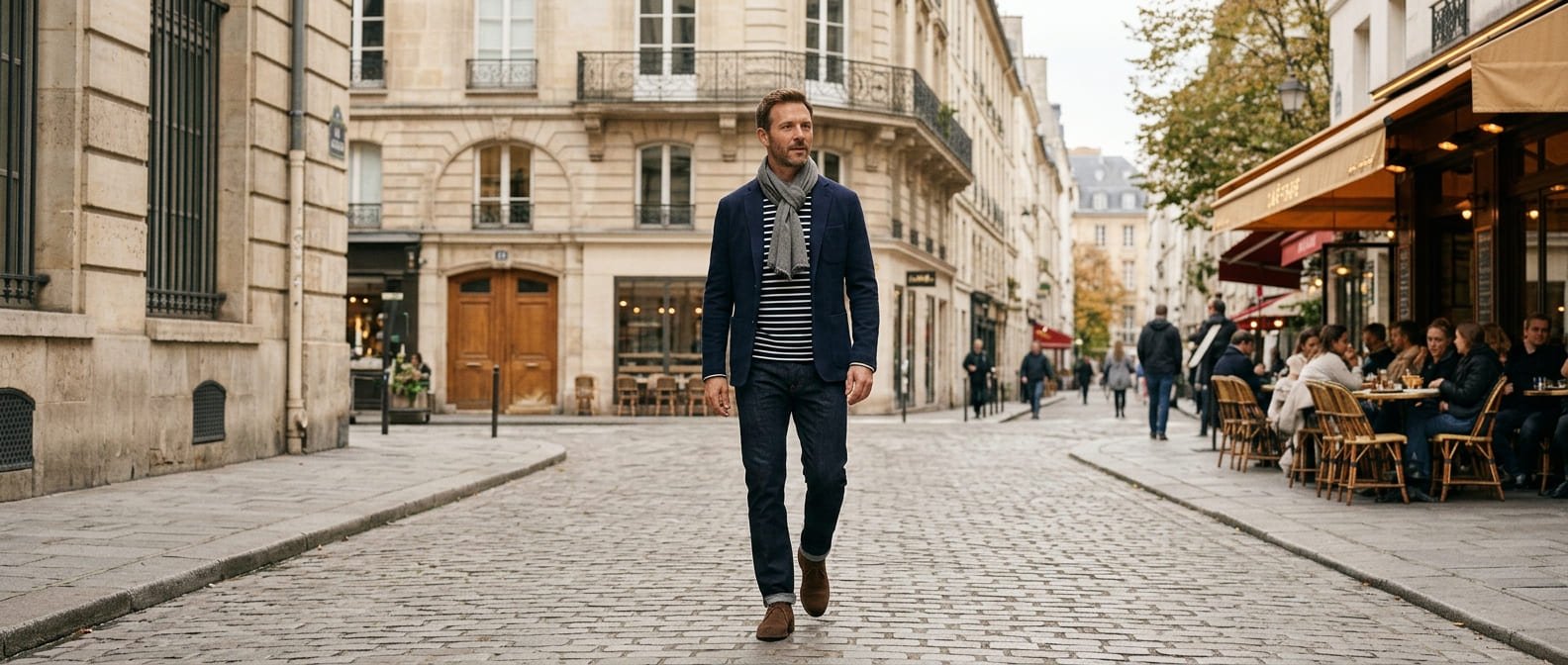
French style for men is admired all over the world, yet it’s surprisingly hard to pin down. It isn’t formal, and it isn’t casual. It doesn’t rely on trends or logos. A well-dressed man in Paris, Lyon or Bordeaux usually wears a handful of simple pieces: a navy knit, straight jeans, a good coat, leather shoes or clean trainers and perhaps a scarf. What makes French style for men distinctive is how those pieces fit, how few colours are involved and how relaxed the whole thing looks. This guide explains the principles of Parisian chic, the key pieces, outfits for every occasion and season, and how to bring the look into your own wardrobe.
Travelling to France soon? Our Paris outfit ideas guide covers what to pack and wear on a trip.
French style for men at a glance
- Understated. Nothing loud, shiny or covered in logos.
- Neutral. Navy, grey, black, white, cream and camel, with the occasional stripe.
- Well fitted. Neat at the shoulder, clean at the hem, never baggy and never tight.
- Built on basics. Knitwear, shirts, straight jeans, chinos and a good coat.
- A little imperfect. A collar left open, a scarf thrown on, hair not quite in place.
- Consistent. French men tend to find what suits them and keep wearing it.
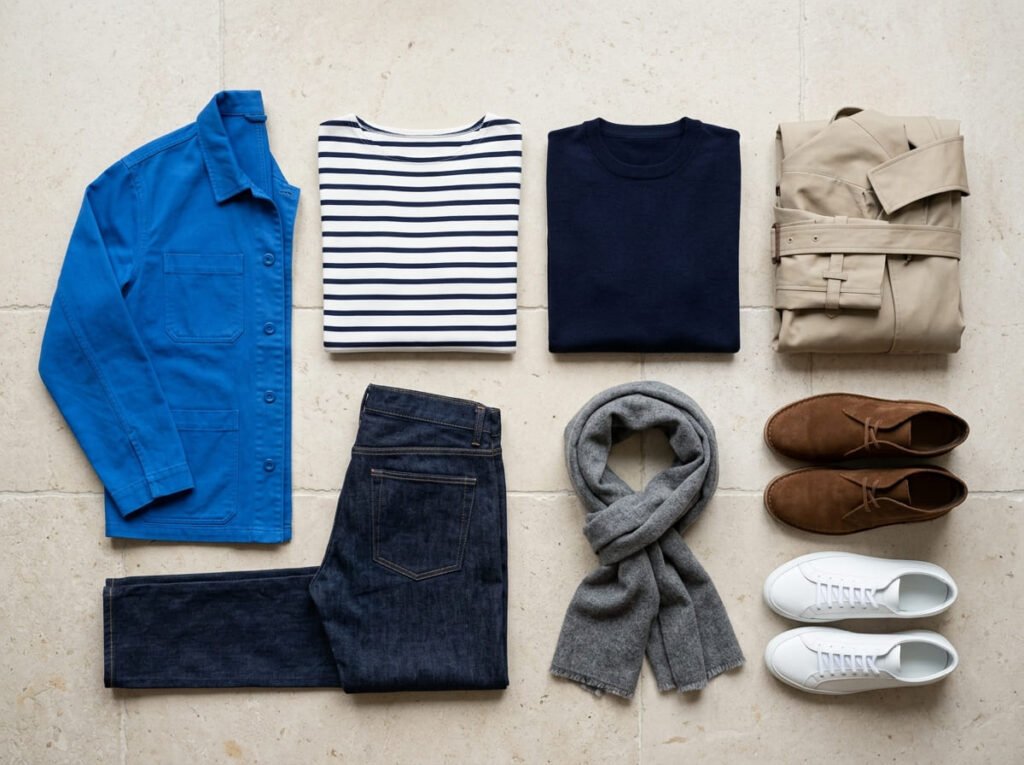
What do French people wear?
Visitors often ask what French people wear day to day, expecting berets and striped shirts on every corner. The reality is more ordinary and more useful. Clothing in France is practical, simple and neat. On a typical weekday, you’ll see men in dark jeans or chinos, a plain knit or shirt, a wool coat or a short jacket and leather shoes, boots or white trainers. Colours are dark and muted, especially in the cities.
What stands out is the care taken. Shoes are clean, coats fit, and outfits are complete without being fussy. The French call this effortless quality “je ne sais quoi”, meaning a certain something that’s hard to define.
The principles of Parisian chic for men
Parisian chic is often discussed as women’s style, but the same ideas shape how French men dress.
1. Less is more
French wardrobes are small. A few good pieces are worn again and again in different combinations. Repeating an outfit isn’t a problem; it’s a sign you know what works.
2. Fit over fashion
Trends come and go, but a jacket that fits at the shoulder and trousers of the right length always look good. French men use tailors for small alterations as a matter of course.
3. One idea per outfit
A striped top, a bold scarf or a textured jacket: one point of interest is enough. Everything else stays plain.
4. Mix smart and casual
A blazer with jeans, a knit with tailored trousers, trainers with a wool coat. Mixing levels of formality keeps outfits from looking stiff.
5. Relaxed, not careless
Clothes are clean and pressed, but worn with ease: sleeves pushed up, a scarf loosely knotted, a coat left open.
The key pieces of French style for men
| Piece | How French men wear it | Colours |
|---|---|---|
| Breton striped top | Under a blazer or jacket, or on its own with jeans | Navy and white |
| Navy crew-neck knit | Over a T-shirt or shirt, with everything | Navy, grey |
| Straight dark jeans | The everyday trouser | Indigo, black |
| Chinos | Smart casual days | Stone, navy, olive |
| Oxford or poplin shirt | Open at the collar, sleeves rolled | White, light blue |
| Unstructured blazer | With jeans or chinos, rarely as a full suit off duty | Navy, grey |
| Chore jacket | A worker’s jacket turned everyday classic | French blue, navy |
| Trench coat or mac | Spring and autumn rain | Stone, navy |
| Wool overcoat | The centre of the winter wardrobe | Navy, camel, charcoal |
| Scarf | Loosely knotted, most of the year | Navy, grey, burgundy |
| Leather shoes or boots | Derbies, loafers, desert and Chelsea boots | Brown, black |
| White leather trainers | Everyday walking | White |
The Breton striped top
The striped sailor’s top, known as the marinière, began as part of the French navy uniform in the nineteenth century and became a civilian classic. It’s the easiest way to add a French note to an outfit. Wear it with dark jeans and a navy blazer or a chore jacket. Read more about its origins in our guide to traditional French clothing.
The chore jacket
The simple cotton worker’s jacket, traditionally in a bright blue, has become a staple of French casual style. It works like a relaxed blazer: over a T-shirt, shirt or knit, with jeans or chinos.
The scarf
French men wear scarves for much of the year: wool in winter, light cotton or linen in spring. A scarf adds colour and texture to a plain outfit and is one of the most recognisable touches of French style.
- Navy and white striped Breton top Top
- Navy unstructured blazer Jacket
- Dark straight jeans Trousers
- Brown suede desert boots Shoes
Colours of French style
Navy is the foundation of French style for men. It’s softer than black, works in every season and combines with everything. Add grey, white and camel, and you have a complete palette. Bright colours appear rarely and in small amounts, such as a scarf or a pair of socks.
Paris street style for men
Paris street style varies by neighbourhood, and watching it is one of the best ways to understand French dressing.
- Le Marais: creative and fashion-aware. Wider trousers, chore jackets, interesting knitwear and clean trainers.
- Saint-Germain-des-Prés: classic and intellectual. Navy blazers, oxford shirts, round-neck knits, corduroy and loafers.
- The grand boulevards and business districts: dark tailoring, long overcoats, leather shoes and scarves.
- Canal Saint-Martin and the east: relaxed and young. Workwear jackets, straight jeans, beanies and trainers.
- Montmartre: artistic and casual, with vintage pieces and layered knitwear.
Across all of them, the common threads are dark, muted colours, neat fits and very few logos.
French style outfits for every occasion
Everyday
A navy knit over a white T-shirt, dark straight jeans and white leather trainers. Add a chore jacket or trench coat depending on the weather.
The office
A navy or grey unstructured blazer, a light-blue shirt, grey wool trousers or chinos and brown leather derbies. Ties are less common than they used to be outside formal sectors. See our guide to business casual for men.
Dinner
A fine rollneck or open-collar shirt under a blazer, dark trousers and leather shoes. French men dress up a little for dinner without looking formal.
- Charcoal fine-knit rollneck Knit
- Navy wool blazer Jacket
- Grey flannel trousers Trousers
- Black leather Chelsea boots Shoes
The weekend
A Breton top or plain T-shirt, a chore jacket, chinos and desert boots or trainers. Relaxed, but still put together.
A wedding or formal event
A well-fitted navy or charcoal suit, a white shirt, a simple tie and polished shoes. French formal style is restrained: no loud colours, novelty ties or flashy accessories.
French style by season
Spring: a trench coat or light jacket over a knit, chinos or jeans and leather trainers. A light scarf for cool mornings.
Summer: linen or cotton shirts, light chinos or tailored shorts, loafers or espadrilles. Colours lighten to white, stone and pale blue.
Autumn: knitwear, corduroy, a chore jacket or mac and suede boots. Burgundy and forest green join the palette.
Winter: a wool overcoat, a scarf, a rollneck or crew-neck knit, dark trousers and leather boots.
French style versus Italian and British style
| Element | French | Italian | British |
|---|---|---|---|
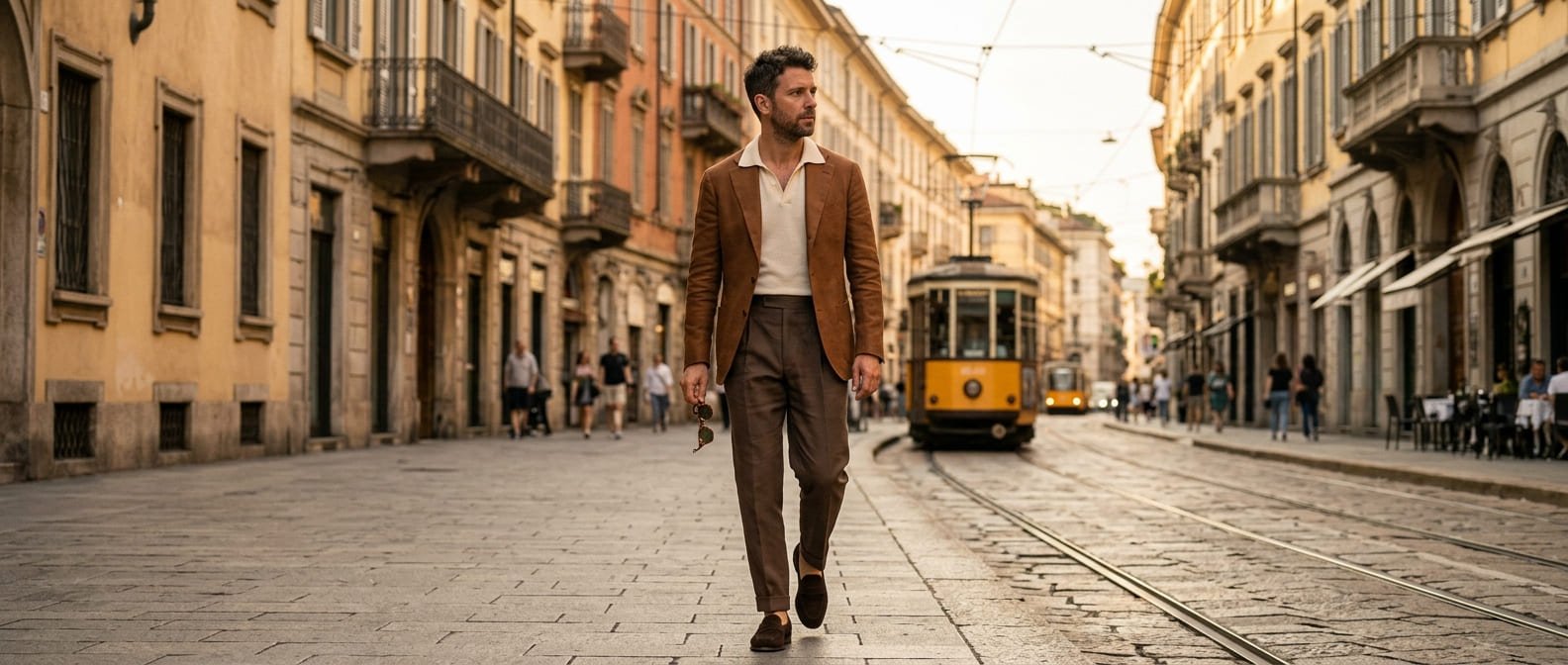
| Overall mood | Understated | Polished and expressive | Traditional with a street edge |
| Colours | Navy, grey, black, white | Warm browns, cream, olive | Navy, green, brown, checks |
| Tailoring | Neat and simple | Soft and unstructured | Structured and classic |
| Signature shoe | Derbies, desert boots, white trainers | Suede loafers | Brogues and boots |
| Signature piece | Navy knit, trench coat, scarf | Soft blazer, knitted polo | Tweed jacket, waxed coat |
For more, read about Italian men’s fashion trends and European men’s fashion as a whole.
French style beyond Paris
Paris sets the tone, but French style for men changes subtly across the country.
- Lyon: quietly elegant and a little more conservative, with fine knitwear, tailored coats and leather shoes.
- Bordeaux: classic and preppy, with navy blazers, chinos, loafers and striped shirts.
- Marseille and the south: more relaxed and colourful, with linen, lighter fabrics and espadrilles in summer.
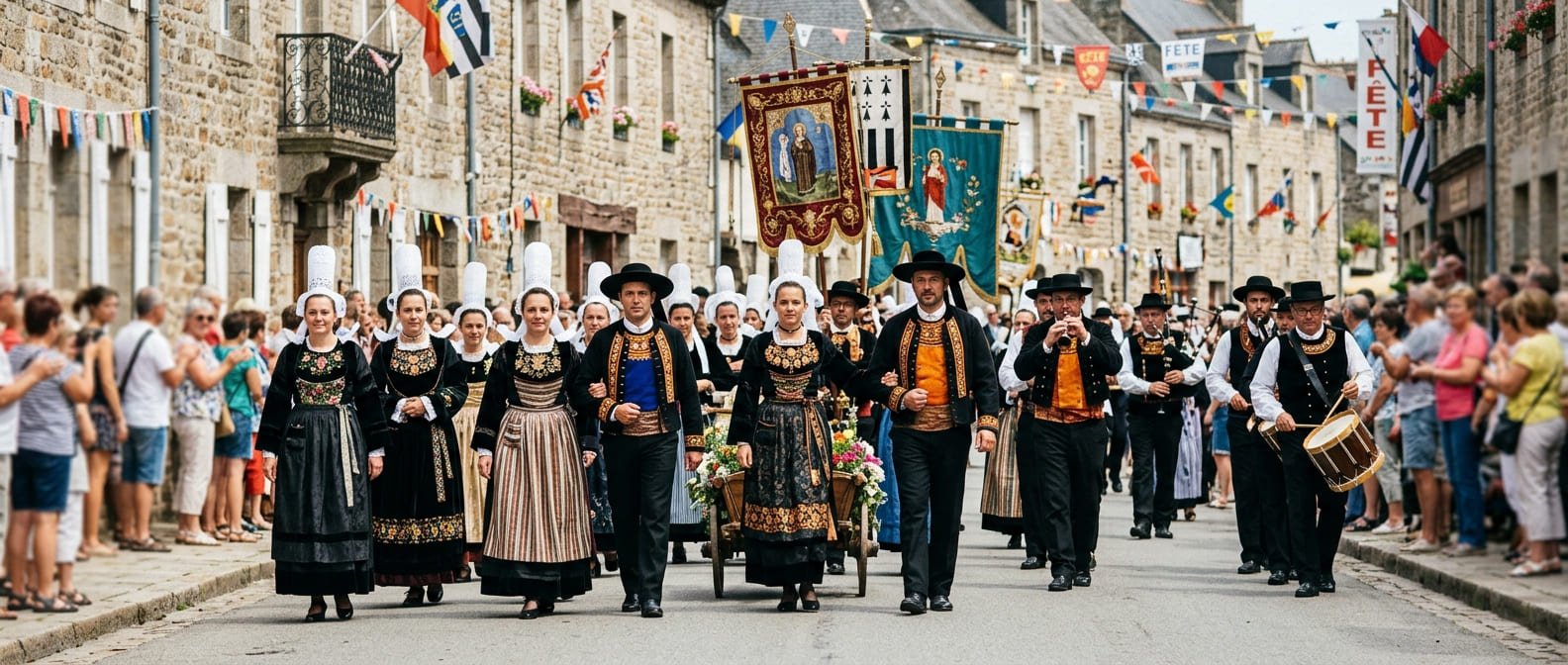
- Brittany and the Atlantic coast: practical and nautical, with striped tops, fisherman’s jumpers, waterproof jackets and deck shoes.
- The Alps: functional and outdoor-led, with quality knitwear and technical outerwear worn in town.
Fabrics and quality
French men tend to choose natural fabrics and judge clothes by touch as much as by look.
- Wool and merino for knitwear, coats and trousers.
- Cotton for shirts, T-shirts, chinos and work jackets.
- Linen for summer shirts and trousers.
- Corduroy and moleskin for autumn and winter trousers and jackets.
- Leather and suede for shoes, belts and bags.
Clothes are often bought to last. It’s common to keep a good coat or pair of shoes for many years and have them repaired rather than replaced.
A French capsule wardrobe for men
These twelve pieces create most French-style outfits.
- A navy crew-neck knit
- A Breton striped top
- Two plain T-shirts in white and navy
- A white or light-blue shirt
- Dark straight jeans
- Stone or navy chinos
- Grey wool trousers
- A navy unstructured blazer
- A blue or navy chore jacket
- A trench coat or wool overcoat
- A wool or cotton scarf
- Leather desert boots or derbies, plus white leather trainers
French style for men at different ages
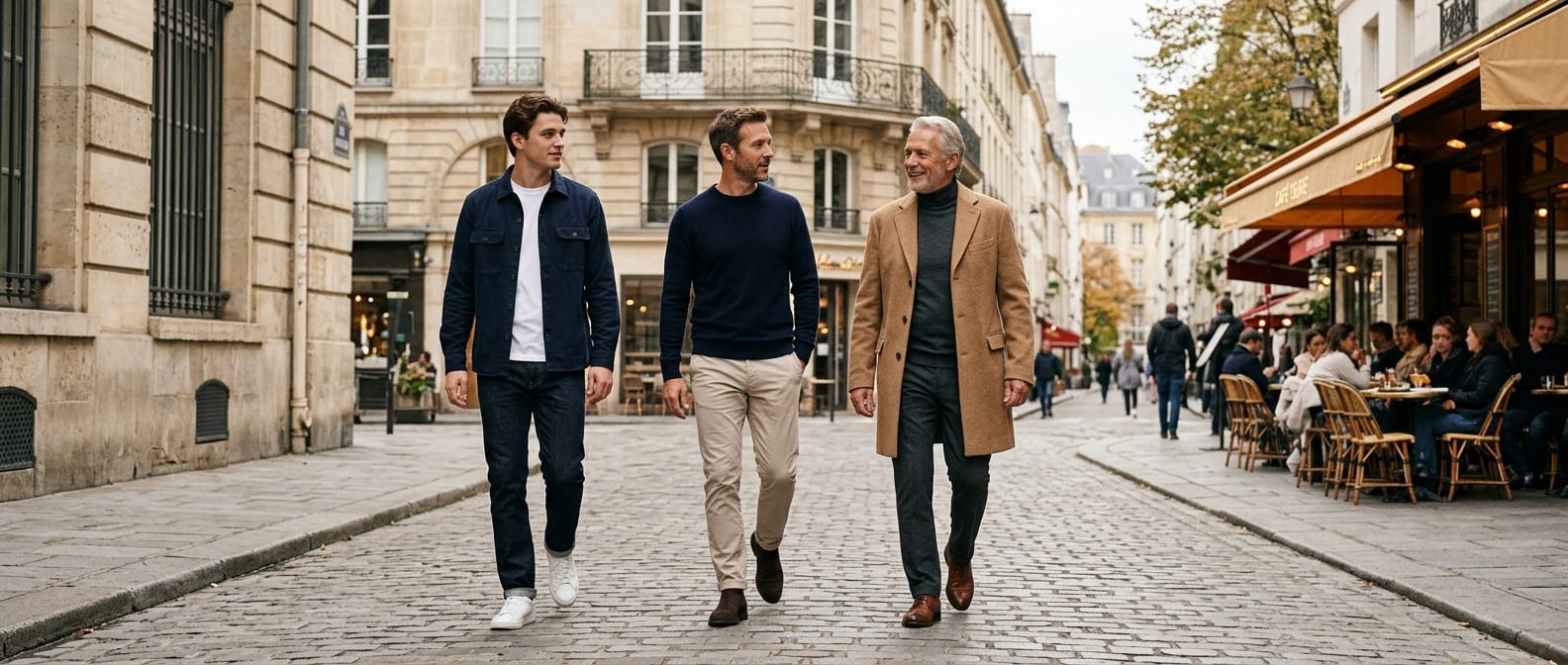
- Students and men in their twenties: straight jeans, plain T-shirts, hoodies under coats, chore jackets and clean trainers. Simple, a little worn-in and never flashy.
- Thirties and forties: the full classic look, with knitwear, blazers, good coats and leather shoes alongside trainers.
- Fifties and beyond: softer tailoring, cashmere and merino knits, well-cut coats, scarves and polished leather shoes. Many of the best-dressed men in France are in this group.
How French men shop
French men tend to shop slowly and selectively. They replace pieces when they wear out, favour the same shapes and colours year after year and often buy during the regulated winter and summer sales. The aim isn’t novelty; it’s a wardrobe that works without much thought each morning.
Grooming the French way
French grooming is natural rather than polished. Hair is neat but not stiff with product, stubble or a short beard is common and fragrance is used lightly. The overall effect is clean and relaxed.
Accessories in French style
Accessories are few, practical and well chosen.
- The scarf: the signature accessory, in wool for winter and light cotton or linen for spring. Wrap it once and let the ends hang, or knot it loosely.
- A simple watch: a slim case on a leather strap, never oversized.
- A leather belt: brown or black, matched to your shoes.
- Sunglasses: classic shapes in black or tortoiseshell.
- A bag: a leather or canvas satchel, tote or small cross-body bag rather than a sports backpack.
- A cap or beanie: a plain wool beanie in winter is far more common on French streets than a beret.
The rule is the same as for clothes: choose one accessory to notice and keep the rest quiet.
How to adopt French style for men
- Start with navy. A navy knit and a navy jacket are the two most useful pieces.
- Simplify your colours. Remove bright, clashing items and build around navy, grey, white and camel.
- Fix the fit. Have trousers hemmed and sleeves shortened where needed.
- Add a Breton top and a scarf. They bring a French note to plain outfits.
- Choose one good coat. A trench for spring and a wool overcoat for winter.
- Wear leather shoes or clean white trainers.
- Don’t overthink it. The look should feel easy.
French style for boys and teenagers
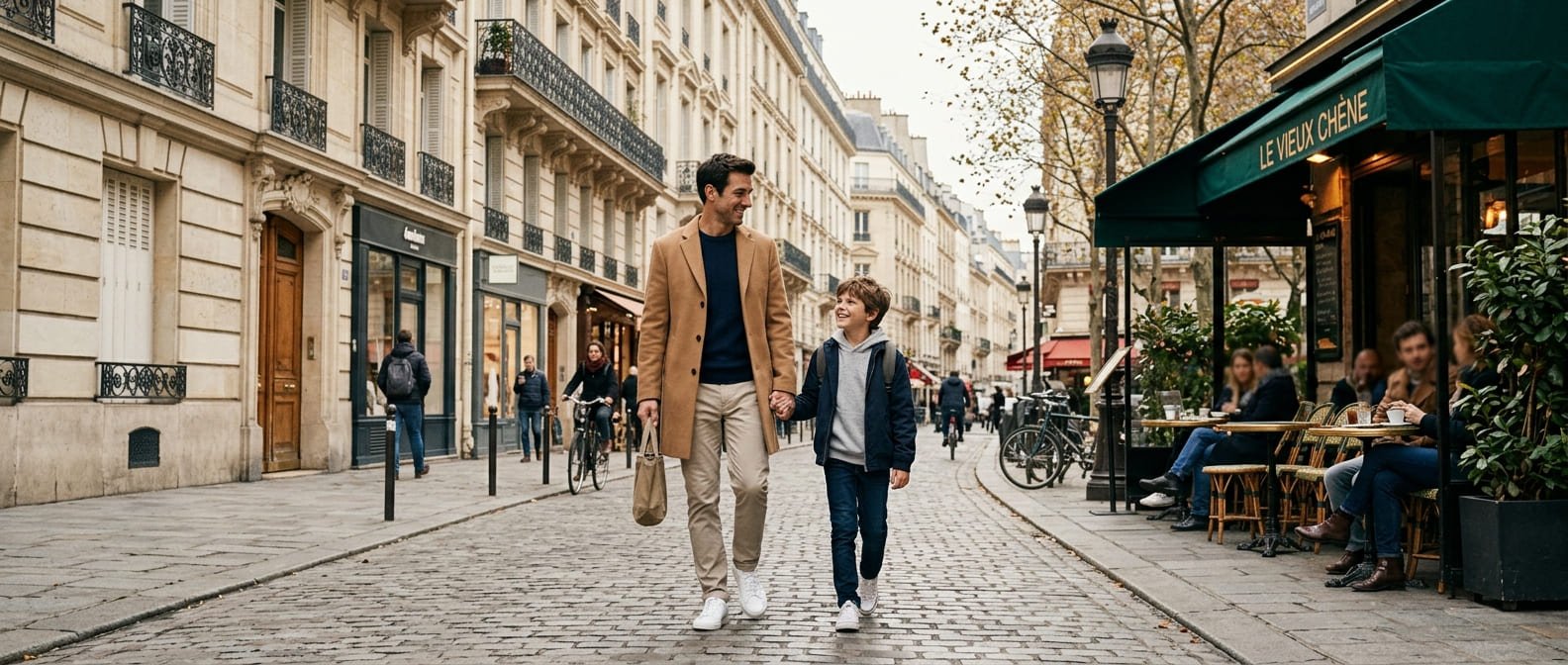
French children’s clothing is known for being classic and practical: navy, white, cream and stripes, with good knitwear and sturdy shoes. For boys and teenagers, the same ideas apply in a relaxed form: straight jeans, a striped or plain long-sleeved top, a navy jumper, a simple jacket and clean trainers. For occasions, add a collared shirt and leather shoes.
Mistakes to avoid
| Mistake | Why it misses the mark | Do this instead |
|---|---|---|
| Dressing in a costume (beret, stripes and neckerchief together) | Looks like a caricature | One French piece at a time |
| Loud colours and logos | The opposite of understated | Navy, grey and plain fabrics |
| Clothes that are too tight | Looks dated and uncomfortable | Neat, slightly relaxed fits |
| Shiny, pointed shoes | Too flashy | Matte leather or suede in classic shapes |
| Too many accessories | Cluttered | A scarf and a simple watch |
Learn more about style across the country in our France style guide, and check which colours work with navy in the Color Matcher.
Frequently asked questions
French style for men is an understated way of dressing built on neutral colours, good fit and simple, quality pieces such as a navy knit, straight jeans, a good coat, a scarf and leather shoes or clean trainers.
Usually dark jeans or chinos, a plain knit or shirt, a jacket or coat and leather shoes, boots or white trainers, in navy, grey, black and white.
Parisian chic for men means looking polished without visible effort: few colours, neat fits, classic pieces and a relaxed way of wearing them.
The striped Breton top is a real everyday classic. Berets are far less common in daily life, though still seen in some regions and among older men.
Navy first, then grey, black, white, cream and camel. Brighter colours appear only as small accents.
Leather derbies, loafers, desert boots, Chelsea boots and clean white leather trainers. Shoes are usually matte and classic in shape.
French style is more understated, with cooler colours and simpler tailoring. Italian style is warmer and more expressive, with soft jackets, earthy colours and suede loafers.
Yes. Dark, straight jeans are an everyday staple in France, usually worn with a knit, shirt or blazer and leather shoes or clean white trainers.
Focus on fit and a navy, grey and white palette. A navy knit, straight jeans, a striped top, a simple coat and clean shoes create the look without expensive pieces.