
Ask most people to describe traditional French clothing and they’ll picture a beret, a striped shirt and perhaps a string of onions. The real picture is far richer. France has no single national costume. Instead, traditional French clothing is a patchwork of regional dress: towering lace headdresses in Brittany, great black bows in Alsace, printed cottons in Provence, and white outfits with red sashes in the Basque Country. This guide explains the traditional clothes of France region by region, the famous pieces that became worldwide classics, what men, women and children wore, when these costumes are still worn today and how they shaped modern French style.
Traditional French clothing at a glance
- No single national costume. Each region developed its own dress, shaped by climate, work, religion and local pride.
- Regional costumes are the heart of the tradition: Breton, Alsatian, Provençal, Basque, Norman, Auvergnat and more.
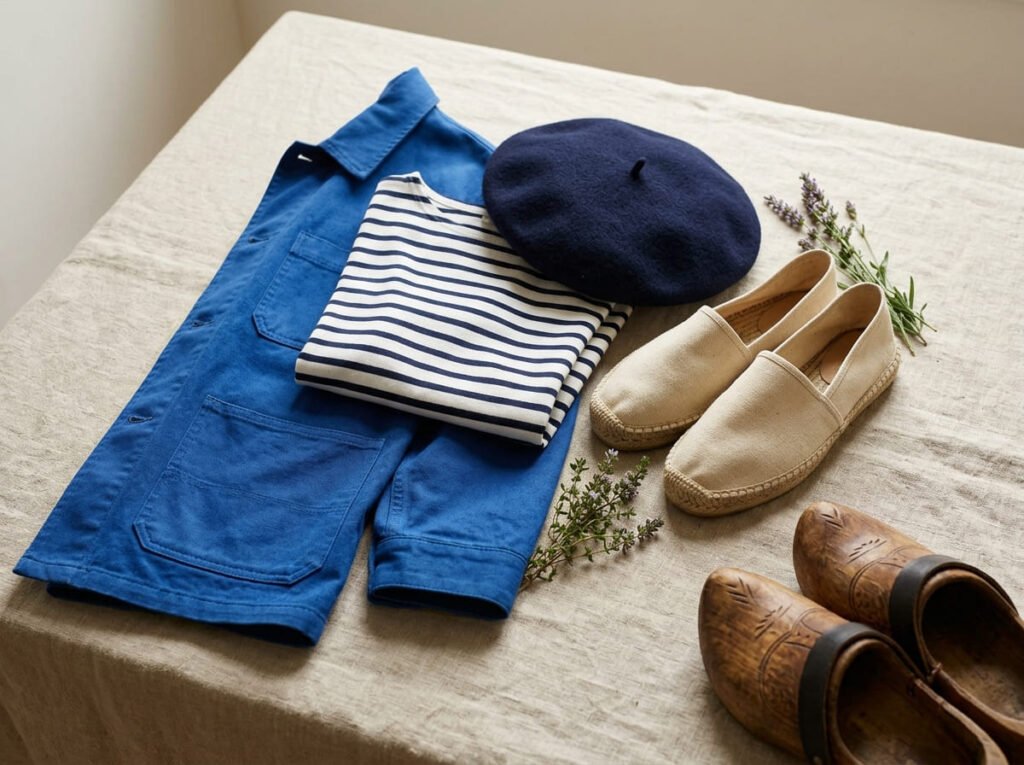
- A few pieces became national symbols: the beret, the striped Breton top, wooden clogs, espadrilles and the blue work jacket.
- Mostly worn at festivals today. Folk dance groups, religious processions and local celebrations keep the costumes alive.
- Still visible in modern fashion. Stripes, berets, espadrilles and workwear jackets are everyday clothes around the world.
Is there a national costume of France?
No. Unlike some countries, France never adopted one official national dress. Until the late nineteenth century, most people lived in the countryside and identified strongly with their region. Clothes were made locally, from local cloth, and details such as the shape of a headdress or the colour of a ribbon could show which village someone came from, whether they were married and how wealthy the family was.
When people today talk about the typical clothes of France, they usually mean one of two things: the regional folk costumes worn mainly in the eighteenth and nineteenth centuries, or the handful of everyday items, such as the beret and the striped top, that the world now treats as French symbols.
Iconic pieces of traditional French clothing
The beret
The soft, round, flat wool cap is the best-known symbol of France. It’s closely linked to the shepherds of the Pyrenees, in Béarn and the Basque Country, who wore it for warmth and protection from rain. From there, it spread across the country among farmers and workers, and later among soldiers, artists and students. Today, it’s worn far less in daily life than outsiders imagine, but it remains a strong regional and cultural symbol.
The Breton striped top
The navy and white striped top, called the marinière, began as part of the French navy’s uniform in the mid-nineteenth century. Sailors from Brittany wore it at sea, and the stripes are often said to have made a man easier to spot if he fell overboard. In the twentieth century, it moved from the docks into fashion and became one of the most recognisable garments in the world.
Wooden clogs
Carved wooden clogs, known as sabots, were the everyday footwear of rural France for centuries. They were cheap, hard-wearing and kept feet dry in muddy fields. They were often worn with thick socks or stuffed with straw for warmth.
Espadrilles
These light canvas shoes with rope soles come from the Pyrenees, on both the French and Spanish sides. Farm workers and fishermen wore them, and they’re still made in the French Basque Country. Today, they’re a summer staple across Europe.
The blue work jacket
The simple cotton jacket in a bright, deep blue, known as the bleu de travail, was the uniform of French labourers, railway workers and craftsmen from the late nineteenth century. It’s now worn as a casual jacket well beyond France.
The smock
Farmers and market traders in many regions wore a loose, blue linen or cotton smock over their clothes to protect them. It was practical and easy to wash, and appears in countless paintings of rural France.
- Navy wool beret Headwear
- Navy and white striped Breton top Top
- Blue cotton work jacket Jacket
- Canvas espadrilles Shoes
Traditional clothes of France by region
Brittany
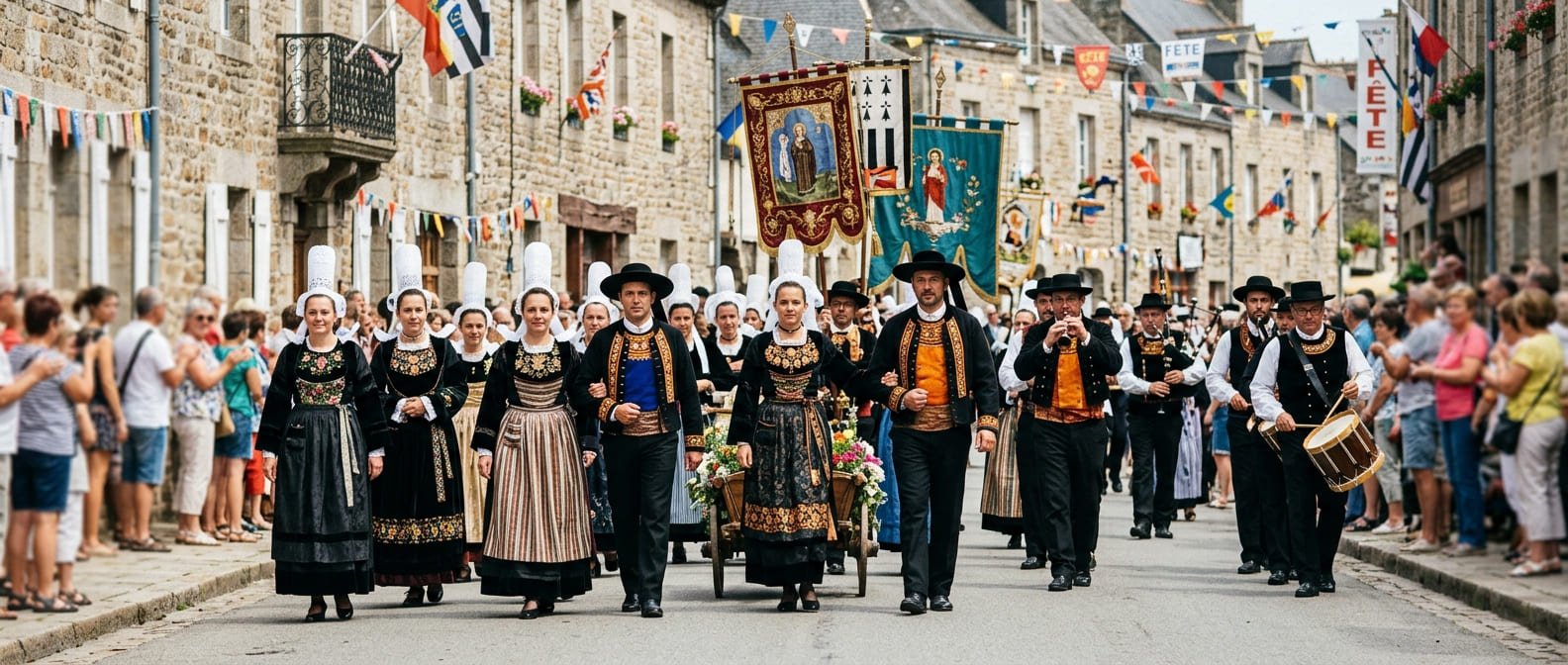
Breton costume is the most famous in France. Women wore dark dresses with embroidered bodices, aprons and, above all, white lace headdresses called coiffes. Each district had its own shape. The best known is the tall, cylindrical lace coiffe of the Bigouden area, which grew higher over time until it stood well above the head.
Men’s Breton dress included a short, embroidered jacket, a waistcoat, a wide-brimmed felt hat with long velvet ribbons and, in older styles, wide pleated breeches worn with gaiters. Embroidery in gold, orange and yellow thread was a mark of pride and skill.
Alsace
In Alsace, on the border with Germany, women’s costume is known for its large bow headdress, usually black, tied over the hair so that it spreads like wings. It’s worn with a full skirt, often red, an embroidered apron and a shawl. Men wore a black felt hat, a white shirt, a red waistcoat with rows of buttons, a black jacket and dark trousers.
Provence
Provençal dress reflects the sun and the south. Women wore skirts and jackets in brightly printed cottons, lace shawls crossed over the chest and small ribbon or lace headdresses pinned over the hair. The costume of Arles is especially elegant and still worn with pride at local festivals.
Men wore white shirts, dark velvet jackets, a wide fabric sash at the waist and felt hats. The horsemen of the nearby Camargue, who herd cattle and white horses, are known for their patterned shirts, moleskin trousers and wide-brimmed hats.
The Basque Country
In the French Basque Country, festival dress is simple and striking: white shirt and white trousers, a red sash at the waist, a red neckerchief and a beret. It’s worn by men, women and children alike at summer festivals, when whole towns dress in white and red. Rope-soled espadrilles complete the outfit.
Normandy
Norman women were known for their tall, elaborate lace headdresses and bonnets, worn with shawls, aprons and striped or printed skirts. Men wore blue smocks, caps and clogs for everyday work, with a dark jacket for Sundays.
Auvergne and the Massif Central
In the mountains of central France, men wore wide-brimmed black hats, blue smocks, dark trousers and clogs. Women wore long skirts, aprons, shawls and straw or lace bonnets. These costumes are still worn for the bourrée, the region’s traditional dance.
Savoy and the Alps
In the Alps, warm woollen skirts, embroidered shawls, velvet bodices and decorative headdresses were typical for women, often with a gold cross worn at the neck. Men wore wool jackets, waistcoats, breeches or trousers and felt hats suited to the cold.
| Region | Women’s dress | Men’s dress | Signature detail |
|---|---|---|---|
| Brittany | Dark dress, embroidered bodice, apron | Short embroidered jacket, waistcoat, ribboned hat | Tall lace coiffe |
| Alsace | Red skirt, apron, shawl | Red waistcoat, black jacket, felt hat | Large black bow headdress |
| Provence | Printed cotton skirt, lace shawl | Velvet jacket, sash, felt hat | Bright printed cottons |
| Basque Country | White outfit, red sash | White outfit, red sash, beret | Red and white, espadrilles |
| Normandy | Shawl, apron, striped skirt | Blue smock, cap, clogs | Tall lace bonnets |
| Auvergne | Long skirt, shawl, bonnet | Black hat, blue smock, clogs | Bourrée dance dress |
| Savoy | Wool skirt, embroidered shawl | Wool jacket, waistcoat, felt hat | Gold cross and headdress |
What men wore in traditional France
Men’s traditional French clothing was practical and built around work.
- A linen or cotton shirt, usually white or undyed.
- A waistcoat, often the most decorated piece, in red, blue or black.
- A short jacket in wool or velvet for Sundays and feast days.
- Breeches or trousers, with gaiters in some regions.
- A smock for work in the fields or at market.
- A hat or cap: a beret in the south-west, a ribboned felt hat in Brittany, a wide black hat in Auvergne.
- Clogs for work and leather shoes for church.
- A sash or neckerchief, which added colour and showed regional identity.
A lasting change came with the French Revolution. Working men wore long trousers rather than the knee breeches of the aristocracy, and trousers soon became the standard for all men.
What children wore
For most of history, French children were dressed as small versions of their parents. Boys wore smocks, short trousers, caps and clogs; girls wore dresses, aprons and bonnets. From the late nineteenth century, the dark school smock became a familiar sight in French classrooms and remained common for much of the twentieth century. Sailor suits with striped collars were also popular for boys.
Fabrics and craftsmanship
Traditional French clothing was made from what each region produced.
- Linen and hemp for shirts, smocks and underclothes.
- Wool for jackets, skirts, capes and berets.
- Printed cotton in Provence, with small floral and geometric patterns in warm colours.
- Lace for headdresses, especially in Brittany and Normandy.
- Embroidery in silk and metal thread on waistcoats, bodices and aprons.
- Velvet and ribbons for trim.
Costumes for Sundays and weddings could take months to make and were handed down through families.
A short history of traditional French clothing
Before the Revolution. For centuries, what people wore depended on their rank. Aristocrats dressed in silk, lace and knee breeches, while peasants wore homespun linen, wool and wooden clogs.
The Revolution. After 1789, dress became a political statement. Working men’s long trousers replaced aristocratic knee breeches, and simpler clothes became a sign of the new era.
The nineteenth century. This was the golden age of regional costume. As rural families became more prosperous and fabrics more affordable, Sunday and festival clothes grew richer, with more lace, embroidery and ribbon. Headdresses in Brittany, Normandy and Alsace reached their most elaborate forms.
The early twentieth century. Railways, factory-made clothing, military service and the move to cities brought national fashions to every region. By the middle of the century, most regional costumes had vanished from daily life.
The revival. From the mid-twentieth century, folk dance and music groups began preserving and recreating costumes. Today, they’re worn with pride at festivals and are recognised as an important part of regional heritage.
Common myths about traditional French clothing
- “Every French person wears a beret.” Berets are rare in everyday city life today, though still worn in the south-west and by some older men.
- “The striped top is a costume.” It’s a genuine everyday garment, worn by people of all ages.
- “There’s one French national dress.” There isn’t. Regional variety is the whole point.
- “Traditional dress has disappeared.” It’s no longer daily wear, but thousands of people still wear it at festivals each year.
When is traditional French clothing worn today?
Regional costumes largely disappeared from daily life in the early twentieth century, as people moved to cities and factory-made clothes became cheap. They live on at festivals, in folk dance groups and at family celebrations.
| Event | Where | What you’ll see |
|---|---|---|
| Celtic and Breton festivals | Brittany, in summer | Lace coiffes, embroidered jackets, pipe bands |
| Religious processions (pardons) | Brittany | Costumes worn in procession with banners |
| Costume festival and bull games | Arles, Provence | Arles dress, Camargue horsemen |
| Summer town festivals | Bayonne and the Basque Country | Whole towns in white and red |
| Wine and harvest festivals | Alsace | Bow headdresses, red waistcoats |
| Folk dance gatherings | Auvergne and across France | Regional dance costumes |
How traditional French clothing shaped modern style
Many of today’s wardrobe classics started as French working clothes.
- The striped top went from the navy to a global fashion staple.
- The beret became a symbol of artists, students and French style itself.
- The work jacket is now a casual jacket worn across Europe.
- Espadrilles are a summer shoe for men, women and children.
- Simple, practical clothes in navy, white and blue remain the foundation of French style.
See how these pieces are worn now in our guide to French style for men.
What do people in France wear today?
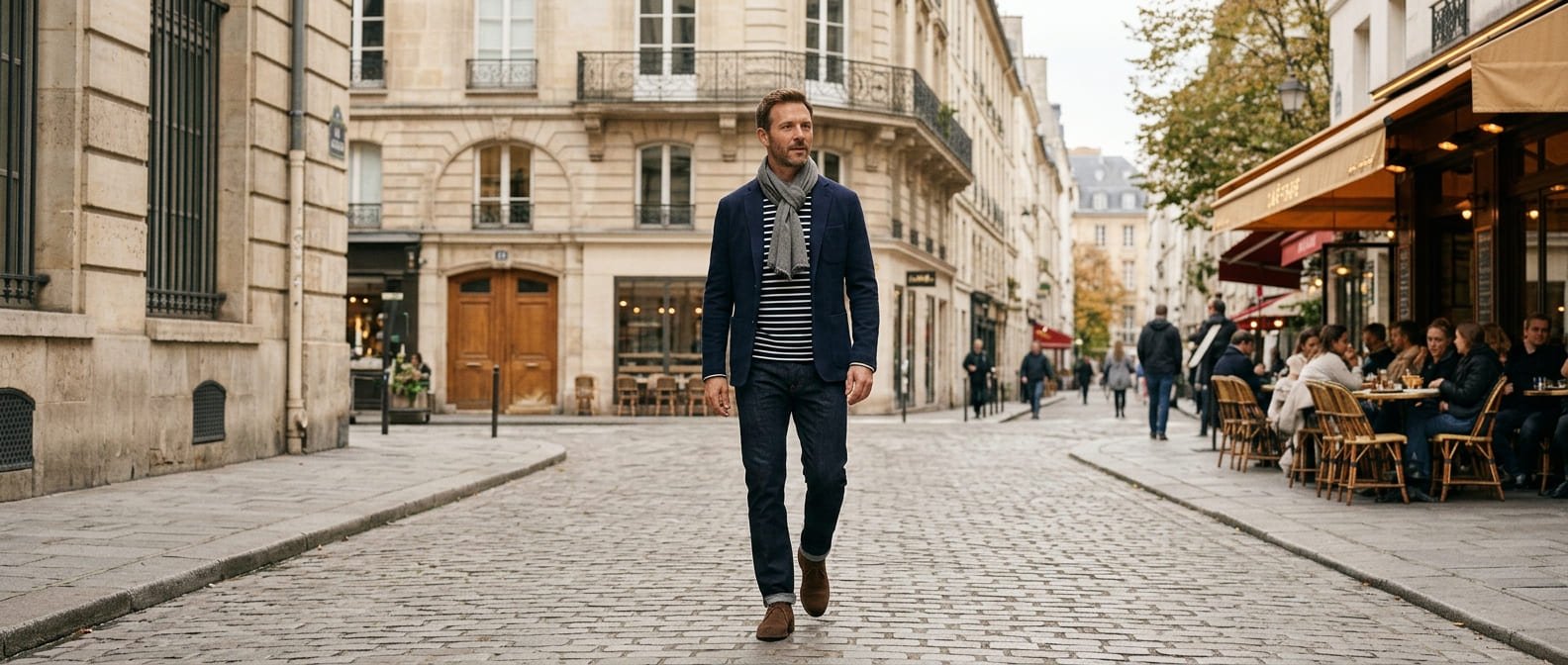
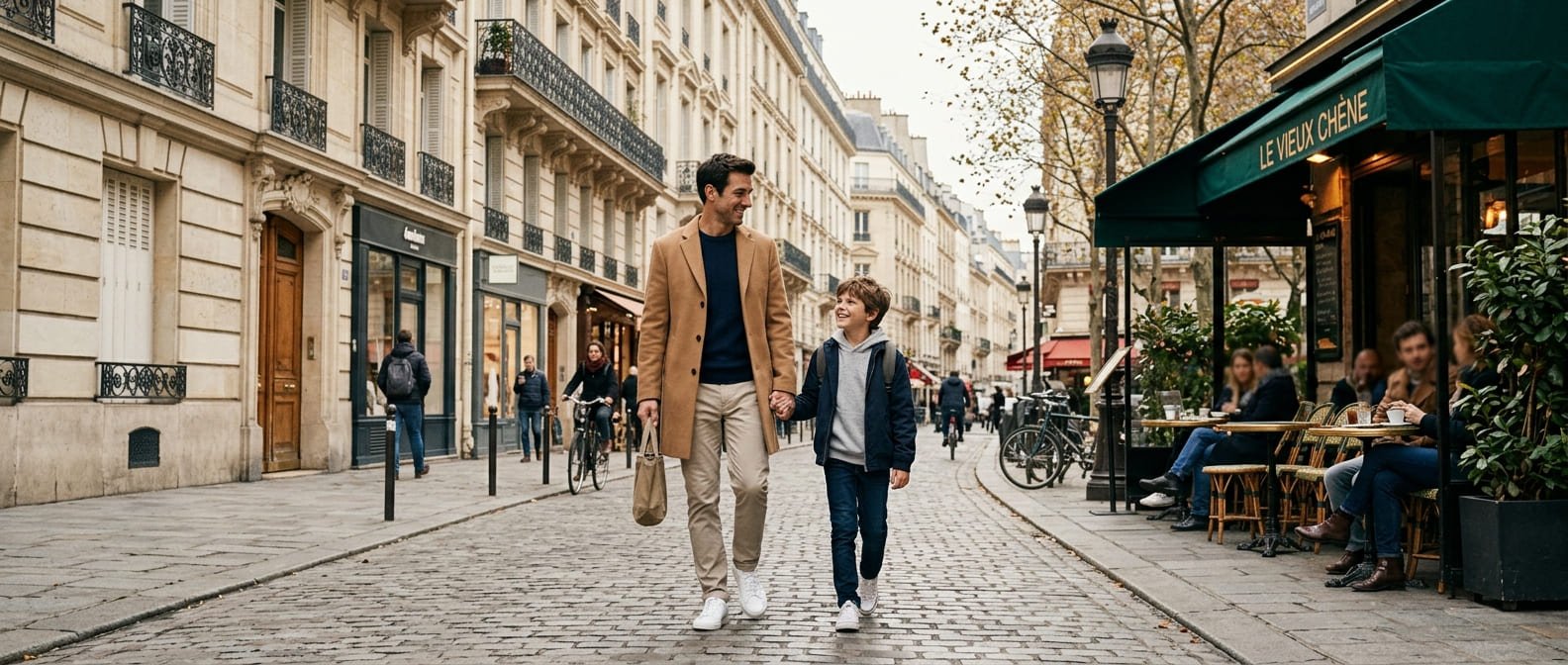
Everyday clothing in France is modern and understated. Most people wear jeans or chinos, knitwear, shirts, coats and leather shoes or trainers, in neutral colours such as navy, grey, black and white. Traditional costume is for festivals, not daily life. For a full picture, read our France style guide and our Paris outfit ideas.
A French costume for school or a themed day
Children are often asked to dress up for a culture day, a language class or a themed party. A simple, respectful French outfit is easy to put together at home.
- A navy and white striped long-sleeved top.
- Dark trousers or a skirt.
- A beret in navy, black or red.
- A red neckerchief.
- Plain shoes or espadrilles.
For a regional touch, choose white clothes with a red sash and neckerchief for the Basque Country. Avoid fake moustaches and stereotypes; the clothes alone make the theme clear.
- Navy and white striped top Top
- Red neckerchief Accessory
- Navy beret Headwear
- Dark trousers Trousers
Colours of French tradition
Discover more national styles in our European fashion guides.
Frequently asked questions
Traditional French clothing is a collection of regional costumes rather than one national dress. It includes Breton lace headdresses, Alsatian bow headdresses, Provençal printed cottons and Basque white and red outfits, along with icons such as the beret and striped top.
No. France has no single national costume. Each region developed its own traditional dress, and a few everyday pieces, such as the beret and the Breton striped top, became national symbols.
Historically, regional folk costumes. Today, people in France wear modern, understated clothes: jeans or chinos, knitwear, shirts, coats and leather shoes or trainers in neutral colours.
A linen shirt, a waistcoat, a short jacket, breeches or trousers, a work smock, clogs and a regional hat, such as a beret in the south-west or a ribboned felt hat in Brittany.
The navy and white striped top was introduced as part of the French navy's uniform in the nineteenth century and was worn by Breton sailors. It later became a fashion classic.
The beret is closely associated with shepherds in the Pyrenees, in Béarn and the Basque Country, and spread across France among farmers, workers, soldiers and artists.
Mainly at regional festivals, religious processions, folk dance events and weddings, especially in Brittany, Alsace, Provence and the Basque Country.
A coiffe is a traditional lace or linen headdress worn by women in regions such as Brittany and Normandy. Its shape and height varied by district, and it was often a mark of local identity.