




Men’s jewellery has moved from the edges of menswear to the middle. A signet ring, a thin silver chain or a small pair of studs now looks as normal with jeans and a T-shirt as cufflinks do with a suit. Worn well, a few small pieces make a plain outfit look finished and personal. Worn badly, they look like a costume. The difference comes down to a handful of simple rules: start small, keep metals consistent, match the size of each piece to your build and dress for the occasion. This guide explains the main types of men’s jewellery, how to choose and wear rings, chains and necklaces, bracelets and earrings, which metals to buy, how much to wear for work, weddings and evenings, how to care for it, and what to look for when buying jewellery as a gift.
The basic rules of men’s jewellery
- Start with one piece. A ring, a chain or a bracelet. Add a second only when the first feels natural.
- Keep metals consistent. Silver with silver, gold with gold, including your watch, belt buckle and glasses frames. Mixing can work, but it takes practice.
- Match the size to your build. Slim chains and thin bands suit smaller frames and hands. Broader men and larger hands can carry heavier pieces.
- Think about the occasion. Fewer, smaller pieces for work and formal events, more freedom in the evening and at the weekend.
- Choose quality over quantity. One solid silver ring beats five cheap plated ones that tarnish within weeks.
- Comfort matters. If you keep fiddling with it, it isn’t right.
Metals: what to buy
| Metal | Look | Pros | Things to know |
|---|---|---|---|
| Sterling silver | Bright, cool white | Affordable, classic, easy to match | Tarnishes, needs cleaning |
| Yellow gold | Warm, rich | Timeless, holds value | Expensive in solid form |
| White gold | Bright like silver | Elegant, durable | Plating wears and needs renewing |
| Rose gold | Pinkish, soft | Warm and different | Less common in menswear |
| Stainless steel | Grey-white | Cheap, tough, doesn’t tarnish | Less refined finish |
| Titanium | Dark grey, light | Very light and strong | Hard to resize |
| Tungsten | Dark, heavy, polished | Scratch-resistant | Cannot be resized |
| Platinum | Heavy white | The most durable, hypoallergenic | The most expensive |
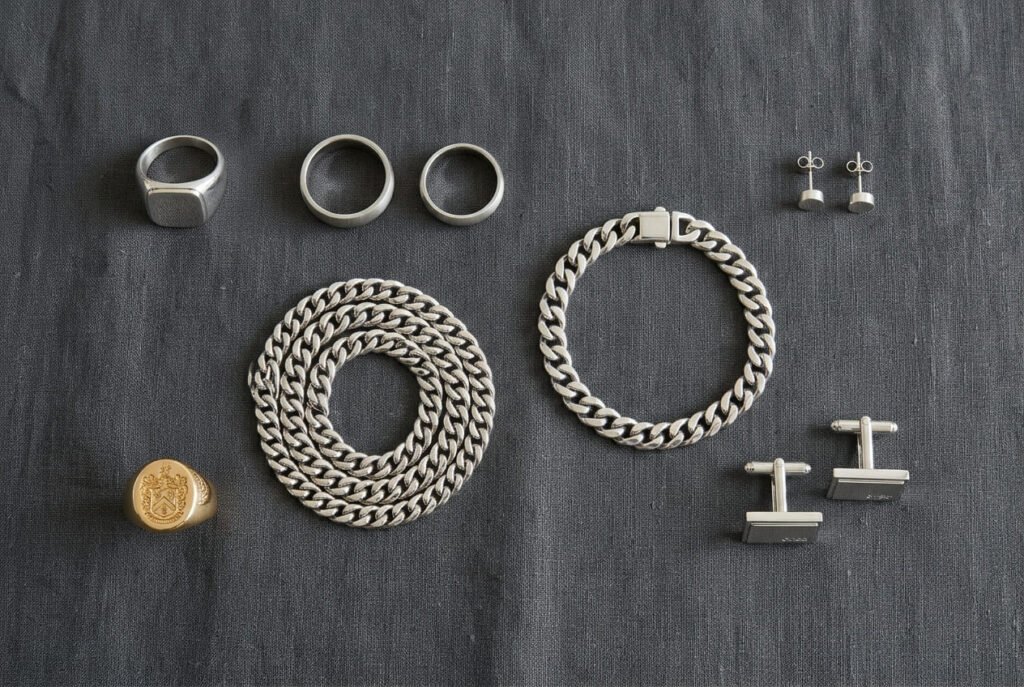
For most men, sterling silver is the best first metal: it suits most skin tones and outfits, and it costs far less than gold. Look for the 925 stamp, which means 92.5% pure silver.
Rings
Types of rings
- The plain band: the simplest ring, in silver, gold or steel.
- The signet ring: a flat-topped ring, plain, engraved with initials or a family crest. Traditionally worn on the little finger.
- The statement ring: larger, with a stone, carving or texture. One is enough.
- Stacking rings: two or three thin rings worn together on one finger or across neighbouring fingers.
- Wedding and engagement rings: usually a plain band in gold, white gold, platinum or titanium.
Which finger?
There are no strict rules for fashion rings, but each finger carries a slightly different message.
| Finger | Typical meaning |
|---|---|
| Little finger | Signet rings, a classic and confident choice |
| Ring finger | Wedding and engagement rings |
| Middle finger | Bold statement rings, balanced and central |
| Index finger | Strong, noticeable, often class or family rings |
| Thumb | Unconventional, relaxed, creative |
In the United Kingdom, France and Italy, wedding rings are usually worn on the left hand. In Germany, Russia, Poland, Norway and much of Spain, they’re usually worn on the right. If you wear a fashion ring on your ring finger, people may assume it’s a wedding ring.
How many rings?
Two or three rings in total is the most that most men can wear without it looking crowded. Spread them across both hands, and keep the biggest ring on its own finger.
Chains and necklaces
Types of chain
- Curb chain: flat, interlocking links, the classic men’s chain.
- Cable chain: simple round or oval links, light and discreet.
- Rope chain: twisted strands, catches the light.
- Box chain: small square links, clean and modern.
- Figaro chain: a pattern of short and long links.
- Snake chain: smooth and flexible, close to a solid line.
- Beaded and cord necklaces: casual, often for summer.
Chain length
| Length | Where it sits | Best for |
|---|---|---|
| 45 cm | Around the base of the neck | Slim chains, worn under a collar |
| 50 to 55 cm | On the collarbone | The most versatile length, visible with a T-shirt |
| 60 cm | Mid-chest | Pendants and layering |
| 70 cm and longer | Lower chest | Statement and layered looks |
A chain about 3 to 5 mm wide suits most men. Thinner chains are discreet and smart. Thicker chains are a bold casual look. To layer, wear two chains of clearly different lengths, about 5 to 10 cm apart, in the same metal.
Pendants
Small pendants such as a cross, a medallion, a tag, a coin or a stone add a personal touch. Keep them small for everyday wear, and remember that some symbols carry religious or cultural meaning.
Bracelets
- Chain bracelets: silver or gold links, the easiest to wear.
- Cuffs: open, rigid bands in metal or leather.
- Beaded bracelets: wood, stone or glass beads, relaxed and casual.
- Leather bracelets: braided or wrapped, good with denim.
- ID bracelets: a chain with a small engraved plate.
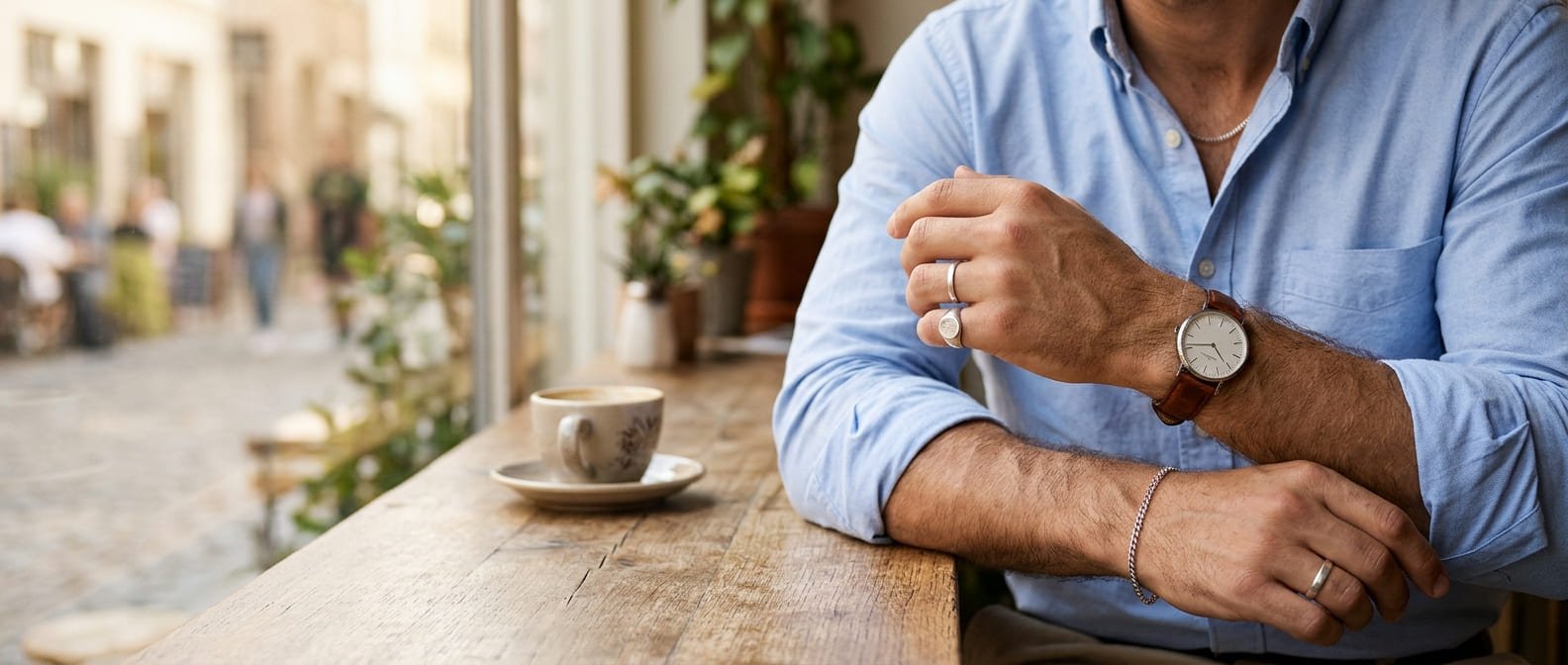
Wear one or two at most. If you wear a watch, either put the bracelet on the other wrist or wear a slim bracelet next to the watch in a matching metal. A bracelet should move freely but not slide over your hand.
Earrings
Earrings for men are now common across Europe, especially for younger men.
- Studs: small silver, gold or black studs are the easiest start. Silver earrings are the most popular choice for men.
- Small hoops and huggies: a slim hoop that hugs the earlobe.
- One or both ears: both are fine today. One small earring is the more understated option.
- Avoid large, dangling earrings unless they suit your personal style.
Cufflinks, tie bars and watches
The most traditional men’s jewellery is worn with tailoring.
- Cufflinks fasten double-cuff shirts. Simple silver or gold ovals or bars suit any occasion.
- Tie bars hold the tie in place and should be shorter than the tie is wide.
- Lapel pins add a small detail to a jacket.
- Watches are often a man’s most important accessory. Match the watch metal to your other jewellery when you can.
For dress codes where these matter, see our guides to wedding guest outfits for men and the two-piece suit.
Men’s jewellery for every occasion
| Occasion | How much | Good choices |
|---|---|---|
| Office | Very little | Wedding band or one signet ring, a watch, discreet cufflinks |
| Smart casual | A little | Ring, thin chain under the shirt, one bracelet |
| Weekend | More freedom | Rings, a visible chain, bracelets, studs |
| Wedding or formal event | Classic and minimal | Wedding band, cufflinks, dress watch |
| Night out | Bolder | Statement ring, layered chains, small hoops |
| Sport and gym | None | Take it off to avoid damage and injury |
Jewellery is also a big part of some styles: classic gold signet rings and watches suit old money style, while heavy silver rings and chains are part of goth fashion for men.
How to look after jewellery
- Take it off before swimming, showering, the gym and sleeping.
- Clean silver with a soft polishing cloth. Store it in a closed bag to slow tarnishing.
- Wash gold and steel in warm water with a little mild soap, then dry them well.
- Store pieces separately so chains don’t tangle and stones don’t scratch.
- Avoid perfume and aftershave on jewellery. Put them on first and the jewellery after.
- Check clasps on chains and bracelets from time to time.
Buying men’s jewellery
- Check the stamp: 925 for sterling silver, 375, 585 or 750 for 9, 14 and 18 carat gold.
- Solid or plated: plated pieces are cheaper but wear through over time.
- Allergies: if your skin reacts to cheap metal, choose sterling silver, titanium, platinum or nickel-free steel.
- Measure your ring size at a jeweller, and remember that fingers are slightly bigger in warm weather.
- Second-hand and vintage jewellery is often better made and good value.
Jewellery as a gift for men
Jewellery is a popular Christmas and birthday present. Safe choices are a silver chain about 50 to 55 cm long, a simple signet ring that can be engraved, a slim silver bracelet, a pair of cufflinks or a small pair of studs if he already wears earrings. Keep the receipt, because ring and bracelet sizes are hard to guess. For more seasonal ideas, see Christmas outfits for men and winter accessories for men.
Common mistakes
| Mistake | Why it doesn’t work | Better choice |
|---|---|---|
| Too many pieces at once | Looks crowded | Two or three pieces in total |
| Clashing metals | Looks unplanned | One metal, matched to the watch |
| Chains too thick for your build | Overwhelms a slim frame | 3 to 5 mm for most men |
| Cheap plating that turns green | Looks worn out quickly | Sterling silver or steel |
| Bracelet that hides the watch | Looks cluttered | Other wrist, or a slim bracelet beside it |
| Jewellery at the gym | Risk of damage and injury | Take it off |
Frequently asked questions
A simple silver ring, a thin silver chain about 50 cm long or a slim bracelet. Start with one piece and add more slowly.
Signet rings traditionally go on the little finger, statement rings on the middle or index finger, and wedding rings on the ring finger. Any finger is acceptable for fashion rings.
Yes. Small silver or gold studs and slim hoops are common for men across Europe today.
Around 50 to 55 cm, which sits on the collarbone and works with T-shirts and open shirts.
It's possible, but it's easier to stick to one metal and match it to your watch. If you mix, keep the shapes simple.
Ideally yes. Match the metal of rings, bracelets and cufflinks to the watch case.
Sterling silver is the best first choice: affordable, classic and easy to wear. Titanium and steel are tough and cheap, and gold is a long-term investment.
Two or three in total is a good maximum, spread across both hands.
Store it in a closed bag, keep it away from water, perfume and the gym, and polish it with a silver cloth.